An Analysis of Natural Law Jurisprudence in the Thought of Saint Thomas Aquinas
Article Sidebar
Main Article Content
Abstract
This study aimed to: (1) examine the development of natural law jurisprudence; (2) investigate the structure of natural law in the thought of Saint Thomas Aquinas; and (3) analyze the criteria for the legitimacy of human law within the framework of the relationship among reason, morality, and the common good. This study employed documentary research, drawing on Aquinas’s primary works as well as relevant books, scholarly articles, and research studies. The data were analyzed through thematic classification, interpretation, and synthesis in accordance with the research objectives.
The findings revealed that:
1. Natural law jurisprudence developed from the search in Greek philosophy for principles of justice that transcend the commands of rulers to a theological account of law in the Middle Ages. A fundamental principle of the natural law tradition is that law does not acquire legitimacy merely because it is enacted by the state; rather, it must be grounded in reason, justice, and morality.
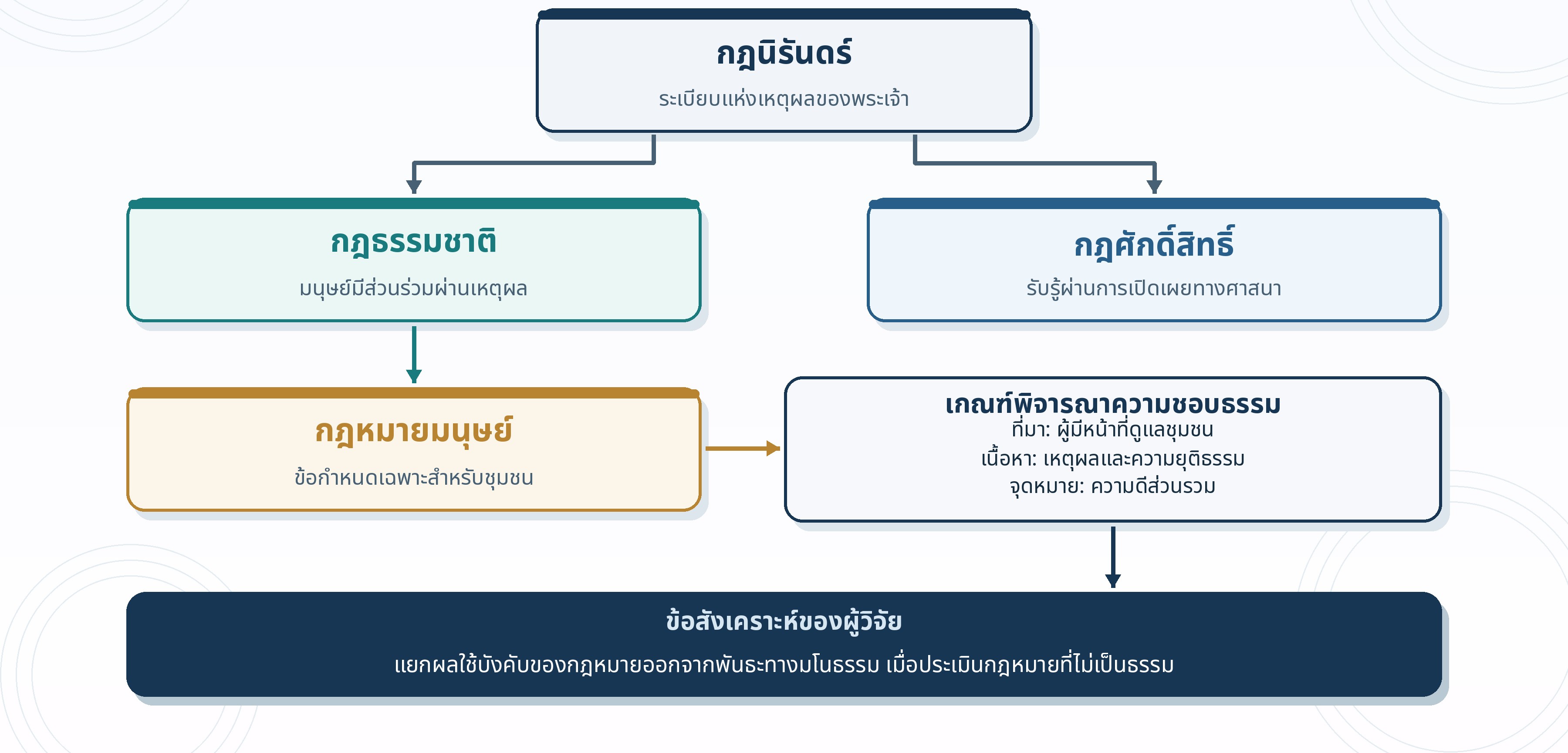
2. Aquinas conceptualized law as comprising four interrelated types: eternal law, natural law, human law, and divine law. Human beings apprehend the fundamental principles of natural law through reason, while human law specifies these principles in ways appropriate to particular social circumstances and must be directed toward the common good.
3. The legitimacy of human law is determined by its source, content, and purpose. Law must be enacted by an authority responsible for the community, be consistent with reason and justice, and be directed toward the common good. A defective or unjust law may lack binding force in conscience; however, noncompliance must also be considered in light of social order and the potential harm that may result to the common good.
Article Details

This work is licensed under a Creative Commons Attribution-NonCommercial-NoDerivatives 4.0 International License.
เพื่อให้เป็นไปตามกฎหมายลิขสิทธิ์ ผู้นิพนธ์ทุกท่านต้องลงลายมือชื่อในแบบฟอร์มใบมอบลิขสิทธิ์บทความ ให้แก่วารสารฯ พร้อมกับบทความต้นฉบับที่ได้แก้ไขครั้งสุดท้าย นอกจากนี้ ผู้นิพนธ์ทุกท่านต้องยืนยันว่าบทความ ต้นฉบับที่ส่งมาตีพิมพ์นั้น ได้ส่งมาตีพิมพ์เฉพาะในวารสาร วิชาการธรรม ทรรศน์ เพียงแห่งเดียวเท่านั้น หากมีการใช้ ภาพหรือตารางของผู้นิพนธ์อื่นที่ปรากฏในสิ่งตีพิมพ์อื่นมาแล้ว ผู้นิพนธ์ต้องขออนุญาตเจ้าของลิขสิทธิ์ก่อน พร้อมทั้ง แสดงหนังสือที่ได้รับการยินยอมต่อบรรณาธิการ ก่อนที่บทความจะได้รับการตีพิมพ์References
กีรติ บุญเจือ. (2522). ปรัชญายุคกลาง. กรุงเทพฯ: ไทยวัฒนาพานิช.
โกวิท วงศ์สุรวัฒน์. (2548). การเมืองการปกครองไทย: หลายมิติ. (พิมพ์ครั้งที่ 2). กรุงเทพฯ: มหาวิทยาลัยเกษตรศาสตร์.
โกวิท วงศ์สุรวัฒน์. (2564). แนวความคิดกฎหมายธรรมชาติและกฎหมายบ้านเมืองที่มีอิทธิพลต่อพัฒนาการของกฎหมายมหาชน. วารสารนิติศาสตร์ มหาวิทยาลัยอัสสัมชัญ, 12(2), 57-72.
จรัญ โฆษณานันท์. (2563). นิติปรัชญา. (พิมพ์ครั้งที่ 21). กรุงเทพฯ: มหาวิทยาลัยรามคำแหง.
ศิริพงษ์ ลดาวัลย์ ณ อยุธยา. (2559). ความคิดทางการเมืองสมัยโบราณและสมัยกลาง. เชียงใหม่: คณะรัฐศาสตร์และรัฐประศาสนศาสตร์ มหาวิทยาลัยเชียงใหม่.
สุขสมัย น่าบัณฑิตย์, จักรพรรณ วงศ์พรพวัณ, สุวิน ทองปั้น และจรัส ลีกา. (2564). ปรัชญากฎหมายธรรมชาติที่มีอิทธิพลต่อรัฐธรรมนูญแห่งราชอาณาจักรไทย พุทธศักราช 2560. วารสารบัณฑิตศึกษามหาจุฬาขอนแก่น, 8(4), 160-173.
สมบัติ จันทรวงศ์. (2562). ประวัติปรัชญาการเมือง เล่ม 1: อริสโตเติลถึงอไควนัส. กรุงเทพฯ: มูลนิธิโครงการตำราสังคมศาสตร์และมนุษยศาสตร์.
วรพจน์ สืบประเสริฐกุล. (2567). ปัญหาที่ไม่ใช่ปัญหาในนิติปรัชญาว่าด้วยกฎหมายธรรมชาติของนักบุญโทมัส อไควนัส: การตีความใหม่ซึ่งนิติปรัชญาของนักบุญโทมัส อไควนัส. วารสารรามคำแหง ฉบับนิติศาสตร์, 13(2), 91-118.
Aquinas, T. (2000). Treatise on law. (R. J. Regan, Trans.). Indianapolis, IN: Hackett Publishing Company.
Ebeh, J. I. (2016). The concept of natural law in Thomas Aquinas: A reconsideration of traditional issues. Quaestio Iuris, 9(4), 2041-2054.
Rahmatina, R., Mahendra, A., Savitri, D. A., Nasrichofifah, F., Nabilah, F., & Herlina, R. (2025). The evolution of natural law from Thomas Aquinas to modern rationalist thought. Devotion: Journal of Research and Community Service, 6(12), 1536-1548. https://doi.org/10.59188/devotion.v6i12.25603
