Development of Community Capital Potential for Creative Tourism in Mae La Noi District, Mae Hong Son Province
Article Sidebar
Main Article Content
Abstract
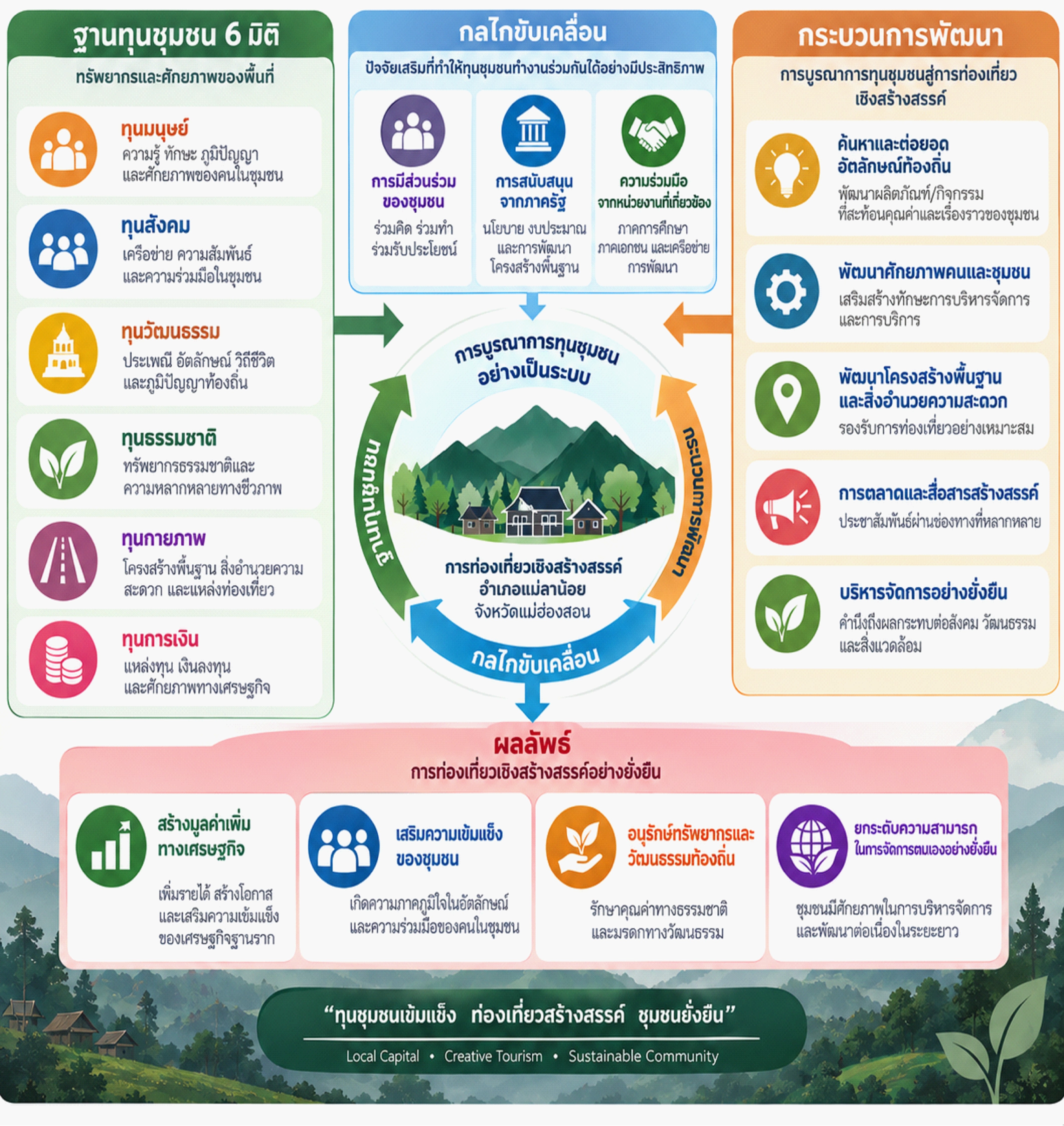
This study aims to (1) assess the level of community capital potential for the development of creative tourism and (2) analyze the factors influencing the enhancement of community capital capacity to strengthen communities’ ability to sustainably support creative tourism. A mixed-methods approach was employed. The quantitative sample consisted of 395 respondents, determined using Yamane’s formula and selected through accidental sampling. In addition, 15 key informants were purposively selected for the qualitative component. The research instruments included a structured questionnaire and in-depth interviews. Quantitative data were analyzed using descriptive statistics frequency, percentage, mean, and standard deviation as well as inferential statistics. Qualitative data was examined through content analysis, categorization, interpretation, and thematic synthesis to systematically explain the spatial context.
The findings reveal that (1) the overall level of community capital potential is high, with cultural and natural capital exhibiting the greatest strength, reflecting a resource base conducive to the development of creative tourism. Human and social capital serve as the primary driving mechanisms for development, whereas physical and financial capital remain significant constraints, particularly in terms of infrastructure and access to funding. (2) The factors influencing the enhancement of community capital potential demonstrate an integrated relationship across all six dimensions of capital. Community participation and government support function as critical systemic enablers that reinforce this integration. The study contributes to the body of knowledge by demonstrating that the sustainable development of creative tourism requires a systematic integration of community capital. Human capital acts as the core driver, social capital operates as a connective mechanism, and cultural and natural capital form the foundational base for value creation in both economic and identity dimensions. This integrated framework ultimately facilitates the strengthening of grassroots economies and the long-term resilience of communities.
Article Details

This work is licensed under a Creative Commons Attribution-NonCommercial-NoDerivatives 4.0 International License.
เพื่อให้เป็นไปตามกฎหมายลิขสิทธิ์ ผู้นิพนธ์ทุกท่านต้องลงลายมือชื่อในแบบฟอร์มใบมอบลิขสิทธิ์บทความ ให้แก่วารสารฯ พร้อมกับบทความต้นฉบับที่ได้แก้ไขครั้งสุดท้าย นอกจากนี้ ผู้นิพนธ์ทุกท่านต้องยืนยันว่าบทความ ต้นฉบับที่ส่งมาตีพิมพ์นั้น ได้ส่งมาตีพิมพ์เฉพาะในวารสาร วิชาการธรรม ทรรศน์ เพียงแห่งเดียวเท่านั้น หากมีการใช้ ภาพหรือตารางของผู้นิพนธ์อื่นที่ปรากฏในสิ่งตีพิมพ์อื่นมาแล้ว ผู้นิพนธ์ต้องขออนุญาตเจ้าของลิขสิทธิ์ก่อน พร้อมทั้ง แสดงหนังสือที่ได้รับการยินยอมต่อบรรณาธิการ ก่อนที่บทความจะได้รับการตีพิมพ์References
กนกกุล เพชรอุทัย และ กานดา จันทร์แย้ม. (2567). ต้นแบบภาวะผู้นำเชิงนวัตกรรมเพื่อการพัฒนา
ทุนมนุษย์อย่างยั่งยืน. วารสารสหวิทยาการนวัตกรรมปริทรรศน์, 7(5), 377–392.
ชุติมันต์ สะสอง นิพนธ์ คำพา และสัญญา สะสอง. (2562). การบูรณาการทุนทางสังคมเชื่อมโยง
เส้นทางการค้าชายแดนเพื่อยกระดับคุณภาพชีวิตของกลุ่มชาติพันธุ์กะยาบ้านดอยแสง จังหวัดแม่ฮ่องสอน. การประชุมวิชาการระดับชาติ ด้านบริหารธุรกิจ ครั้งที่ 6, คณะบริหารธุรกิจ มหาวิทยาลัยแม่โจ้, เชียงใหม่.
ธัญยธรณ์ ตันโน, ทักษ์ อุดมรัตน์, อัจฉรา ศรีพันธ์, และ ชนัดดา ภูหงษ์ทอง. (2566). แนวทางการ
พัฒนาการเรียนรู้ของผู้นำชุมชนในการจัดการท่องเที่ยวเชิงสร้างสรรค์บนฐานเอกลักษณ์ชุมชนในเมืองรองของภาคเหนือตอนล่าง 2. วารสารวิจัยวิชาการ, 6(6), 237–254.
นฤเบศ สิงห์คะนัน. (2566).การขับเคลื่อนการท่องเที่ยวเชิงสร้างสรรค์โดยใช้ทุนทางวัฒนธรรมเพื่อ
การพัฒนาชุมชนที่ยั่งยืน กรณีศึกษา ชุมชนบ้านเมืองรวง จังหวัดเชียงราย. วิทยานิพนธ์นี้เป็นส่วนหนึ่งของการศึกษาตามหลักสูตรศิลปศาสตรมหาบัณฑิต สาขาวิชาการพัฒนาเชิงสร้างสรรค์, วิทยาลัยพัฒนศาสตร์ ป๋วย อึ๊งภากรณ์มหาวิทยาลัยธรรมศาสตร
พระมหาวีรศักดิ์ สุรเมธี, พระพิทักษ์ ฐานิสสโร, และ รัตติกร ชาญชำนิ. (2567). นวัตกรรมการพัฒนา
เชิงพื้นที่ย่านสร้างสรรค์บนฐานทุนทางพระพุทธศาสนาและวัฒนธรรมท้องถิ่นเพื่อยกระดับมูลค่าเศรษฐกิจฐานรากของชุมชนกลุ่มชาติพันธุ์ จังหวัดแม่ฮ่องสอน. วารสารวิชาการวิทยาลัยบริหารศาสตร์, 7(1), 86–103.
วรภพ วงค์รอด,นราธิป เพ่งพิศ และหทัยชนก คะตะสมบูรณ์. (2568). การพัฒนาศักยภาพชุมชนเพื่อ
การท่องเที่ยวเชิงสร้างสรรค์ทางวัฒนธรรมพื้นที่คุ้มครองวัฒนธรรมชุมชนชาติพันธุ์กะเหรี่ยง จังหวัดอุทัยธานี. วารสารสังคมศาสตร์และวัฒนธรรม, 9(10), 1–15.
วันชัย ธรรมสัจการ, อัศวลักษ์ ราชพลสิทธิ์, ปรีดี โชติช่วง, อังคณา ธรรมสัจการ, สมฤดี สงวนแก้ว.
(2565). ทุนชุมชนและศักยภาพในการจัดการตนเองเพื่อการพัฒนาที่ยั่งยืนของชุมชนท้องถิ่น. Nakkhabut Paritat Journal, 14(1), 22–32.
สัญญา สะสอง และอารีย์ บินประทาน. (2561). การพัฒนาศักยภาพชุมชนด้านอัตลักษณ์ความเชื่อ
เพื่อการจัดการท่องเที่ยวอย่างยั่งยืนของชุมชนแพมบก อำเภอปาย จังหวัดแม่ฮ่องสอน. บัณฑิตวิทยาลัย มหาวิทยาลัยราชภัฏบุรีรัมย์.
สัญญา สะสอง. (2564). การประเมินชุมชนพหุวัฒนธรรมให้เข้มแข็งด้วยมิติเทคโนโลยีเชิงสร้างสรรค์
และการท่องเที่ยวอย่างยั่งยืนในจังหวัดแม่ฮ่องสอน. (รายงานวิจัย), สำนักงานคณะกรรมการส่งเสริมวิทยาศาสตร์ วิจัยและนวัตกรรม (สกสว.)
สุกัญญา อิ่มโค่น. (2567). การศึกษาทุนชุมชนเพื่อส่งเสริมการท่องเที่ยวโดยชุมชน: กรณีศึกษาชุมชน
ท่าฉลอม ตำบลท่าฉลอม อำเภอเมือง จังหวัดสมุทรสาคร. พัฒนาชุมชนมหาบัณฑิต, มหาวิทยาลัยธรรมศาสตร์
สุกิจชัย มุสิก. (2568). บทบาทของชุมชนในการสร้างทุนทางสังคมเพื่อการพัฒนาที่ยั่งยืน. วารสาร
นวัตกรรมสังคมศาสตร์, 2(3), 23–33.
สุพจน์ คํามะนิด, รภัสสรณ์ คงธนจารุอนันต์ และ เสฏฐพร เสทธะยะ. (2568). การพัฒนาศักยภาพ
การแข่งขันของวิสาหกิจชุมชนเพื่อขจัดความยากจนและลดความเหลื่อมล้ำทางเศรษฐกิจ กรณีศึกษาในจังหวัดแม่ฮ่องสอน. Journal of Lanna Societies, 3(3), 20–38.
สุรพงษ์ แสงเรณู, ขวัญชนก อำภา, ลลิตา พิมทา และสิทธิศักดิ์ พรมสิทธิ์. (2568).การจัดการ
ทรัพยากรทางวัฒนธรรมเชิงสร้างสรรค์บนฐานอัตลักษณ์วัฒนธรรมอีสาน เพื่อการพัฒนาเศรษฐกิจและการท่องเที่ยวชุมชน. วารสารการจัดการองค์กร และพัฒนาสังคม, 5(2), 1–12.
สุวภัทร พิรณฤทธิ์ และ อรินทร์ศักดิ์ รัตนวงษ์. (2569). การจัดการทุนชุมชนเพื่อสร้างความเข้มแข็งให้
ชุมชนท้องถิ่นเทศบาลตำบลแพรกศรีราชา อำเภอสรรคบุรี จังหวัดชัยนาท. วารสารบัณฑิตแสงโคมคำ, 11(1), 63–79.
Suriyankietkaew, S., Krittayaruangroj, K., Thinthan, S., & Lumlongrut, S. (2025).
Community capitals framework for sustainable development: A qualitative study of creative tourism in Ban Chiang World Heritage Site. Sustainability, 17(8), 3311.
Zahra, A., & McGehee, N. G. (2013). Volunteer tourism: A host community capital
perspective. Annals of Tourism Research, 42, 22-45.
