Development of the PAORE Integrated Supervision Process to Enhance Teachers’ Competency in Educational Quality Assurance and Improve Student Quality under the Secondary Educational Service Area Office Nakhon Si Thammarat
Article Sidebar
Main Article Content
Abstract
This study aimed to: (1) investigate the current implementation of internal quality assurance in schools and their supervision needs; (2) develop and validate an integrated supervision process to enhance teachers’ competency and improve student quality; (3) examine the outcomes following implementation of the process; and (4) assess its acceptance and synthesize guidelines for further expansion. The study employed a research and development approach combined with participatory action research. The process was implemented in three cycles during the 2022–2024 academic years across 71 schools. The sample comprised 790 participants in Phase 1, 710 participants in Phase 3, and 40 lead teachers. Data were analyzed using mean, standard deviation, the modified Priority Needs Index, trend analysis, and content analysis.
The findings revealed that:
1. The overall implementation of internal quality assurance was at a high level, while the expected level was at the highest level. The two areas with the highest modified Priority Needs Index value of 0.37 were personnel development through professional learning communities and improvement of student achievement.
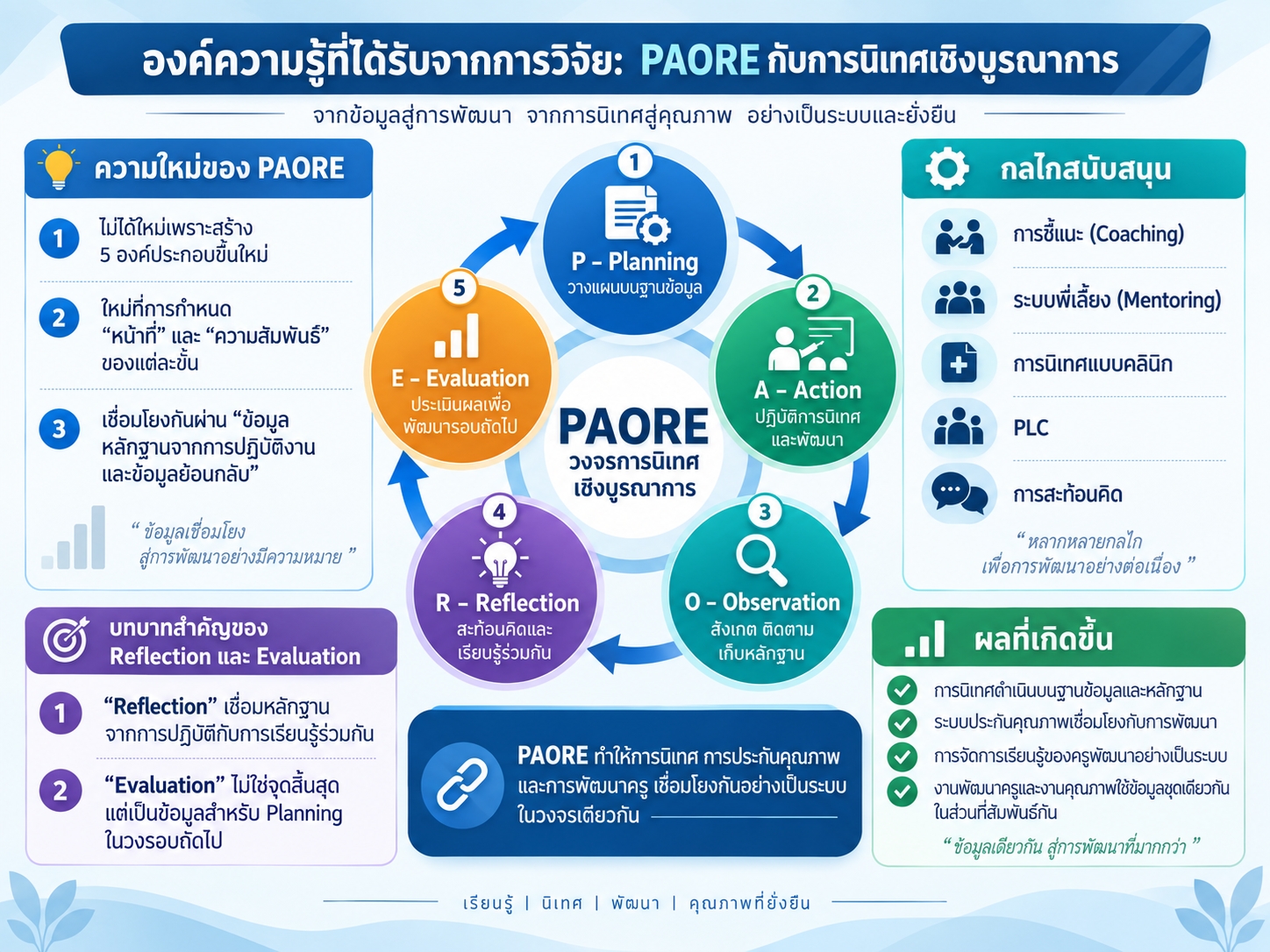
2. The developed PAORE process consisted of Planning, Action, Observation, Reflection, and Evaluation. The overall quality of the process was rated at the highest level (x̄ = 4.64, S.D. = 0.24), as was the implementation manual (x̄ = 4.70, S.D. = 0.19).
3. After three implementation cycles, the mean post-development knowledge scores were descriptively higher than the pre-development scores. School-level process skills increased from 4.43 to 4.65, while teachers’ attitudes increased from 3.14 to 4.67. The proportion of schools rated “Excellent” in self-assessment increased from 28.17% to 40.85%. In addition, all 24 schools that underwent the fifth-round external quality assessment met the criteria across all three standards.
4. Stakeholders perceived PAORE as valuable in promoting the use of authentic evidence, reducing duplicated work, fostering collegial supervision, and supporting collaborative learning. The process should therefore be integrated into schools’ routine work systems.
Article Details

This work is licensed under a Creative Commons Attribution-NonCommercial-NoDerivatives 4.0 International License.
เพื่อให้เป็นไปตามกฎหมายลิขสิทธิ์ ผู้นิพนธ์ทุกท่านต้องลงลายมือชื่อในแบบฟอร์มใบมอบลิขสิทธิ์บทความ ให้แก่วารสารฯ พร้อมกับบทความต้นฉบับที่ได้แก้ไขครั้งสุดท้าย นอกจากนี้ ผู้นิพนธ์ทุกท่านต้องยืนยันว่าบทความ ต้นฉบับที่ส่งมาตีพิมพ์นั้น ได้ส่งมาตีพิมพ์เฉพาะในวารสาร วิชาการธรรม ทรรศน์ เพียงแห่งเดียวเท่านั้น หากมีการใช้ ภาพหรือตารางของผู้นิพนธ์อื่นที่ปรากฏในสิ่งตีพิมพ์อื่นมาแล้ว ผู้นิพนธ์ต้องขออนุญาตเจ้าของลิขสิทธิ์ก่อน พร้อมทั้ง แสดงหนังสือที่ได้รับการยินยอมต่อบรรณาธิการ ก่อนที่บทความจะได้รับการตีพิมพ์References
กฎกระทรวงการประกันคุณภาพการศึกษา พ.ศ. 2561. (2561, 23 กุมภาพันธ์). ราชกิจจานุเบกษา, 135(11 ก), 3-5.
ธนพล วงศ์ฉลาด และธรินธร นามวรรณ. (2564). การพัฒนาแนวทางการดำเนินงานการประกันคุณภาพการศึกษาภายในสถานศึกษา โดยประยุกต์ใช้แนวคิดชุมชนแห่งการเรียนรู้เชิงวิชาชีพ สังกัดสำนักงานเขตพื้นที่การศึกษามัธยมศึกษาสุรินทร์. วารสารวิทยาลัยนครราชสีมา สาขามนุษยศาสตร์และสังคมศาสตร์, 15(2), 146-159.
ธัญพิชชา อุ่นรัมย์ และธรินธร นามวรรณ. (2564). การพัฒนาแนวทางการนิเทศภายในแบบสอนแนะโดยใช้แนวคิดชุมชนแห่งการเรียนรู้เชิงวิชาชีพ สำหรับสถานศึกษาในสังกัดสำนักงานเขตพื้นที่การศึกษามัธยมศึกษา เขต 33. วารสารมหาวิทยาลัยราชภัฏมหาสารคาม, 15(1), 145-158.
พระราชบัญญัติการศึกษาแห่งชาติ พ.ศ. 2542. (2542, 19 สิงหาคม). ราชกิจจานุเบกษา, 116(74 ก), 1-23.
พิมพ์สุดา เอี่ยมสกุล, วิไลลักษณ์ ลังกา และวิลาวัลย์ ด่านสิริสุข. (2563). การพัฒนารูปแบบการนิเทศการศึกษาที่เสริมสร้างสมรรถนะด้านการประกันคุณภาพการศึกษาของครู. วารสารสังคมศาสตร์และมานุษยวิทยาเชิงพุทธ, 5(9), 442-459.
สำนักทดสอบทางการศึกษา สำนักงานคณะกรรมการการศึกษาขั้นพื้นฐาน. (2563). แนวทางการพัฒนาระบบการประกันคุณภาพการศึกษา ตามกฎกระทรวงการประกันคุณภาพการศึกษา พ.ศ. 2561. กรุงเทพฯ: สำนักทดสอบทางการศึกษา สำนักงานคณะกรรมการการศึกษาขั้นพื้นฐาน.
Anderson, L. W., & Krathwohl, D. R. (Eds.). (2001). A taxonomy for learning, teaching, and assessing: A revision of Bloom's taxonomy of educational objectives. (Complete ed.). New York: Longman.
Cogan, M. L. (1973). Clinical supervision. Boston: Houghton Mifflin.
Costa, A. L., & Garmston, R. J. (2016). Cognitive coaching: Developing self-directed leaders and learners. (3rd ed.). Lanham, MD: Rowman & Littlefield.
Deming, W. E. (2018). Out of the crisis. (Reissue ed.). Cambridge, MA: The MIT Press.
Fullan, M. (2019). Leading in a culture of change. (2nd ed.). San Francisco, CA: Jossey-Bass.
Glickman, C. D., Gordon, S. P., & Ross-Gordon, J. M. (2018). SuperVision and instructional leadership: A developmental approach. (10th ed.). Boston, MA: Pearson.
Kemmis, S., McTaggart, R., & Nixon, R. (2014). The action research planner: Doing critical participatory action research. Singapore: Springer.
McClelland, D. C. (1973). Testing for competence rather than for “intelligence.” American Psychologist, 28(1), 1-14. https://doi.org/10.1037/h0034092
Rogers, E. M. (2003). Diffusion of innovations. (5th ed.). New York: Free Press.
Stoll, L., Bolam, R., McMahon, A., Wallace, M., & Thomas, S. (2006). Professional learning communities: A review of the literature. Journal of Educational Change, 7(4), 221-258. https://doi.org/10.1007/s10833-006-0001-8
