A Synthesis of Research on Educational Quality Assurance Using Content Analysis and Meta-Analysis
Article Sidebar
Main Article Content
Abstract
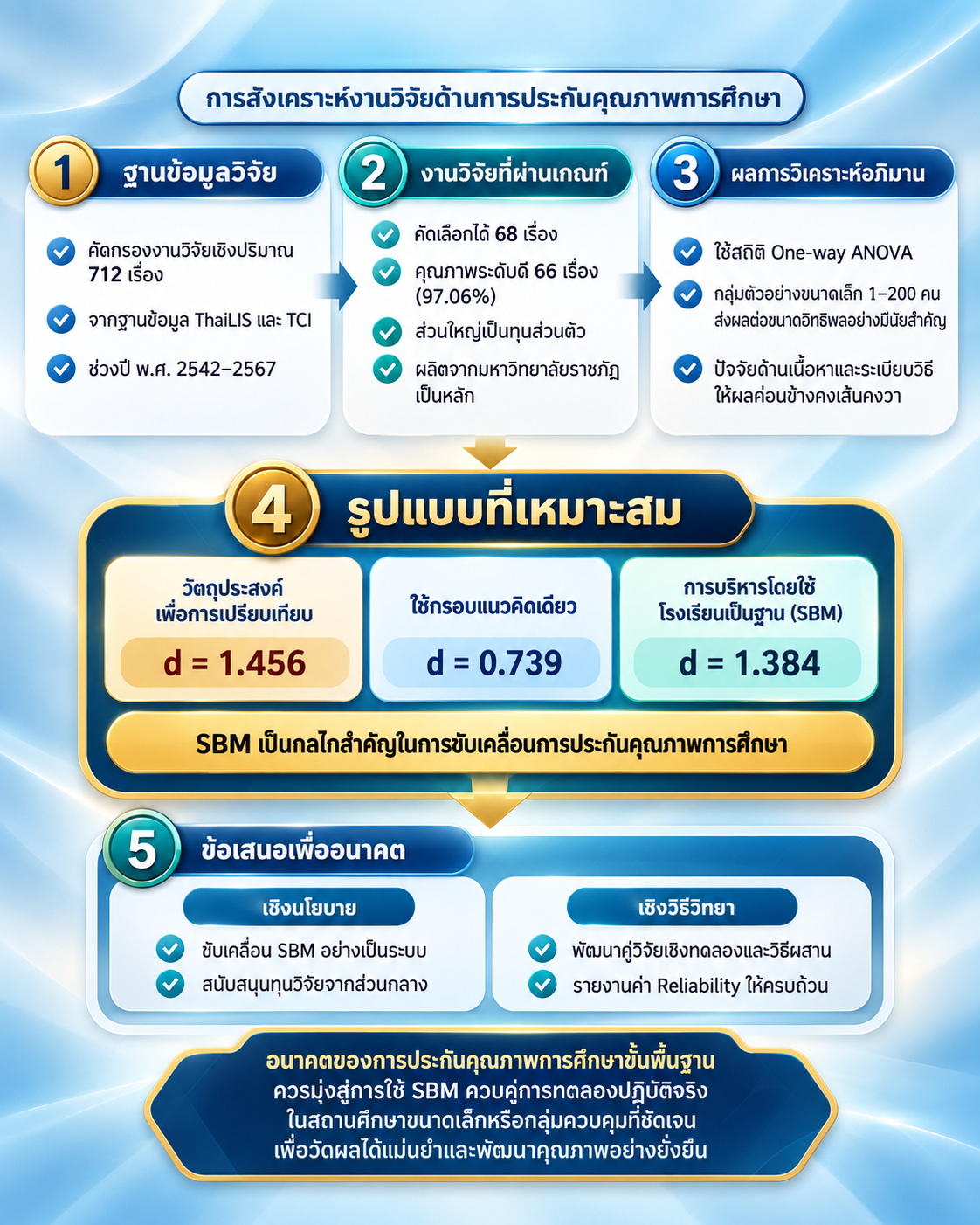
The findings showed that:
1. The overall quality of the research evaluated was at a good level, with no studies requiring revision.
2. Regarding basic research characteristics, all studies were privately funded (100%), with the highest proportion produced by Rajabhat Universities (45.59%) in the field of Educational Administration (97.06%). In terms of content, most research aimed for comparative analysis (73.52%), applied the concept of participation (72.05%), and utilized participatory management models (72.05%). Methodologically, directional hypotheses were predominantly used (97.06%), all studies were survey research (100%), questionnaires were the primary instrument (89.71%) containing 41-60 items (88.24%), content validity was routinely verified (94.12%), and One-Way ANOVA was the most common statistical tool for data analysis (82.35%).
3. Meta-analysis results showed an overall average effect size of 0.95 (S.D. = 1.197) When classified by substantive research characteristics, these characteristics did not yield statistically significant differences in mean effect sizes. However, a descriptive comparison indicated that studies aiming for comparison and analysis, applying school-based management concepts, and using a single theoretical framework tended to yield higher average effect sizes than other groups.
Article Details

This work is licensed under a Creative Commons Attribution-NonCommercial-NoDerivatives 4.0 International License.
เพื่อให้เป็นไปตามกฎหมายลิขสิทธิ์ ผู้นิพนธ์ทุกท่านต้องลงลายมือชื่อในแบบฟอร์มใบมอบลิขสิทธิ์บทความ ให้แก่วารสารฯ พร้อมกับบทความต้นฉบับที่ได้แก้ไขครั้งสุดท้าย นอกจากนี้ ผู้นิพนธ์ทุกท่านต้องยืนยันว่าบทความ ต้นฉบับที่ส่งมาตีพิมพ์นั้น ได้ส่งมาตีพิมพ์เฉพาะในวารสาร วิชาการธรรม ทรรศน์ เพียงแห่งเดียวเท่านั้น หากมีการใช้ ภาพหรือตารางของผู้นิพนธ์อื่นที่ปรากฏในสิ่งตีพิมพ์อื่นมาแล้ว ผู้นิพนธ์ต้องขออนุญาตเจ้าของลิขสิทธิ์ก่อน พร้อมทั้ง แสดงหนังสือที่ได้รับการยินยอมต่อบรรณาธิการ ก่อนที่บทความจะได้รับการตีพิมพ์References
กระทรวงศึกษาธิการ. (2561). กฎกระทรวงการประกันคุณภาพการศึกษา พ.ศ. 2561. ราชกิจจานุเบกษา, 135(11 ก), 3-5.
สำนักงานเลขาธิการสภาการศึกษา. (2560). แผนการศึกษาแห่งชาติ พ.ศ. 2560-2579. กรุงเทพฯ: กระทรวงศึกษาธิการ.
Almanasreh, E., Moles, R., & Chen, T. F. (2019). Evaluation of methods used for estimating content validity. Research in Social and Administrative Pharmacy, 15(2), 214-221.
Barrera-Osorio, F., Fasih, T., Patrinos, H. A., & Santibáñez, L. (2009). Decentralized decision-making in schools: The theory and evidence on school-based management. Washington, DC: World Bank.
Boateng, G. O., Neilands, T. B., Frongillo, E. A., Melgar-Quiñonez, H. R., & Young, S. L. (2018). Best practices for developing and validating scales for health, social, and behavioral research: A primer. Frontiers in Public Health, 6, 149.
Borenstein, M., Hedges, L. V., Higgins, J. P. T., & Rothstein, H. R. (2021). Introduction to meta-analysis. (2nd ed.). Hoboken, NJ: Wiley.
Cooper, H. (2017). Research synthesis and meta-analysis: A step-by-step approach. (5th ed.). Thousand Oaks, CA: SAGE Publications.
Glass, G. V., McGaw, B., & Smith, M. L. (1981). Meta-analysis in social research. Beverly Hills, CA: Sage Publications.
Krippendorff, K. (2019). Content analysis: An introduction to its methodology. (4th ed.). Thousand Oaks, CA: SAGE Publications.
OECD. (2020). Back to the future of education: Four OECD scenarios for schooling. Paris: OECD Publishing.
Sterne, J. A. C., Sutton, A. J., Ioannidis, J. P. A., Terrin, N., Jones, D. R., Lau, J., Carpenter, J., Rücker, G., Harbord, R. M., Schmid, C. H., Tetzlaff, J., Deeks, J. J., Peters, J., Macaskill, P., Schwarzer, G., Duval, S., Altman, D. G., Moher, D., & Higgins, J. P. T. (2011). Recommendations for examining and interpreting funnel plot asymmetry in meta-analyses of randomised controlled trials. BMJ, 343, d4002.
