The Development of a Strategic Leadership Model for School Administrators in Managing Proactive Learning of Teachers Under the Nakhon Si Thammarat Secondary Educational Service Office
Article Sidebar
Main Article Content
Abstract
The research findings were as follows:
1. Overall, the current conditions were at a moderate level (x̄ = 3.18, S.D. = 0.62), whereas the desired conditions were at the highest level (x̄ = 4.68, S.D. = 0.47). The overall priority needs index was 0.52. Regarding strategic leadership, change management demonstrated the highest priority need (PNI Modified = 0.84), while, in terms of active learning management, the use of instructional media and learning resources showed the highest priority need (PNI Modified = 0.43).
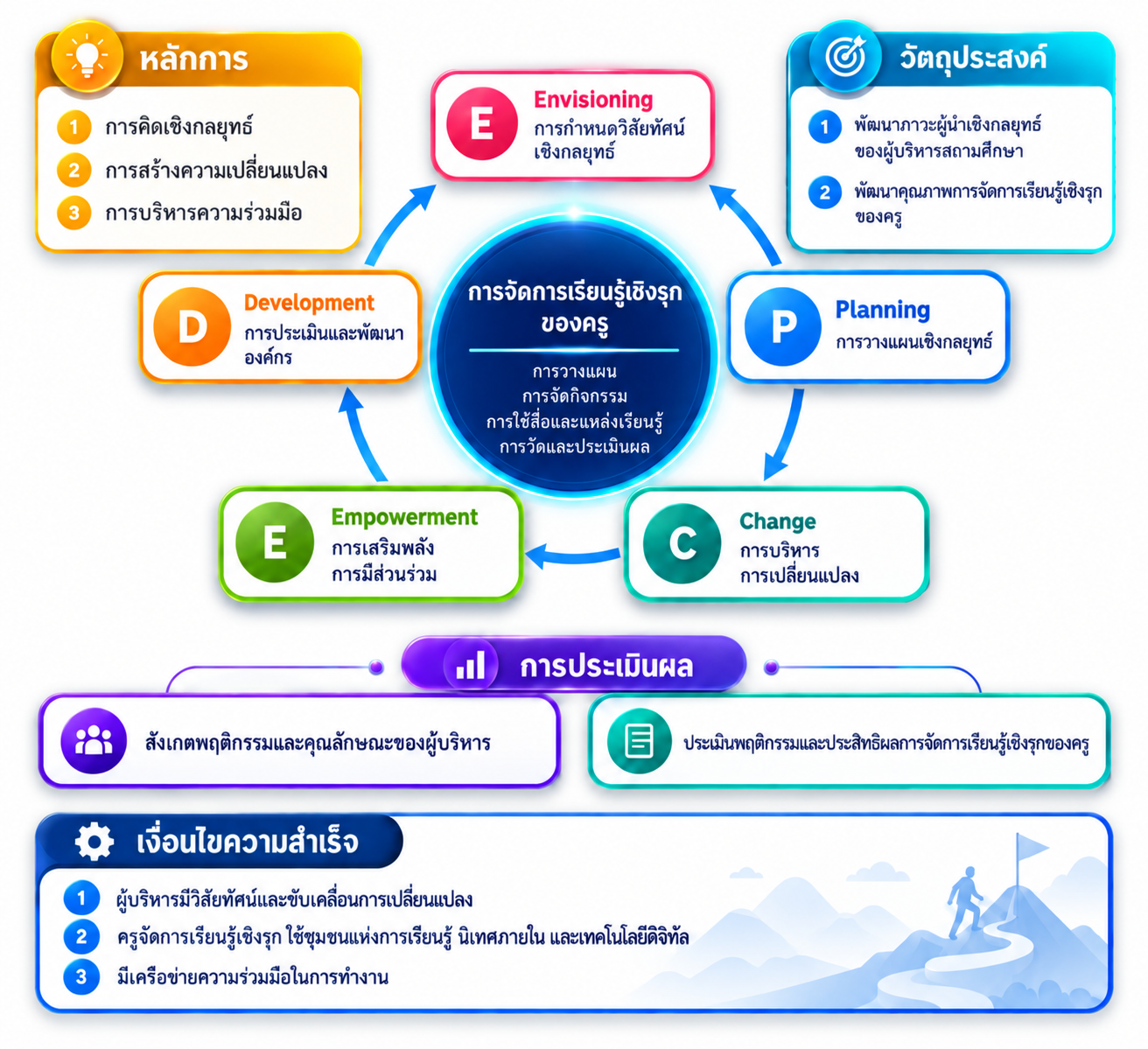
2. The EPCED Model consisted of five processes: Strategic Vision Formulation, Strategic Planning, Change Management, Participatory Empowerment, and Organizational Evaluation and Development. These processes were grounded in the principles of strategic thinking, change creation, and collaborative management.
3. The evaluation results indicated that the model was rated at the highest level in all aspects: accuracy (x̄ = 4.62, S.D. = 0.53), appropriateness (x̄ = 4.86, S.D. = 0.25), utility (x̄ = 4.76, S.D. = 0.29), and feasibility (x̄ = 5.00, S.D. = 0.00).
Article Details

This work is licensed under a Creative Commons Attribution-NonCommercial-NoDerivatives 4.0 International License.
เพื่อให้เป็นไปตามกฎหมายลิขสิทธิ์ ผู้นิพนธ์ทุกท่านต้องลงลายมือชื่อในแบบฟอร์มใบมอบลิขสิทธิ์บทความ ให้แก่วารสารฯ พร้อมกับบทความต้นฉบับที่ได้แก้ไขครั้งสุดท้าย นอกจากนี้ ผู้นิพนธ์ทุกท่านต้องยืนยันว่าบทความ ต้นฉบับที่ส่งมาตีพิมพ์นั้น ได้ส่งมาตีพิมพ์เฉพาะในวารสาร วิชาการธรรม ทรรศน์ เพียงแห่งเดียวเท่านั้น หากมีการใช้ ภาพหรือตารางของผู้นิพนธ์อื่นที่ปรากฏในสิ่งตีพิมพ์อื่นมาแล้ว ผู้นิพนธ์ต้องขออนุญาตเจ้าของลิขสิทธิ์ก่อน พร้อมทั้ง แสดงหนังสือที่ได้รับการยินยอมต่อบรรณาธิการ ก่อนที่บทความจะได้รับการตีพิมพ์References
กระทรวงศึกษาธิการ. (2544). แนวทางการจัดการเรียนรู้ตามพระราชบัญญัติการศึกษาแห่งชาติ พ.ศ. 2542. กรุงเทพฯ: องค์การรับส่งสินค้าและพัสดุภัณฑ์ (ร.ส.พ.).
กัญญาณัฐ ไชยชะนะ. (2563). ความสัมพันธ์ระหว่างภาวะผู้นำเชิงกลยุทธ์ในศตวรรษที่ 21 ของผู้บริหารสถานศึกษากับประสิทธิผลของสถานศึกษาในอำเภอแม่สรวย สังกัดสำนักงานเขตพื้นที่การศึกษาประถมศึกษาเชียงราย เขต 2. (สารนิพนธ์การศึกษามหาบัณฑิต). พะเยา: มหาวิทยาลัยพะเยา.
กุหลาบ อารีวงศ์. (2566). รูปแบบภาวะผู้นำดิจิทัลของผู้บริหารเพื่อยกระดับคุณภาพการศึกษาของสถานศึกษา สังกัดสำนักงานเขตพื้นที่การศึกษามัธยมศึกษานครศรีธรรมราช. (วิทยานิพนธ์ครุศาสตรดุษฎีบัณฑิต). นครศรีธรรมราช: มหาวิทยาลัยราชภัฏนครศรีธรรมราช.
ดาราวรรณ ศรีกาญจนา. (2562). รูปแบบการพัฒนาภาวะผู้นำทางวิชาการตามหลักพุทธธรรมสำหรับผู้บริหารสถานศึกษามัธยมศึกษา สังกัดกรุงเทพมหานคร. (วิทยานิพนธ์พุทธศาสตรดุษฎีบัณฑิต). พระนครศรีอยุธยา: มหาวิทยาลัยมหาจุฬาลงกรณราชวิทยาลัย.
ธีระ รุญเจริญ. (2553). ความเป็นมืออาชีพในการจัดและบริหารการศึกษายุคปฏิรูปการศึกษา (ฉบับปรับปรุงเพิ่มเติม). กรุงเทพฯ: ข้าวฟ่าง.
ปาริชาติ ชมชื่น. (2555). รูปแบบการบริหารงานวิชาการแบบมีส่วนร่วมของชุมชนที่มีประสิทธิผลในสถานศึกษา สังกัดสำนักงานเขตพื้นที่การศึกษาประถมศึกษา. (วิทยานิพนธ์ครุศาสตรดุษฎีบัณฑิต). อุบลราชธานี: มหาวิทยาลัยราชภัฏอุบลราชธานี.
มัทนา วังถนอมศักดิ์. (2561). ภาวะผู้นำทางการศึกษา ทฤษฎีและการปฏิบัติ. นครปฐม: เพชรเกษมพริ้นติ้งกรุ๊ป จำกัด.
สมนึก บุญใหญ่. (2557). รูปแบบการบริหารจัดการสถานศึกษาเพื่อพัฒนาความเป็นพลเมืองของนักเรียนในสถานศึกษาขั้นพื้นฐาน. (วิทยานิพนธ์ครุศาสตรดุษฎีบัณฑิต). เชียงราย: มหาวิทยาลัยราชภัฏเชียงราย.
สมาน อัศวภูมิ. (2550). การใช้ระเบียบวิธีวิจัยเชิงพัฒนาเพื่อทำวิทยานิพนธ์และงานวิจัย. อุบลราชธานี: มหาวิทยาลัยราชภัฏอุบลราชธานี.
สำนักงานคณะกรรมการการศึกษาขั้นพื้นฐาน. (2562). แนวทางการจัดการเรียนรู้เชิงรุก (Active Learning). กรุงเทพฯ: ชุมนุมสหกรณ์การเกษตรแห่งประเทศไทย.
สุพรรณี ชาประสิทธิ์. (2557). Active Learning: จัดการเรียนรู้อย่างไรให้เป็น Active Learning. นิตยสาร สสวท., 42(187), 1-5.
Brown, W. B., & Moberg, D. J. (1980). Organizational Theory and Management: A Macro Approach. New York: John Wiley & Sons.
Keeves, J. P. (1988). Educational research, Methodology and measurement: An international handbook. Oxford: Pergamon.
Krejcie, R. V., & Morgan, D. W. (1970). Determining sample size for research activities. Educational and Psychological Measurement, 30(3), 607-610. https://doi.org/ 10.1177/00131644700300030
