The Relationship Between Saṅkhāra in the Three Characteristics (Tilakkhaṇa) and Saṅkhāra in the Five Aggregates (Pañcakkhandha): A Practical Application in Daily Life
Article Sidebar
Main Article Content
Abstract
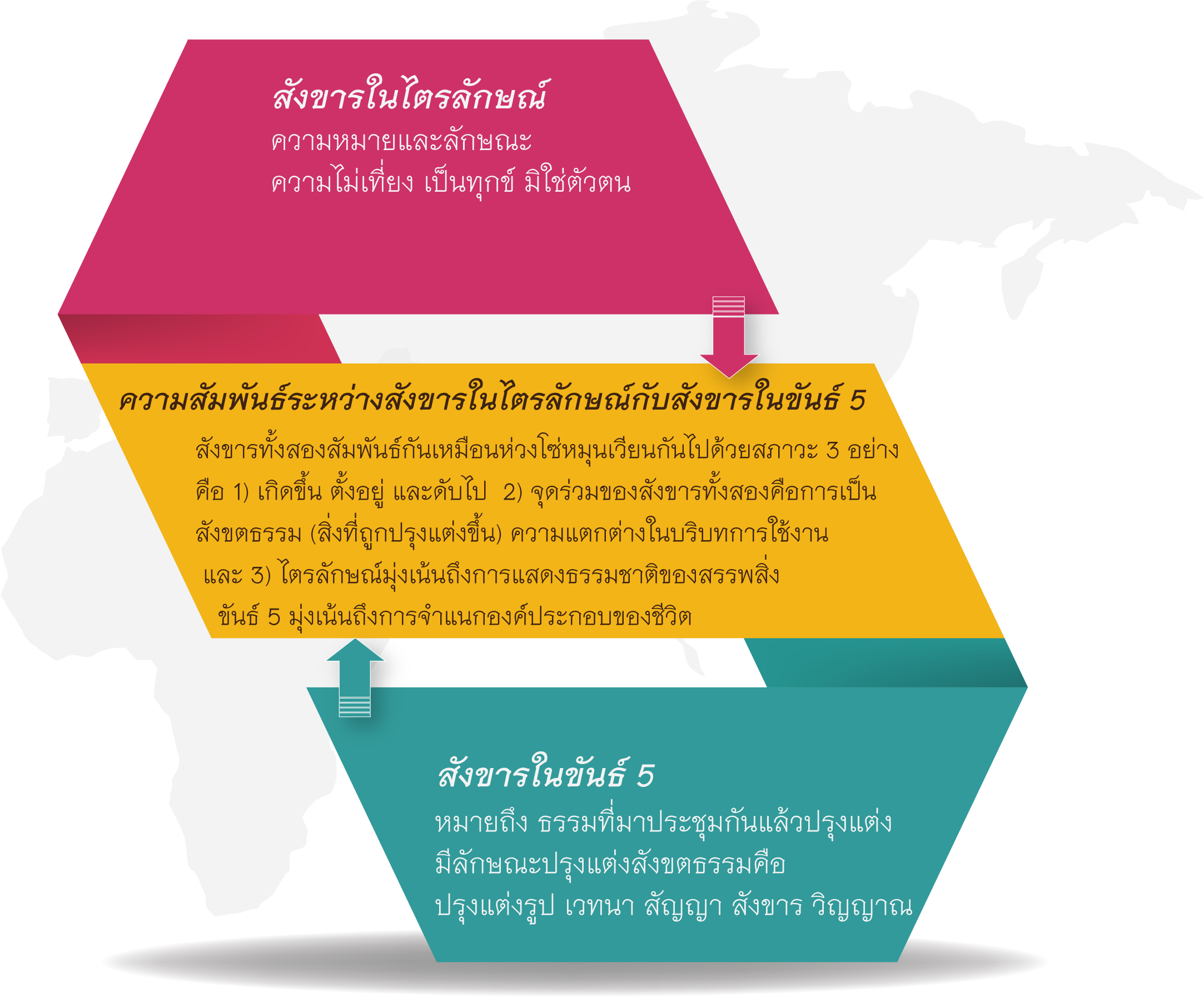
This article aims to analyze and clarify the relationship between saṅkhāra in the Three Characteristics (Tilakkhaṇa) and saṅkhāra in the Five Aggregates (Khandhas), in order to deepen the understanding of Dhamma and its practical application. The study reveals that saṅkhāra in the context of the Three Characteristics refers to all conditioned phenomena, both physical and mental. Meanwhile, saṅkhāra in the Five Aggregates pertains to mental formations that shape the mind toward wholesome, unwholesome, or neutral tendencies, with volition (cetanā) playing a central role. Saṅkhāra, as a conditioned phenomenon, is subject to impermanence (anicca), suffering (dukkha), and non-self (anattā), characterized by arising and cessation, lacking any essence of a true self and beyond personal control. The relationship between the two forms of saṅkhāra can be understood as follows: Saṅkhāra in the Three Characteristics represents a cyclical process of arising, persisting, and ceasing inherent in all phenomena. In the Five Aggregates, the physical aspect of saṅkhāra manifests impermanence and suffering from the moment of bodily existence, while its mental aspect is observable through physical and verbal behaviors. The shared nature between these two aspects lies in their being saṅkhatadhamma (conditioned phenomena). Their distinction lies in their scope: saṅkhāra in the Three Characteristics reflects the universal nature of all phenomena, whereas saṅkhāra in the Five Aggregates emphasizes the structural composition of an individual being. Recognizing this relationship fosters insight into the true nature of reality, enabling detachment and the cultivation of wisdom. In practice, this understanding supports meditative development through insight (vipassanā), beginning from nāma-rūpa-pariccheda-ñāṇa (knowledge of the distinction between mind and matter) to paṭisaṅkhā-anupassanā-ñāṇa (knowledge of contemplation through wise reflection), applying the Three Characteristics to all saṅkhāra. The Five Aggregates are supported by spiritual faculties—faith (saddhā), energy (viriya), mindfulness (sati), concentration (samādhi), and wisdom (paññā)—which culminate in the arising of magga-ñāṇa (path knowledge), thereby eliminating defilements (kilesa).
Article Details

This work is licensed under a Creative Commons Attribution-NonCommercial-NoDerivatives 4.0 International License.
เพื่อให้เป็นไปตามกฎหมายลิขสิทธิ์ ผู้นิพนธ์ทุกท่านต้องลงลายมือชื่อในแบบฟอร์มใบมอบลิขสิทธิ์บทความ ให้แก่วารสารฯ พร้อมกับบทความต้นฉบับที่ได้แก้ไขครั้งสุดท้าย นอกจากนี้ ผู้นิพนธ์ทุกท่านต้องยืนยันว่าบทความ ต้นฉบับที่ส่งมาตีพิมพ์นั้น ได้ส่งมาตีพิมพ์เฉพาะในวารสาร วิชาการธรรม ทรรศน์ เพียงแห่งเดียวเท่านั้น หากมีการใช้ ภาพหรือตารางของผู้นิพนธ์อื่นที่ปรากฏในสิ่งตีพิมพ์อื่นมาแล้ว ผู้นิพนธ์ต้องขออนุญาตเจ้าของลิขสิทธิ์ก่อน พร้อมทั้ง แสดงหนังสือที่ได้รับการยินยอมต่อบรรณาธิการ ก่อนที่บทความจะได้รับการตีพิมพ์References
พระเทพเวที (ประยุทธ์ ปยุตฺโต). (2536). พจนานุกรมพุทธศาสน์ ฉบับประมวลศัพท์. (พิมพ์ครั้งที่ 7). กรุงเทพฯ: มหาจุฬาลงกรณราชวิทยาลัย.
พระธรรมปิฎก (ป.อ.ปยุตโต). (2562). พุทธธรรม ฉบับปรับขยาย. กรุงเทพฯ: มหาจุฬาลงกรณราชวิทยาลัย.
_______. (2538). พจนานุกรมพุทธศาสตร์ ฉบับประมวลธรรม. (พิมพ์ครั้งที่ 8). กรุงเทพฯ: มหาจุฬาลงกรณราชวิทยาลัย..
พระพรหมคุณาภรณ์ (ป.อ.ปยุตฺโต). (2549). พุทธธรรม ฉบับขยายความ. (พิมพ์ครั้งที่ 11). กรุงเทพฯ: สหธรรมิก.
พระพุทธโฆสาจารย์. (2546). คัมภีร์วิสุทธิมรรค ฉบับ 100 ปี สมเด็จพระพุฒาจารย์ (อาจ อาสภมหาเถร). (พิมพ์ครั้งที่ 4) . กรุงเทพฯ: ประยูรวงศ์พริ้นติ้ง.
พระมหาวุฒิชัย วชิรเมธี. (2550). พุทธธรรม ฉบับย่อ. กรุงเทพฯ: สถาบันวิมุตตยาลัย.
พระสัทธัมมโชติกะ ธัมมาจริยะ. (ม.ป.ป.). ปฏิจจสมุปปาททีปนี. ม.ป.ท.
พระสุมังคลมีเถระ. (ม.ป.ป.). อภิธัมมัตถสังคหะ ใน ฎีกาอภิธัมมัตถสังคหะ ชื่อว่าอภิธัมมัตถวิภาวินี (พระธรรมวโรดม (บุญมา คุณสมฺปนฺโน ป.ธ.9), ผู้แปล). ม.ป.ท.
มหาจุฬาลงกรณราชวิทยาลัย. (2500). พระไตรปิฎกภาษาบาลี ฉบับมหาจุฬาเตปิฏกํ. กรุงเทพฯ: มหาจุฬาลงกรณราชวิทยาลัย.
_______. (2533). อรรถกถาบาลี ฉบับมหาจุฬาอฏฺฐกถา. กรุงเทพฯ: วิญญาณ.
_______. (2539). พระไตรปิฎกภาษาไทย ฉบับมหาจุฬาลงกรณราชวิทยาลัย. กรุงเทพฯ: มหาจุฬาลงกรณราชวิทยาลัย.
มหามกุฏราชวิทยาลัย. (2534). พระไตรปิฎกพร้อมอรรถกถาแปล ชุด 91 เล่ม. กรุงเทพฯ: มหามกุฏราชวิทยาลัย.
ราชบัณฑิตยสถาน. (2546). พจนานุกรมฉบับราชบัณฑิตยสถาน พ.ศ. 2542. (พิมพ์ครั้งที่ 2). กรุงเทพฯ: นานมีบุ๊คส์พับลิเคชั่น.
