The Affecting of Media Usage on Political Trust and Corruption in Thailand
Article Sidebar
Main Article Content
Abstract
The objective of this research is to study the predication of social media usage on political trust and corruption in Thailand. Quantitative research was used in collecting 1,600 respondents of the opinions of generation X, Y, Z who live in Thailand. The research tools is the questionnaire with .883 of validity test. The statistical analysis are mean, percentage, standard deviation, t-test and multi-regression analysis.
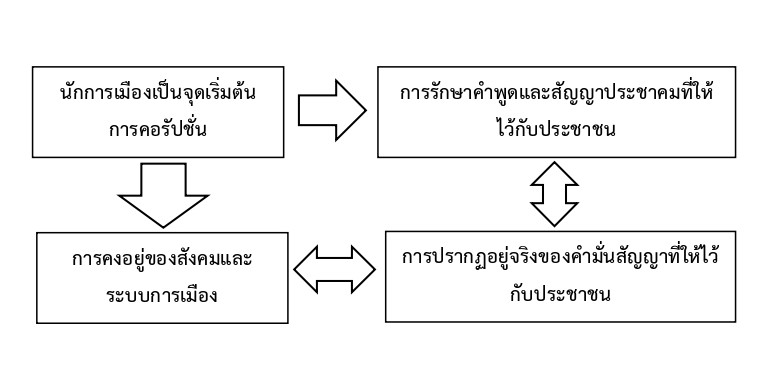
The findings show that: 1) Social media usage could predict significantly to political trust at Beta = -.05, t = -2.86 (Sig .004). 2) Political trust could not predict significantly to political trust at Beta = .02, t = 1.08 (Sig .277). 3) Social media usage and attitude to government unit except political interest, predicted significantly and simultaneously to political trust, the value of coefficient of determination is R2 = .65, Std. error = .84, F = 662.95 (Sig .000). 4) Media usage predicted significantly lower than attitude to government unit, to political trust such as justice system, public service, police department, transportation, public health system and local government at Beta = .31, .15, .18. .20, .07 and .07, (Sig .00 and .01), respectively. 5) The findings conclude that only the component of political trust in terms of trust in politician could predict significantly to corruption at Beta = .06, t = 2.16 (Sig .031). Therefore, politician’s keeping words is the most crucial factor, could effect on people’s political trust.
Article Details

This work is licensed under a Creative Commons Attribution-NonCommercial-NoDerivatives 4.0 International License.
เพื่อให้เป็นไปตามกฎหมายลิขสิทธิ์ ผู้นิพนธ์ทุกท่านต้องลงลายมือชื่อในแบบฟอร์มใบมอบลิขสิทธิ์บทความ ให้แก่วารสารฯ พร้อมกับบทความต้นฉบับที่ได้แก้ไขครั้งสุดท้าย นอกจากนี้ ผู้นิพนธ์ทุกท่านต้องยืนยันว่าบทความ ต้นฉบับที่ส่งมาตีพิมพ์นั้น ได้ส่งมาตีพิมพ์เฉพาะในวารสาร วิชาการธรรม ทรรศน์ เพียงแห่งเดียวเท่านั้น หากมีการใช้ ภาพหรือตารางของผู้นิพนธ์อื่นที่ปรากฏในสิ่งตีพิมพ์อื่นมาแล้ว ผู้นิพนธ์ต้องขออนุญาตเจ้าของลิขสิทธิ์ก่อน พร้อมทั้ง แสดงหนังสือที่ได้รับการยินยอมต่อบรรณาธิการ ก่อนที่บทความจะได้รับการตีพิมพ์References
กัญญ์สิริ จันทร์เจริญ. (2554). การกำหนดประชากรและกลุ่มตัวอย่าง. เข้าถึงได้จาก https://www.ict.up.ac.th/surinthips/ResearchMethodology_2554
ณัฐฐ์วัฒน์ สุทธิโยธิน. (2559). การตรวจสอบคุณภาพเครื่องมือวิจัย. เข้าถึงได้จาก https://nattawatt.blogspot.com/2016/09/blog-post_99.html
ณัฐพงศ์ พิมพ์จันทร์ และกฤษณ์ ทองเลิศ. (2561). การสะท้อนปัญหาการทุจริตคอร์รัปชั่นผ่านภาพยนตร์สั้นประกวดของสำนักงานคณะกรรมการการป้องกันและปราบปรามการทุจริตแห่งชาติ. (วิทยานิพนธ์นิเทศศาสตรมหาบัณฑิต). กรุงเทพฯ: มหาวิทยาลัยรังสิต.
ทรงยศ บัวเผื่อน. (2559). บทบาทสื่อมวลชนในยุค คสช. กับการส่งเสริมประชาธิปไตยให้ประชาชนในภาคตะวันออก. ชลบุรี: มหาวิทยาลัยบูรพา.
ไทยบีพีเอส. (2566). เผยตัวเลขคนไทยแต่ละเจเนอเรชัน ตัวแปรสำคัญเลือกตั้ง 2566. เข้าถึงได้จาก https://www.thaipbs.or.th/now/content/61
ไทยรัฐ. (2566, 28 สิงหาคม). นโยบายรัฐบาลกับความเป็นจริง. ไทยรัฐ, หน้า 6.
_______. (2566, 28 สิงหาคม). รัฐบาลใหม่กับความเชื่อมั่น. ไทยรัฐ, หน้า 6.
_______. (2567, 1 มิถุนายน). สงครามเย็นเศรษฐกิจระลอกใหม่. ไทยรัฐ, หน้า 12
นภาภรณ์ อัจฉริยะกุล และอมรมาศ คงธรรม. (2547). ความหมายและความสำคัญของวิทยุกระจายเสียงและวิทยุโทรทัศน์. เอกสารการสอนชุดความรู้เบื้องต้นเกี่ยวกับวิทยุและโทรทัศน์. นนทบุรี: มหาวิทยาลัยสุโขทัยธรรมาธิราช.
ประสพชัย พสุนนท์. (2557). ความเชื่อมั่นของแบบสอบถามในงานวิจัยเชิงปริมาณ. วารสารปาริชาต มหาวิทยาลัยทักษิณ, 27(1), 144-163.
พชรดนัย วัชรธนพัฒน์ธาดา. (2562). ปัจจัยที่มีผลต่อการคอร์รัปชั่นขององค์กรปกครองส่วนท้องถิ่น. วารสารการเมือง การบริหาร และกฎหมาย, 12(2), 37-54.
พรจิต สมบัติพานิช. (2547). โฆษณาในทศวรรษที่ 2000-2010: การศึกษาถึงปัจจัยด้านสื่อที่มีต่อรูปแบบโฆษณา. (วิทยานิพนธ์ปรัชญาดุษฎีบัณฑิต). กรุงเทพฯ: มหาวิทยาลัยธรรมศาสตร์.
พิชญาพร ประครองใจ. (2558). หลักนิเทศศาสตร์. กรุงเทพฯ: จุฬาลงกรณ์มหาวิทยาลัย.
ไพบูลย์ สุขเจตนี. (2564). ความไว้วางใจทางการเมืองของประชาชนที่มีต่อนักการเมืองระดับท้องถิ่นในจังหวัดนนทบุรี. วารสาร มจร สังคมศาสตร์ปริทรรศน์, 10(1), 267-276.
วิไลรักษ์ สันติกุล. (2566). พฤติกรรมการใช้สื่อของผู้สูงอายุไทยและการสื่อสารที่เหมาะสมสำหรับเมืองที่เป็นมิตรกับผู้สูงอายุ. วารสารประชาสัมพันธ์และการโฆษณา, 16(1), 94-115.
วีระศักดิ์ จินารัตน์. (2564). มาตรฐานงานวิจัยเชิงปริมาณและการพัฒนา. อุบลราชธานี: ยงสวัสดิ์อินเตอร์กรุ๊ป.
_______. (2564). ระเบียบวิธีวิจัยสมัยใหม่. อุบลราชธานี: ยงสวัสดิ์อินเตอร์กรุ๊ป.
สำนักงานคณะกรรมการข้าราชการพลเรือน. (2549). คู่มือการจัดทำแผนกลยุทธ์การบริหารทรัพยากรบุคคล. กรุงเทพฯ: พี.เอ.ลีฟวิ่ง.
Ardanaz, M., Otalvaro-Ramirez, S. & Scartascini, C. (2023). Does information about citizen participation initiatives increase political trust?. World Development, 16(2), 106-132. https://doi.org/10.1016/j.worlddev.2022.106132
Bauer, P. C., & Freitag, M. (2018). Measuring trust. In E. M. Uslander (Ed.), The Oxford handbook of social and political trust (pp. 15-36). Oxford University Press.
Becker. (1972). Discovering Mass Communication. Glenview, Ill.: Scott, Foresman.
Beesley, C., & Hawkins, D. (2022). Corruption, institutional trust and political engagement in Peru. Contents lists available at Science Direct. World Development, 151, 105743.
Berlo, D. K. (1960). The process of communication: An introduction to theory and practice. New York: Holt, Rinehart and Winston.
Brunkert, L., Kruse, S., & Welzel, C. (2019). A Tale of Culture-Bound Regime Evolution: The Centennial Democratic Trend and Its Recent Reversal. Democratization, 26(3), 422-443.
Freiberg, A., & Gaps, B. (2021). Not Leaping Chasms: Trust, Confidence and Sentencing Councils. International Journal for Court Administration, 12(3), 6. https://doi.org/10.36745/ijca.421
Gerring, J., Thacker, S., & Moreno, C. (2009). Are parliamentary systems better? Comparative Political Studies, 42(3), 327-359. https://doi.org/10.1177/0010414008331142
Grimmelikhuijsen, S. (2012). Linking transparency, knowledge and citizen trust in government: An experiment. International Review of Administrative Sciences, 78(1), 50-73. https://doi.org/10.1177/0020852311429667
Hartanto, D., & Siregar, S. M. (2021). Determinants of overall public trust in local government: meditation of government response to COVID-19 in Indonesian context. Transforming Government: People, Process and Policy, 15(2), 261-274. https://doi.org/10.1007/s11205-015-1182-4.
Jennifer, H., & Cynthia, P. (2020). The power of media in shaping political attitudes. Current Opinion in Behavioral Science, 34, 19-24. https://10.1016/j.cobeha.2019.11.005
Keefer, K. V., Parker, J. D. A., & Saklofske, D. (2018). Three decades of emotional intelligence research: Perennial issues, emerging trends, and lessons learned in education: Introduction to emotional intelligence in education: Integrating research with practice. In K. V. Keefer, J. D. A. Parker, & D. Saklofske (Eds.), Emotional intelligence in education (pp. 1-19). Springer.
Kumar, C., Herndon, P., & Richter, D. (2020). Critical agents of change at Earth's surface. Eos. https://doi.org/10.1029/2020EO149750
Lee, J. H., & Suh, J. (2021). Decentralization and government trust in South Korea: distinguishing local government trust from national government trust. Asia and the Pacific Policy Studies, 8(1), 68-93.
Moore, J., & Atkin, C. (2012). An application (app) for learning: The student interface with tablet technology in graduate studies. Proceedings of the European Conference on e-Government (ECEG), 328-335.
Mummolo, J. (2016). News from the other side: how topic relevance limits the prevalence of partisan selective exposure. J. Polit. 78, 763-773. https://doi.org/110.1086/685584
Nathongjue, C. (2013). Corruption Problems. Retrieved from https://sdgroup1.blogspot.com/2013/01/53241790.html
Newton, A., Brito, A.C., Icely, J., & Derolez, V. (2018). Assessing, quantifying and valuing the ecosystem services of coastal lagoons. Journal for Nature Conservation, 44(2), 50-65. https://doi.org/10.1016/j.jnc.2018.02.009
Peerthum, S., & Luckho, T. (2021). Exploring the linkage between public corruption and political trust in Mauritius: A PLS-SEM approach. Public Organization Review, 21(3), 317-335. https://doi.org/10.1007/s11115-020-00491-4
Porta, D. (2000). Social Capital, Beliefs in Government, and Political Corruption. In S. J. Pharr, & R. D. Putnam (Eds.), Disaffected Democracies: What’s Troubling the Trilateral Countries? (pp. 202-27). Princeton: Princeton University Press.
Qin, J., Du, Q., Deng, Y., Zhang, B., & Sun, X. (2023). How does short video use generate political identity? Intermediate mechanisms with evidence from China's small-town youth. Frontiers in Psychology, 14, 1107273. https://doi.org/10.3389/fpsyg.2023.1107273
Robinson, S. L. (1996). Trust and breach of the psychological contract. Administrative Science Quarterly, 41(4), 574-599. https://doi.org/10.2307/2393868
Salgado, S. (2018). Online media impact on politics: Views on post-truth politics and post-postmodernism. International Journal of Media & Cultural Politics, 14(3), 317-331. https://doi.org/10.1386/macp.14.3.317_1
Turper, S., & Aarts, K. (2017). Political trust and sophistication: Taking measurement seriously. Social Indicators Research, 130(1), 415-434. https://doi.org/10.1007/s11205-015-1182-4
Turper, S., & Aarts, K. (2017). Political trust and sophistication: Taking measurement seriously. Social indicators research, 130(1), 415-434.
Uslander, E. M. (2018). The study of trust. In E. M. Uslander (Ed.), The Oxford handbook of social and political trust (pp. 3-13). Oxford University Press.
Wang, Z., Guo, D., & Wang, X. (2016). Determinants of residents’ e-waste recycling behaviour intentions: Evidence from China. Journal of Cleaner Production, 137, 850-860.
Weeks, B., Ardèvol-Abreu, A., & Gil de Zúñiga, H. (2015). Online influence? Social media use, opinion leadership, and political persuasion. International Journal of Public Opinion Research, 28(4), edv050-edv026. https://doi.org/10.1093/ijpor/edv050
