การใช้สื่อที่มีผลต่อความไว้วางใจทางการเมืองและการคอรัปชั่นในประเทศไทย
Article Sidebar
Main Article Content
บทคัดย่อ
การวิจัยครั้งนี้ มีวัตถุประสงค์เพื่อศึกษาความสามารถในการพยากรณ์ของการใช้สื่อที่มีต่อความไว้วางใจทางการเมืองและการคอรัปชั่นในประเทศไทย เป็นการวิจัยเชิงปริมาณ ประชากรที่ใช้ในการวิจัยคือ ประชาชนต่างอายุทั้งในกลุ่ม Gen X, Y และ Z ที่อาศัยอยู่ในประเทศไทย ได้กลุ่มตัวอย่างจำนวน 1,600 คน เครื่องมือที่ใช้ในการวิจัยเป็นแบบสอบถาม มีค่าความเที่ยงทั้งฉบับเท่ากับ .883 สถิติที่ใช้ในการวิเคราะห์ข้อมูล ได้แก่ ค่าเฉลี่ย ร้อยละ ส่วนเบี่ยงเบนมาตรฐาน สถิติทดสอบที และสถิติวิเคราะห์ถดถอยพหุคูณ
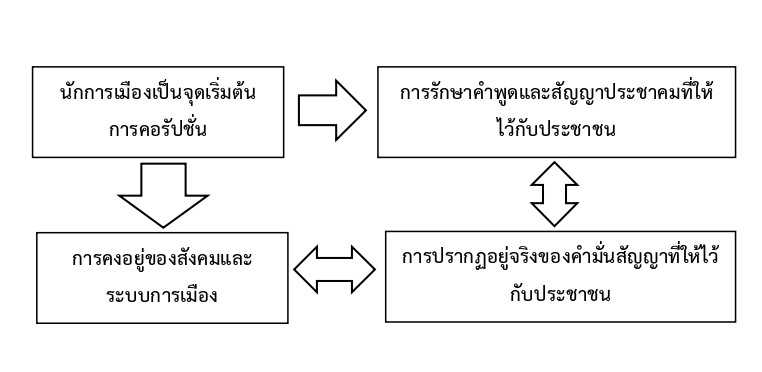
ผลการวิจัยพบว่า 1) การใช้สื่อมีความสามารถพยากรณ์ความไว้วางใจทางการเมืองได้อย่างมีนัยสำคัญทางสถิติที่ระดับ .01 2) ความสนใจทางการเมืองไม่มีความสามารถพยากรณ์ได้อย่างมีนัยสำคัญทางสถิติโดยมีผลทดสอบ t = 1.08 (Sig .277) 3) การใช้สื่อสังคมและทัศนคติต่อหน่วยงานรัฐมีอำนาจพยากรณ์อย่างมีนัยสำคัญทางสถิติต่อความไว้วางใจทางการเมืองยกเว้นความสนใจทางการเมือง รวมถึงมีสัมประสิทธิ์สหสัมพันธ์ที่ค่า R2 .65 มีความคลาดเคลื่อนสะสม .84 กับมีผลทดสอบความแปรปรวนที่ 662.95 (Sig. 000) 4) การใช้สื่อมีอำนาจพยากรณ์น้อยกว่าทัศนคติต่อหน่วยงานรัฐ ได้แก่ระบบยุติธรรม Beta .31 บริการสาธารณะ Beta .15 กรมตำรวจ Beta .18 ขนส่ง Beta .20 ระบบสาธารณสุข Beta .07 และองค์กรปกครองส่วนท้องถิ่น Beta .07 อย่างมีนัยสำคัญทางสถิติที่ระดับ .00 และ .01 5) มีเพียงองค์ประกอบความไว้วางใจต่อนักการเมืองเดียวเท่านั้นที่มีอำนาจพยากรณ์คอรัปชั่นได้อย่างมีนัยสำคัญทางสถิติที่ระดับ .05 โดยมีผลทดสอบ t = 2.16 (Sig. 031) กับมีสัมประสิทธิ์พยากรณ์ที่ Beta .06 ดังนั้น การรักษาคำพูดของนักการเมืองเท่านั้นที่เป็นปัจจัยสำคัญที่สุดที่ส่งผลให้ประชาชนมีความไว้วางใจทางการเมือง
Article Details

อนุญาตภายใต้เงื่อนไข Creative Commons Attribution-NonCommercial-NoDerivatives 4.0 International License.
เพื่อให้เป็นไปตามกฎหมายลิขสิทธิ์ ผู้นิพนธ์ทุกท่านต้องลงลายมือชื่อในแบบฟอร์มใบมอบลิขสิทธิ์บทความ ให้แก่วารสารฯ พร้อมกับบทความต้นฉบับที่ได้แก้ไขครั้งสุดท้าย นอกจากนี้ ผู้นิพนธ์ทุกท่านต้องยืนยันว่าบทความ ต้นฉบับที่ส่งมาตีพิมพ์นั้น ได้ส่งมาตีพิมพ์เฉพาะในวารสาร วิชาการธรรม ทรรศน์ เพียงแห่งเดียวเท่านั้น หากมีการใช้ ภาพหรือตารางของผู้นิพนธ์อื่นที่ปรากฏในสิ่งตีพิมพ์อื่นมาแล้ว ผู้นิพนธ์ต้องขออนุญาตเจ้าของลิขสิทธิ์ก่อน พร้อมทั้ง แสดงหนังสือที่ได้รับการยินยอมต่อบรรณาธิการ ก่อนที่บทความจะได้รับการตีพิมพ์เอกสารอ้างอิง
กัญญ์สิริ จันทร์เจริญ. (2554). การกำหนดประชากรและกลุ่มตัวอย่าง. เข้าถึงได้จาก https://www.ict.up.ac.th/surinthips/ResearchMethodology_2554
ณัฐฐ์วัฒน์ สุทธิโยธิน. (2559). การตรวจสอบคุณภาพเครื่องมือวิจัย. เข้าถึงได้จาก https://nattawatt.blogspot.com/2016/09/blog-post_99.html
ณัฐพงศ์ พิมพ์จันทร์ และกฤษณ์ ทองเลิศ. (2561). การสะท้อนปัญหาการทุจริตคอร์รัปชั่นผ่านภาพยนตร์สั้นประกวดของสำนักงานคณะกรรมการการป้องกันและปราบปรามการทุจริตแห่งชาติ. (วิทยานิพนธ์นิเทศศาสตรมหาบัณฑิต). กรุงเทพฯ: มหาวิทยาลัยรังสิต.
ทรงยศ บัวเผื่อน. (2559). บทบาทสื่อมวลชนในยุค คสช. กับการส่งเสริมประชาธิปไตยให้ประชาชนในภาคตะวันออก. ชลบุรี: มหาวิทยาลัยบูรพา.
ไทยบีพีเอส. (2566). เผยตัวเลขคนไทยแต่ละเจเนอเรชัน ตัวแปรสำคัญเลือกตั้ง 2566. เข้าถึงได้จาก https://www.thaipbs.or.th/now/content/61
ไทยรัฐ. (2566, 28 สิงหาคม). นโยบายรัฐบาลกับความเป็นจริง. ไทยรัฐ, หน้า 6.
_______. (2566, 28 สิงหาคม). รัฐบาลใหม่กับความเชื่อมั่น. ไทยรัฐ, หน้า 6.
_______. (2567, 1 มิถุนายน). สงครามเย็นเศรษฐกิจระลอกใหม่. ไทยรัฐ, หน้า 12
นภาภรณ์ อัจฉริยะกุล และอมรมาศ คงธรรม. (2547). ความหมายและความสำคัญของวิทยุกระจายเสียงและวิทยุโทรทัศน์. เอกสารการสอนชุดความรู้เบื้องต้นเกี่ยวกับวิทยุและโทรทัศน์. นนทบุรี: มหาวิทยาลัยสุโขทัยธรรมาธิราช.
ประสพชัย พสุนนท์. (2557). ความเชื่อมั่นของแบบสอบถามในงานวิจัยเชิงปริมาณ. วารสารปาริชาต มหาวิทยาลัยทักษิณ, 27(1), 144-163.
พชรดนัย วัชรธนพัฒน์ธาดา. (2562). ปัจจัยที่มีผลต่อการคอร์รัปชั่นขององค์กรปกครองส่วนท้องถิ่น. วารสารการเมือง การบริหาร และกฎหมาย, 12(2), 37-54.
พรจิต สมบัติพานิช. (2547). โฆษณาในทศวรรษที่ 2000-2010: การศึกษาถึงปัจจัยด้านสื่อที่มีต่อรูปแบบโฆษณา. (วิทยานิพนธ์ปรัชญาดุษฎีบัณฑิต). กรุงเทพฯ: มหาวิทยาลัยธรรมศาสตร์.
พิชญาพร ประครองใจ. (2558). หลักนิเทศศาสตร์. กรุงเทพฯ: จุฬาลงกรณ์มหาวิทยาลัย.
ไพบูลย์ สุขเจตนี. (2564). ความไว้วางใจทางการเมืองของประชาชนที่มีต่อนักการเมืองระดับท้องถิ่นในจังหวัดนนทบุรี. วารสาร มจร สังคมศาสตร์ปริทรรศน์, 10(1), 267-276.
วิไลรักษ์ สันติกุล. (2566). พฤติกรรมการใช้สื่อของผู้สูงอายุไทยและการสื่อสารที่เหมาะสมสำหรับเมืองที่เป็นมิตรกับผู้สูงอายุ. วารสารประชาสัมพันธ์และการโฆษณา, 16(1), 94-115.
วีระศักดิ์ จินารัตน์. (2564). มาตรฐานงานวิจัยเชิงปริมาณและการพัฒนา. อุบลราชธานี: ยงสวัสดิ์อินเตอร์กรุ๊ป.
_______. (2564). ระเบียบวิธีวิจัยสมัยใหม่. อุบลราชธานี: ยงสวัสดิ์อินเตอร์กรุ๊ป.
สำนักงานคณะกรรมการข้าราชการพลเรือน. (2549). คู่มือการจัดทำแผนกลยุทธ์การบริหารทรัพยากรบุคคล. กรุงเทพฯ: พี.เอ.ลีฟวิ่ง.
Ardanaz, M., Otalvaro-Ramirez, S. & Scartascini, C. (2023). Does information about citizen participation initiatives increase political trust?. World Development, 16(2), 106-132. https://doi.org/10.1016/j.worlddev.2022.106132
Bauer, P. C., & Freitag, M. (2018). Measuring trust. In E. M. Uslander (Ed.), The Oxford handbook of social and political trust (pp. 15-36). Oxford University Press.
Becker. (1972). Discovering Mass Communication. Glenview, Ill.: Scott, Foresman.
Beesley, C., & Hawkins, D. (2022). Corruption, institutional trust and political engagement in Peru. Contents lists available at Science Direct. World Development, 151, 105743.
Berlo, D. K. (1960). The process of communication: An introduction to theory and practice. New York: Holt, Rinehart and Winston.
Brunkert, L., Kruse, S., & Welzel, C. (2019). A Tale of Culture-Bound Regime Evolution: The Centennial Democratic Trend and Its Recent Reversal. Democratization, 26(3), 422-443.
Freiberg, A., & Gaps, B. (2021). Not Leaping Chasms: Trust, Confidence and Sentencing Councils. International Journal for Court Administration, 12(3), 6. https://doi.org/10.36745/ijca.421
Gerring, J., Thacker, S., & Moreno, C. (2009). Are parliamentary systems better? Comparative Political Studies, 42(3), 327-359. https://doi.org/10.1177/0010414008331142
Grimmelikhuijsen, S. (2012). Linking transparency, knowledge and citizen trust in government: An experiment. International Review of Administrative Sciences, 78(1), 50-73. https://doi.org/10.1177/0020852311429667
Hartanto, D., & Siregar, S. M. (2021). Determinants of overall public trust in local government: meditation of government response to COVID-19 in Indonesian context. Transforming Government: People, Process and Policy, 15(2), 261-274. https://doi.org/10.1007/s11205-015-1182-4.
Jennifer, H., & Cynthia, P. (2020). The power of media in shaping political attitudes. Current Opinion in Behavioral Science, 34, 19-24. https://10.1016/j.cobeha.2019.11.005
Keefer, K. V., Parker, J. D. A., & Saklofske, D. (2018). Three decades of emotional intelligence research: Perennial issues, emerging trends, and lessons learned in education: Introduction to emotional intelligence in education: Integrating research with practice. In K. V. Keefer, J. D. A. Parker, & D. Saklofske (Eds.), Emotional intelligence in education (pp. 1-19). Springer.
Kumar, C., Herndon, P., & Richter, D. (2020). Critical agents of change at Earth's surface. Eos. https://doi.org/10.1029/2020EO149750
Lee, J. H., & Suh, J. (2021). Decentralization and government trust in South Korea: distinguishing local government trust from national government trust. Asia and the Pacific Policy Studies, 8(1), 68-93.
Moore, J., & Atkin, C. (2012). An application (app) for learning: The student interface with tablet technology in graduate studies. Proceedings of the European Conference on e-Government (ECEG), 328-335.
Mummolo, J. (2016). News from the other side: how topic relevance limits the prevalence of partisan selective exposure. J. Polit. 78, 763-773. https://doi.org/110.1086/685584
Nathongjue, C. (2013). Corruption Problems. Retrieved from https://sdgroup1.blogspot.com/2013/01/53241790.html
Newton, A., Brito, A.C., Icely, J., & Derolez, V. (2018). Assessing, quantifying and valuing the ecosystem services of coastal lagoons. Journal for Nature Conservation, 44(2), 50-65. https://doi.org/10.1016/j.jnc.2018.02.009
Peerthum, S., & Luckho, T. (2021). Exploring the linkage between public corruption and political trust in Mauritius: A PLS-SEM approach. Public Organization Review, 21(3), 317-335. https://doi.org/10.1007/s11115-020-00491-4
Porta, D. (2000). Social Capital, Beliefs in Government, and Political Corruption. In S. J. Pharr, & R. D. Putnam (Eds.), Disaffected Democracies: What’s Troubling the Trilateral Countries? (pp. 202-27). Princeton: Princeton University Press.
Qin, J., Du, Q., Deng, Y., Zhang, B., & Sun, X. (2023). How does short video use generate political identity? Intermediate mechanisms with evidence from China's small-town youth. Frontiers in Psychology, 14, 1107273. https://doi.org/10.3389/fpsyg.2023.1107273
Robinson, S. L. (1996). Trust and breach of the psychological contract. Administrative Science Quarterly, 41(4), 574-599. https://doi.org/10.2307/2393868
Salgado, S. (2018). Online media impact on politics: Views on post-truth politics and post-postmodernism. International Journal of Media & Cultural Politics, 14(3), 317-331. https://doi.org/10.1386/macp.14.3.317_1
Turper, S., & Aarts, K. (2017). Political trust and sophistication: Taking measurement seriously. Social Indicators Research, 130(1), 415-434. https://doi.org/10.1007/s11205-015-1182-4
Turper, S., & Aarts, K. (2017). Political trust and sophistication: Taking measurement seriously. Social indicators research, 130(1), 415-434.
Uslander, E. M. (2018). The study of trust. In E. M. Uslander (Ed.), The Oxford handbook of social and political trust (pp. 3-13). Oxford University Press.
Wang, Z., Guo, D., & Wang, X. (2016). Determinants of residents’ e-waste recycling behaviour intentions: Evidence from China. Journal of Cleaner Production, 137, 850-860.
Weeks, B., Ardèvol-Abreu, A., & Gil de Zúñiga, H. (2015). Online influence? Social media use, opinion leadership, and political persuasion. International Journal of Public Opinion Research, 28(4), edv050-edv026. https://doi.org/10.1093/ijpor/edv050
