Political Communication on the Pheu Thai Party’s Facebook Page
Article Sidebar
Main Article Content
Abstract
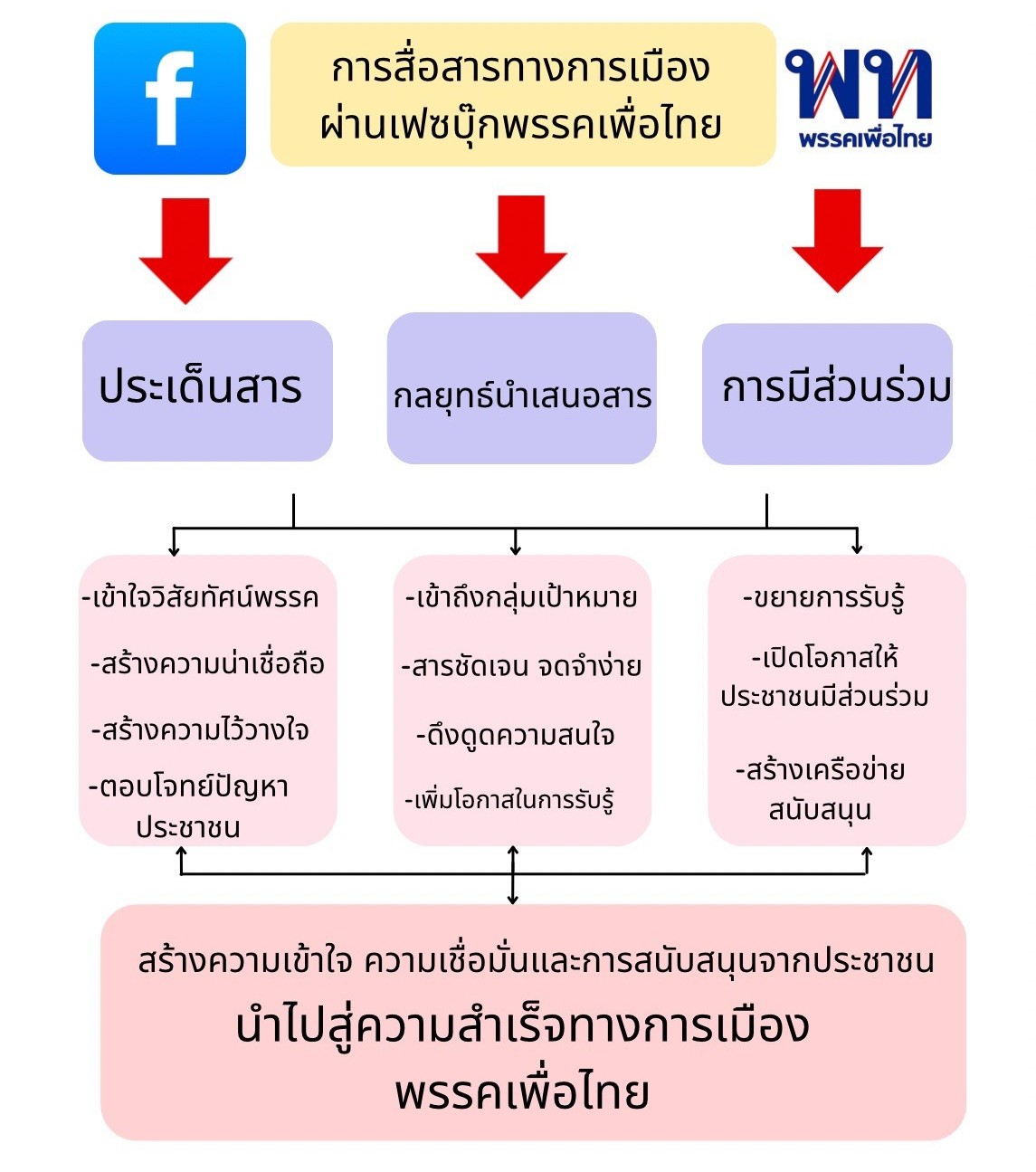
The objectives of this research were to 1) study political content on the Pheu Thai Party’s Facebook page; 2) strategies used to present political content on the Pheu Thai Party’s Facebook page; and 3) public participation in political communication on the Pheu Thai Party’s Facebook page. This research used the qualitative research method of in-depth interviews. The 12 key informants were chosen by purposive sampling from three groups of individuals who played key roles in the research topic: 1) Pheu Thai Party administrators 6 participants; 2) people involved with administering the Pheu Thai Party Facebook page 1 participants; and 3) committed fans of the Pheu Thai Party 5 participants. The data collection tool was a structured interview form. Data were analyzed by drawing conclusions.
The results showed that:
1. Political content on the Pheu Thai Party’s Facebook page consisted of (1) general information, such as the party’s policies, ideals, and values; the party leader’s past work results and results that reflect on his credibility; (2) content with intended results, such as content intended to build popularity, get an emotional response, incite fear and a sense of urgency, recruit forces, and comparatively lessen the popularity of the opponent parties.
2. Strategies used to present political content on the Pheu Thai Party’s Facebook page: (1) posting during the days and times when there are the most people viewing the page; (2) using formal and easy-to-understand language; (3) using photos, audio and short video clips that are eye-catching; (4) stimulating participation by asking questions and initiating activities; (5) making the content more credible by citing references from reputable sources and getting testimonies from well-known people or organizations.
3. There were 5 levels of public participation in political communication on the Pheu Thai Party’s Facebook page: (1) followers and viewers who sometimes liked posts; (2) viewers who shared posts and wrote comments; (3) creative participants who wrote or created original content, and posted photos, video clips or other stories about the party; (4) active participants who asked and answered questions on Facebook live streams; and (5) political supporters and movers who actively invited their friends and family members to support the party, and worked for unity and cooperation.
Article Details

This work is licensed under a Creative Commons Attribution-NonCommercial-NoDerivatives 4.0 International License.
เพื่อให้เป็นไปตามกฎหมายลิขสิทธิ์ ผู้นิพนธ์ทุกท่านต้องลงลายมือชื่อในแบบฟอร์มใบมอบลิขสิทธิ์บทความ ให้แก่วารสารฯ พร้อมกับบทความต้นฉบับที่ได้แก้ไขครั้งสุดท้าย นอกจากนี้ ผู้นิพนธ์ทุกท่านต้องยืนยันว่าบทความ ต้นฉบับที่ส่งมาตีพิมพ์นั้น ได้ส่งมาตีพิมพ์เฉพาะในวารสาร วิชาการธรรม ทรรศน์ เพียงแห่งเดียวเท่านั้น หากมีการใช้ ภาพหรือตารางของผู้นิพนธ์อื่นที่ปรากฏในสิ่งตีพิมพ์อื่นมาแล้ว ผู้นิพนธ์ต้องขออนุญาตเจ้าของลิขสิทธิ์ก่อน พร้อมทั้ง แสดงหนังสือที่ได้รับการยินยอมต่อบรรณาธิการ ก่อนที่บทความจะได้รับการตีพิมพ์References
กาญจนา แก้วเทพ. (2541). การวิเคราะห์สื่อ: แนวคิดและเทคนิค. กรุงเทพฯ: อินฟินิตี้.
_______. (2554). สื่อสารมวลชน: ทฤษฎีและแนวทางการศึกษา. (พิมพ์ครั้งที่ 3). กรุงเทพฯ: จุฬาลงกรณ์มหาวิทยาลัย.
พิชิต ทนงค์. (2550). การสื่อสารทางการเมืองกับการสร้างอัตลักษณ์ ประชาธิปไตยของเยาวชนในจังหวัดอุบลราชธานี. กรุงเทพฯ: มหาวิทยาลัยรามคำแหง.
อรทัย ก๊กผล. (2552). คู่คิด คู่มือ การมีส่วนร่วมของประชาชนสำหรับผู้บริหารท้องถิ่น. กรุงเทพฯ: จรัญสนิทวงศ์การพิมพ์.
Agee, W. K., Ault, P. H., & Emery, E. (1994). Introduction to Mass Communications. (11th ed.). New York: HarperCollins College Publishers.
Albarracin, D., & Shavitt, S. (2018). Attitudes and attitude change. Annual Review of Psychology, 69, 299-327. https://doi.org/10.1146/annurev-psych-122216-011911
Deutsch, K. W. (1966). The Nerves of Government: Models of Political Communication and Control. New York: Free Press.
Dommett, K., & Temple, L. (2018). Digital Campaigning: The Rise of Facebook and Satellite Campaigns. Parliamentary Affairs, 71(1), 189-202. https://doi.org/10.1093/pa/gsx056
Kotler, P., & Lee, N. (2008). Social marketing: Infuencing behaviors for good. (3rd ed.). SAGE Publications.
Metaxas, P. T., Mustafaraj, E., Wong, K., Zeng, L., O’Connor, B., & Gayo-Avello, D. (2011). What do retweets indicate? Results from user survey and meta-review of research. arXiv. https://arxiv.org/abs/1104.1142
Naaman, M., Boase, J., & Lai, C. -H. (2010). Is it really about me? Message content in social awareness streams. In Proceedings of the 2010 ACM Conference on Computer Supported Cooperative Work (CSCW) (pp. 189-192). ACM. https://doi.org/10.1145/1718918.1718953
WeVis. (2566). ส่องเพจพรรค โค้งสุดท้ายก่อน เลือกตั้ง 66. เข้าถึงได้จาก https://wevis.info/election-on-social-3/
