Grounded Theory Study of a School with Outstanding Sufficiency Economy Practices
Article Sidebar
Main Article Content
Abstract
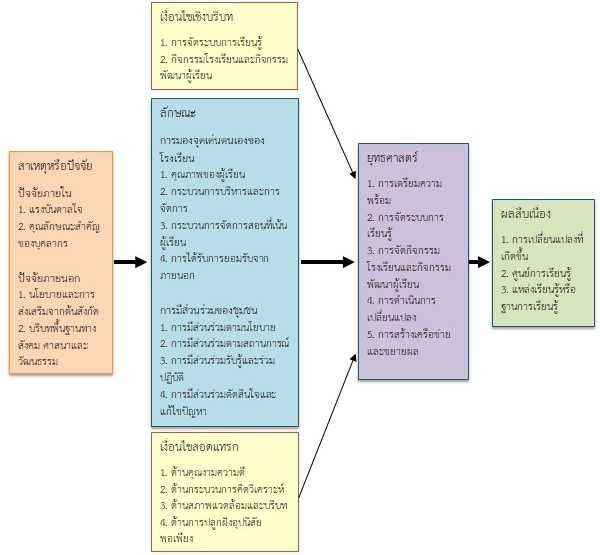
This research aims to: 1) Examine the characteristics and causal conditions of the core phenomenon related to the development of schools adhering to the principles of sufficiency economy that have been recognized for their excellence; 2) Investigate the strategies employed by these schools, which have earned them recognition as outstanding practitioners of the sufficiency economy, including specific contextual conditions and general intervening conditions affecting the choice of these strategies; and 3) Analyze the consequential outcomes resulting from the implementation of these strategies that illustrate the schools' excellence in applying the principles of sufficiency economy. This study employs a qualitative research approach, with a sample comprising 40 individuals involved in the phenomenon providing data through interviews. The instruments employed in this study consisted of open-ended questionnaires for conducting in-depth interviews and focus group discussions; observation checklists for both participant and non-participant observations; audio recording devices; and relevant official documents, while data analysis is conducted using constant comparative data analysis. This process involves comparing the new and the existing information categories and adopting an inductive approach to analyze indicators, codes, and categories throughout the research period to eliminate redundancy. Data analysis follows 3 stages: 1) Open Coding, 2) Axial Coding, and 3) Selective Coding, culminating in developing a logical paradigm or a visual representation of the generated theory.
The findings of the research indicate that:
1. The characteristics and causal conditions of the core phenomenon in sufficiency economy schools are rooted in the sufficiency economy principles.
2. Contextual and intervening conditions influence the strategic choices of sufficiency economy schools.
3. The consequences of employing these strategies include observable changes, the learning center establishment, and educational resources aligned with the sufficiency economy principles.
Article Details

This work is licensed under a Creative Commons Attribution-NonCommercial-NoDerivatives 4.0 International License.
เพื่อให้เป็นไปตามกฎหมายลิขสิทธิ์ ผู้นิพนธ์ทุกท่านต้องลงลายมือชื่อในแบบฟอร์มใบมอบลิขสิทธิ์บทความ ให้แก่วารสารฯ พร้อมกับบทความต้นฉบับที่ได้แก้ไขครั้งสุดท้าย นอกจากนี้ ผู้นิพนธ์ทุกท่านต้องยืนยันว่าบทความ ต้นฉบับที่ส่งมาตีพิมพ์นั้น ได้ส่งมาตีพิมพ์เฉพาะในวารสาร วิชาการธรรม ทรรศน์ เพียงแห่งเดียวเท่านั้น หากมีการใช้ ภาพหรือตารางของผู้นิพนธ์อื่นที่ปรากฏในสิ่งตีพิมพ์อื่นมาแล้ว ผู้นิพนธ์ต้องขออนุญาตเจ้าของลิขสิทธิ์ก่อน พร้อมทั้ง แสดงหนังสือที่ได้รับการยินยอมต่อบรรณาธิการ ก่อนที่บทความจะได้รับการตีพิมพ์References
กระทรวงศึกษาธิการ. (2561). ประกาศกระทรวงศึกษาธิการ เรื่อง หลักเกณฑ์และวิธีการพัฒนาสถานศึกษาแบบอย่างการจัดกิจกรรมการเรียนรู้ตามหลักปรัชญาของเศรษฐกิจพอเพียง “สถานศึกษาพอเพียง” พ.ศ. 2561. กรุงเทพฯ: กระทรวงศึกษาธิการ.
_______. (2563). แนวทางการขับเคลื่อนการพัฒนาสถานศึกษาแบบมีส่วนร่วมตามหลักปรัชญาของเศรษฐกิจพอเพียง. กรุงเทพฯ: สำนักเศรษฐกิจพอเพียงเพื่อการศึกษา.
_______. (2563). แผนยุทธศาสตร์กระทรวงศึกษาธิการ พ.ศ. 2563-2565. กรุงเทพฯ: สำนักงานปลัดกระทรวงศึกษาธิการ.
เกษมสันต์ สกุลรัตน์. (2560). การพัฒนารูปแบบศูนย์การเรียนรู้ชุมชนเสมือนภายใต้แนวคิดปรัชญาของเศรษฐกิจพอเพียงโดยใช้กรณีศึกษาเป็นฐานเพื่อเสริมสร้างความสามารถในการแก้ปัญหาของนิสิตปริญญาบัณฑิต. (วิทยานิพนธ์ครุศาสตรดุษฎีบัณฑิต). กรุงเทพฯ: จุฬาลงกรณ์มหาวิทยาลัย.
ปรียานุช ธรรมปิยา. (2560). การพัฒนาที่ยั่งยืนตามหลักปรัชญาของเศรษฐกิจพอเพียง. วารสารวิชาการมหาวิทยาลัยราชภัฏนครปฐม, 6(2), 15-28.
พระราชบัญญัติการศึกษาแห่งชาติ (ฉบับที่ 4) พ.ศ. 2562. (1 พฤษภาคม 2562). ราชกิจจานุเบกษา. เล่ม 136 ตอนที่ 57 ก.
สัมฤทธิ์ กางเพ็ง. (2562). การพัฒนาแหล่งเรียนรู้ตามหลักปรัชญาของเศรษฐกิจพอเพียงในโรงเรียนขยายโอกาส. วารสารวิจัยและพัฒนาการศึกษา, 14(1), 45-56.
สำนักงานคณะกรรมการกฤษฎีกา. (2560). รัฐธรรมนูญแห่งราชอาณาจักรไทย พุทธศักราช 2560. กรุงเทพฯ: สำนักนายกรัฐมนตรี.
สำนักงานคณะกรรมการการศึกษาขั้นพื้นฐาน. (2562). นโยบายสำนักงานคณะกรรมการการศึกษาขั้นพื้นฐาน ปีงบประมาณ พ.ศ. 2563. กรุงเทพฯ: ชุมนุมสหกรณ์การเกษตรแห่งประเทศไทย.
สำนักงานคณะกรรมการการศึกษาขั้นพื้นฐาน. (2563). นโยบายและจุดเน้นการดำเนินงาน สำนักงานคณะกรรมการการศึกษาขั้นพื้นฐาน ปีงบประมาณ พ.ศ. 2563. กรุงเทพฯ: สำนักงานคณะกรรมการการศึกษาขั้นพื้นฐาน.
สำนักงานคณะกรรมการพัฒนาการเศรษฐกิจและสังคมแห่งชาติ. (2560). แผนพัฒนาเศรษฐกิจและสังคมแห่งชาติ ฉบับที่ 12 (พ.ศ. 2560-2564). กรุงเทพฯ: สำนักนายกรัฐมนตรี.
สำนักงานเลขาธิการสภาการศึกษา. (2560). แผนการศึกษาแห่งชาติ พ.ศ. 2560-2579. เข้าถึงได้จาก https://bit.ly/3X7iORY
Avery, G. C., & Bergsteiner, H. (2016). Sustainable leadership: Honeybee and locust approaches. Routledge.
Creswell, J. W. (2008). Educational research: Planning, conducting, and evaluating quantitative and qualitative research. (3rd ed.). New Jersey: Merrill Prentice Hall.
Daft, R. L. (2017). Management. (13th ed.). Mason, OH: South-Western.
Griffin, R. W. (2017). Management. (12th ed.). Mason, OH: South-Western.
Locke, K. (2001). Grounded theory in management research. SAGE Publications.
Schermerhorn, J. R. (2016). Management. (12th ed.). Hobogen, NJ: John Wiley & Sons.
Schwandt, T. A. (2001). Dictionary of qualitative inquiry. (2nd ed.). Thousand Oaks, CA: Sage.
