The Development of Learning Management Competency focus on the Learner-Centered Approach by Using Five-step Proactive Supervision Technique to Reflect for the Professional Training of Student Teachers
Article Sidebar
Main Article Content
Abstract
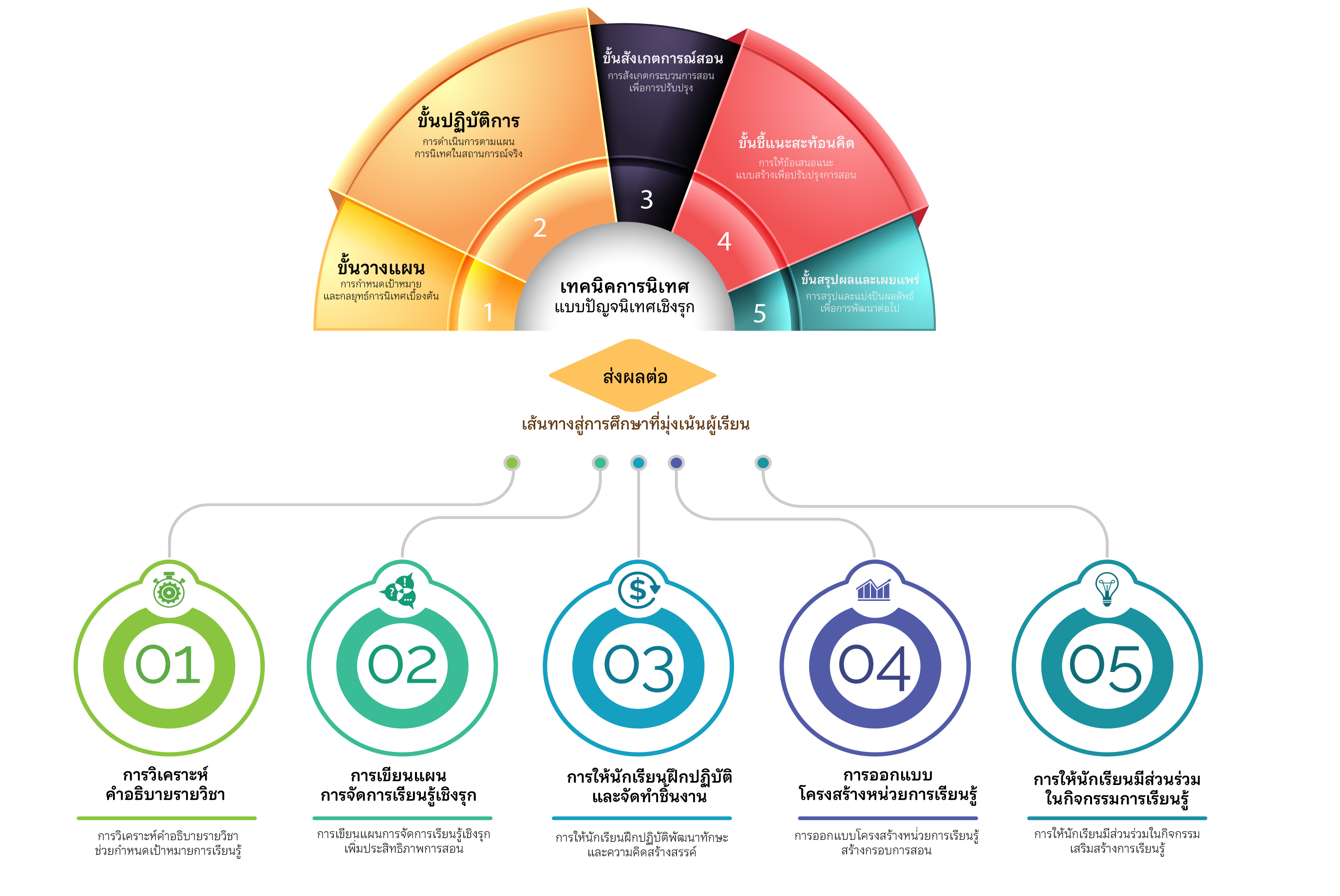
The purposes of this research were 1) develop competence in learning management that focuses on learners by using Five-step Proactive Supervision Technique to provide guidance and reflection for student teacher interns, with a passing criterion of 75 percent, and 2) study the satisfaction of students towards the process. The research instruments were the supervision plan, activity plan, competency assessment form, and satisfaction assessment form. The target group was 30 student teacher interns in the Diploma in Teaching program, using purposive selection. The statistics used were the mean, standard deviation, percentage, and effectiveness index.
The research found that:
1. The development of competence in learning management with the Five-step proactive supervision technique was 77.00 percent, passing the 75 percent criterion, for the normal supervision technique, it was 69.40 percent, not passing the criterion.
2. The assessment of competence in learning management that focused on learners by using Five-step proactive supervision technique was at the highest level ( = 4.52, S.D. = 0.40).
3. The index of effectiveness of using the technique was 0.7754, indicating a 77.54% increase in knowledge.
4. The satisfaction of students towards the development of competence using the Five-step proactive supervision technique was at the highest level ( = 4.79, S.D. = 0.34).
Article Details

This work is licensed under a Creative Commons Attribution-NonCommercial-NoDerivatives 4.0 International License.
เพื่อให้เป็นไปตามกฎหมายลิขสิทธิ์ ผู้นิพนธ์ทุกท่านต้องลงลายมือชื่อในแบบฟอร์มใบมอบลิขสิทธิ์บทความ ให้แก่วารสารฯ พร้อมกับบทความต้นฉบับที่ได้แก้ไขครั้งสุดท้าย นอกจากนี้ ผู้นิพนธ์ทุกท่านต้องยืนยันว่าบทความ ต้นฉบับที่ส่งมาตีพิมพ์นั้น ได้ส่งมาตีพิมพ์เฉพาะในวารสาร วิชาการธรรม ทรรศน์ เพียงแห่งเดียวเท่านั้น หากมีการใช้ ภาพหรือตารางของผู้นิพนธ์อื่นที่ปรากฏในสิ่งตีพิมพ์อื่นมาแล้ว ผู้นิพนธ์ต้องขออนุญาตเจ้าของลิขสิทธิ์ก่อน พร้อมทั้ง แสดงหนังสือที่ได้รับการยินยอมต่อบรรณาธิการ ก่อนที่บทความจะได้รับการตีพิมพ์References
กาญจนา ลินทรัตนศิริกุล. (2550). การวัดความรู้ ความคิดในประมวลสาระชุดวิชาการประเมินและการวิจัยเพื่อพัฒนาการเรียนการสอน หน่วยที่ 2. นนทบุรี: สาขาวิชาศึกษาศาสตร์ มหาวิทยาลัยสุโขทัยธรรมาธิราช.
ชนาธิป พรกุล. (2557). การสอนกระบวนการคิด. กรุงเทพฯ: จุฬาลงกรณ์มหาวิทยาลัย.
ไชยวัฒน์ ชุ่มนาเสียว และอธิศ ไชยคิรินทร์. (2565). เทคนิคการนิเทศเชิงรุกแบบปัญจนิเทศ. ขอนแก่น: คณะศึกษาศาสตร์ มหาวิทยาลัยภาคตะวันออกเฉียงเหนือ.
นัยนา ฉายวงศ์. (2561). การพัฒนารูปแบบการนิเทศตามแนวคิดการเรียนรู้แบบผสมผสานเพื่อเสริมสร้างความสามารถด้านการวิจัยในชั้นเรียนของครู สังกัดสำนักงานเขตพื้นที่การศึกษาประถมศึกษานครพนม เขต 1. (วิทยานิพนธ์ปรัชญาดุษฎีบัณฑิต). สกลนคร: มหาวิทยาลัยราชภัฏสกลนคร.
พิมพันธ์ เดชะคุปต์ และพเนาว์ ยินดีสุข. (2550). การจัดการเรียนรู้ในศตวรรษที่ 21. กรุงเทพฯ: จุฬาลงกรณ์มหาวิทยาลัย.
ไพฑูรย์ สินลารัตน์. (2561). การศึกษา 4.0 เป็นยิ่งกว่าการศึกษา. (พิมพ์ครั้งที่ 5). กรุงเทพฯ: จุฬาลงกรณ์มหาวิทยาลัย.
วาสนา บุญมาก. (2562). การพัฒนารูปแบบการนิเทศแบบบูรณาการเพื่อส่งเสริมสมรรถนะการจัดการเรียนรู้เชิงรุกของครู. (วิทยานิพนธ์ศึกษาดุษฎีบัณฑิต). พิษณุโลก: มหาวิทยาลัยนเรศวร.
สงัด อุทรานันท์. (2530). การนิเทศการศึกษา: หลักการทฤษฎีและปฏิบัติ (ฉบับปรับปรุงเพิ่มเติม). (พิมพ์ครั้งที่ 2). กรุงเทพฯ: มิตรสยาม.
สุดสาย ศรีศักดา, สุนีย์ เงินยวง, เกียรติสุดา ศรีสุข และน้ำผึ้ง อินทะเนตร. (2563). รูปแบบการนิเทศเพื่อส่งเสริมสมรรถนะด้านการวิจัยของครูอาชีวศึกษา. วารสารศึกษาศาสตร์ มหาวิทยาลัยนเรศวร, 22(1), 287-300. https://so06.tci-thaijo.org/index.php/edujournal_nu/article/view/98872/155940
เสาวนี สิริสุขศิลป์. (2564). ภาวะผู้นำทางการนิเทศการศึกษา. ขอนแก่น: มหาวิทยาลัยขอนแก่น.
Desimone, L. M., & Garet, M. S. (2015). Best practices in teachers’ professional development in the United States. Psychology, Society, & Education, 7(3), 252-263. https://doi.org/10.25115/psye.v7i3.515
Glickman, C. D., Gordon, S. P., & Ross-Gordon, J. M. (2009). The basic guide to supervision and instructional leadership. (2nd ed.). Boston: Peason.
Guskey, T. R. (2002). Professional development and teacher change. Teachers and Teaching, 8(3), 381-391. https://doi.org/10.1080/135406002100000512
Johns, C. (2010). Guided reflection: A narrative approach to advancing professional practice. (2nd ed.). Wiley Blackwell.
Kolb, D. A. (1984). Experiential learning: Experience as the source of learning and development. Prentice Hall.
Oliva, P. F., & Panlas, G. E. (2001). Supervision for Today’s Schools. (6th ed.). New York: John Wiley & Sons, Inc.
Schon, D. A. (1983). The reflective practitioner: How professionals think in action. Basic Books.
Vygotsky, L. S. (1978). Mind in society: The development of higher psychological processes (M. Cole, V. John-Steiner, S. Scribner, & E. Souberman, Eds. & Trans.). Harvard University Press.
