Motivation for Learning the Thai Language Program Among Chinese Students at Kunming University
Article Sidebar
Main Article Content
Abstract
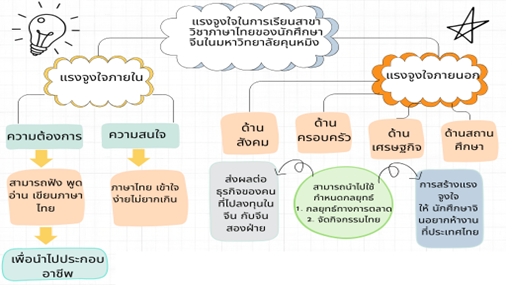
This research aims to 1) study the levels of internal, external, and overall motivation in learning the Thai language program among Chinese students at Kunming University and 2) examine the internal and external factors affecting their motivation. This study employs quantitative research methods, with the population comprising Chinese students at Kunming University. This study is quantitative research. The sample consisted of 140 Chinese undergraduate students who were enrolled in the Thai language program from years 1 to 4 at Kunming University. The research tool used is a questionnaire, developed based on relevant concepts, theories, and previous studies. The statistical methods employed include means, standard deviations, and multiple regression analysis.
The results revealed that:
1. The overall level of internal and external motivation is high.
2. Internal and external factors affecting the motivation of Chinese students to study the Thai language program at Kunming University. The internal factor with the strongest independent variable is personal needs, which is statistically significant at the 0.05 level with a predictive power of 61.8% (R² =0.618), followed by personal interest. Among external factors, economic factors are the strongest predictor, with a statistically significant impact at the 0.05 level and a predictive power of 66.0% (R² = 0.66), followed by family influence. However, educational institutions and social factors do not significantly predict motivation in learning the Thai language program among Chinese students at Kunming University.
Article Details

This work is licensed under a Creative Commons Attribution-NonCommercial-NoDerivatives 4.0 International License.
เพื่อให้เป็นไปตามกฎหมายลิขสิทธิ์ ผู้นิพนธ์ทุกท่านต้องลงลายมือชื่อในแบบฟอร์มใบมอบลิขสิทธิ์บทความ ให้แก่วารสารฯ พร้อมกับบทความต้นฉบับที่ได้แก้ไขครั้งสุดท้าย นอกจากนี้ ผู้นิพนธ์ทุกท่านต้องยืนยันว่าบทความ ต้นฉบับที่ส่งมาตีพิมพ์นั้น ได้ส่งมาตีพิมพ์เฉพาะในวารสาร วิชาการธรรม ทรรศน์ เพียงแห่งเดียวเท่านั้น หากมีการใช้ ภาพหรือตารางของผู้นิพนธ์อื่นที่ปรากฏในสิ่งตีพิมพ์อื่นมาแล้ว ผู้นิพนธ์ต้องขออนุญาตเจ้าของลิขสิทธิ์ก่อน พร้อมทั้ง แสดงหนังสือที่ได้รับการยินยอมต่อบรรณาธิการ ก่อนที่บทความจะได้รับการตีพิมพ์References
กนกพรรณ ธรรมสถิตสุข. (2565). ความคิดเห็นของนักศึกษาต่างชาติที่มีต่อหลักสูตรการสอนวิชาภาษาไทยพื้นฐาน: กรณีศึกษานักศึกษาชาวจีน มหาวิทยาลัยธุรกิจบัณฑิตย์. วารสารมนุษยศาสตร์วิชาการ มหาวิทยาลัยเกษตรศาสตร์, 29(1), 239-255. https://sso04.tci-thaijo.org//index.php/abc/article/download/236840/175369
กฤตติกา เศวตอมรกุล. (2564). ภาษาที่น่าสนใจแห่งยุคสมัย. เข้าถึงได้จาก https://www.tcjapress.com/2021/11/07/chinese-language-as-a-world-language/
ชวิศา พิศาลวัชรินทร์ และกษมา สุวรรณรักษ์. (2563). การศึกษาแรงจูงใจของผู้เรียนระดับมัธยมศึกษาตอนปลายในการเรียนภาษาอังกฤษที่โรงเรียนกวดวิชา. วารสารสุทธิปริทัศน์, 34(110), 90-102. https://so05.tcithaijo.org/index.php/DPUSuthiparithatJournal/article/view/243721
ปริลักษณ์ กลิ่นช้าง และสุภาภรณ์ สุวรรณโอภาส. (2559). แรงจูงใจและกลวิธีการเรียนรู้ภาษาเยอรมันของนักเรียนมัธยมศึกษาตอนปลายในภาคใต้ของไทย. วารสารวิชาการ คณะมนุษยศาสตร์และสังคมศาสตร์, 12(2), 35-70.
ภาณุเดช จริยฐิตินันท์. (2562). สภาพการเรียนการสอนภาษาจีนในประเทศไทย. เข้าถึงได้จาก http://www.brmpeo.moe.go.th/schoolmapping/Article-Detail/18
มหาวิทยาลัยคุนหมิง. (2566). ข้อมูลจำนวนนักศึกษาจีนระดับปริญญาตรีชั้นปีที่ 1-4. เข้าถึงได้จาก https://english.kmust.edu.cn/
ยิ่นเฟย เฉิน. (2562). สภาพการเรียนภาษาไทยของนักศึกษาชาวจีน สาขาวิชาภาษาไทย ระดับปริญญาตรีในมหาวิทยาลัย ณ มณฑลยูนนาน สาธารณรัฐประชาชนจีน. (วิทยานิพนธ์ศิลปศาสตรมหาบัณฑิต). กรุงเทพฯ: มหาวิทยาลัยศรีนครินทรวิโรฒ.
วัชรพล วิบูลยศริน. (2556). นวัตกรรมและการเรียนการสอนภาษาไทย. กรุงเทพฯ: จุฬาลงกรณ์มหาวิทยาลัย.
วิทวัส เหล่ามะลอ. (2562). ปัจจัยที่มีผลต่อการตัดสินใจเข้าศึกษาต่อระดับปริญญาตรีของนักศึกษามหาวิทยาลัยขอนแก่น ประจำปีการศึกษา 2562 โดยผ่านการคัดเลือกด้วยระบบ TCAS. (รายงานการวิจัย). ขอนแก่น: มหาวิทยาลัยขอนแก่น.
วิโรจน์ กองแก้ว. (2564). ปัญหาการใช้ภาษาไทยของนักศึกษาจีนที่เรียนภาษาไทยเป็นวิชาเอกมหาวิทยาลัยเกษตรศาสตร์ยูนนาน สาธารณรัฐประชาชนจีน. วารสารมนุษยศาสตร์และสังคมศาสตร์ มหาวิทยาลัยราชภัฏบ้านสมเด็จเจ้าพระยา, 15(2), 147-170. https://so08.tcithaijo.org/index.php/jhusocbru/article/view/506
ศยามล ศรสุวรรณศร. (2562). ปัจจัยที่มีผลต่อแรงจูงใจในการเลือกเรียนภาษาเกาหลีระดับมัธยมศึกษา และระดับมหาวิทยาลัยในเขตภาคเหนือตอนบนของประเทศไทย. Chiang Mai University Journal of Humanities, 21(3), 152-176. https://cmudc.library.cmu.ac.th/frontend/Info/item/dc:165413
ศุภิกา นิรัติศัย. (2561). ทัศนคติ แรงจูงใจ และพฤติกรรมการเรียนภาษาอังกฤษของนักศึกษามหาวิทยาลัยราชภัฏภูเก็ต. วารสารมนุษยศาสตร์และสังคมศาสตร์, 9(2), 138-170. https://so02.tci-thaijo.org/index.php/human_ubu/article/view/187135
สถานกงสุลใหญ่ ณ นครคุนหมิง. (2565). สถานกงสุลใหญ่ ณ นครคุนหมิง. เข้าถึงได้จาก https://kunming.thaiembassy.org/
สุมนทิพย์ วัฒนา. (2561). การศึกษาแรงจูงใจและกลยุทธ์การเรียนรู้ภาษาไทยในฐานะภาษาต่างประเทศของนักศึกษาปริญญาตรีชาวจีนในมหาวิทยาลัยวิจัยไทย. (วิทยานิพนธ์ศึกษาศาสตรมหาบัณฑิต). นครปฐม: มหาวิทยาลัยมหิดล.
อรุณโรจน์ สอนเถื่อน. (2562). แรงจูงใจในการเลือกเรียนภาษาไทยของนักศึกษาชาวจีน. กรุงเทพฯ: มหาวิทยาลัยศิลปากร.
Huang, X. (2024). Motivation for choosing to study Thai among Chinese learners. Procedia of Multidisciplinary Research, 10(2), 1-10. https://so09.tci-thaijo.org/index.php/PMR/article/view/5285/3261
O’Brien, R. M. (2007). A caution regarding rules of thumb for variance inflation factors. Quality & Quantity, 41(5), 673-690. https://doi.org/10.1007/s11135-006-9018-6
Pedhazur, E. J. (1997). Multiple regression in behavioral research: Explanation and prediction. (3rd ed.). New York, NY: Holt, Rinehart & Winston.
Spaulding, W. B. (1992). The relationship between organizational commitment and job performance: A meta-analysis. Academy of Management Journal, 35(5), 1081-1102.
Yang, L. (2017). ปัจจัยที่มีอิทธิพลต่อนักศึกษาจีนในการเลือกศึกษาต่อในมหาวิทยาลัยราชภัฏเชียงใหม่. (วิทยานิพนธ์บริหารธุรกิจมหาบัณฑิต). เชียงใหม่: มหาวิทยาลัยราชภัฏเชียงใหม่.
Yu, Z., & Visuttakul, C. (2568). การศึกษาแรงจูงใจและกลวิธีการเรียนรู้ของนักศึกษาชาวจีนระดับปริญญาตรี สาขาวิชาภาษาไทยในฐานะภาษาต่างประเทศ: กรณีศึกษา มหาวิทยาลัยแห่งหนึ่ง มณฑลยูนนาน ประเทศจีน. วารสารศรีล้านช้างปริทรรศน์, 11(1), 118-130. https://so06.tci-thaijo.org/index.php/jslc/article/download/286794/190290
