
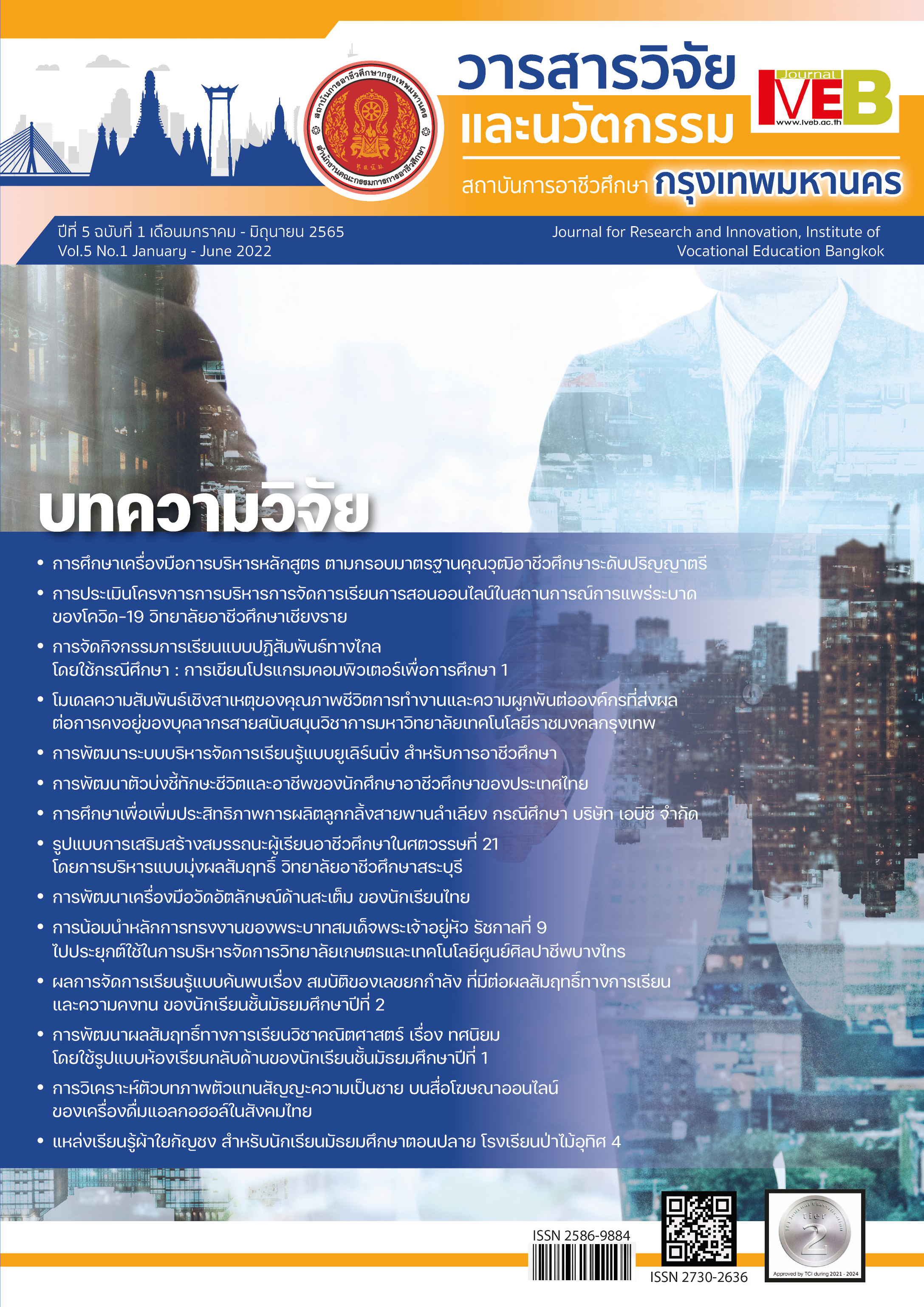
โมเดลความสัมพันธ์เชิงสาเหตุของคุณภาพชีวิตการทำงานและความผูกพันต่อองค์กรที่ส่งผลต่อการคงอยู่ของบุคลากรสายสนับสนุนวิชาการมหาวิทยาลัยเทคโนโลยีราชมงคลกรุงเทพ A Causal Relationship Model of Quality of Work Life and Organizational Commitment Affecting the Employee Retention of Supporting Staffs of Rajamangala University of Technology Krungthep
Article Sidebar
Main Article Content
บทคัดย่อ
การวิจัยนี้มีวัตถุประสงค์ 1) เพื่อพัฒนาโมเดลความสัมพันธ์เชิงสาเหตุของคุณภาพชีวิตการทำงานและความผูกพันต่อองค์กรที่ส่งผลต่อการคงอยู่ของบุคลากรสายสนับสนุนวิชาการมหาวิทยาลัยเทคโนโลยีราชมงคลกรุงเทพ และ 2) เพื่อตรวจสอบความสอดคล้องของโมเดลที่พัฒนาขึ้นกับข้อมูลเชิงประจักษ์ กลุ่มตัวอย่าง คือ บุคลากรสายสนับสนุนวิชาการ จำนวน 260 คน โดยใช้วิธีการสุ่มอย่างง่าย ดำเนินการเก็บข้อมูลโดยใช้แบบสอบถามออนไลน์ด้วย Google Form และวิเคราะห์โมเดลความสัมพันธ์เชิงสาเหตุ ผลการวิจัย พบว่า 1) โมเดลความสัมพันธ์เชิงสาเหตุของคุณภาพชีวิตการทำงานและความผูกพันต่อองค์กรที่ส่งผลต่อการคงอยู่ของบุคลากรสายสนับสนุนวิชาการมหาวิทยาลัยเทคโนโลยีราชมงคลกรุงเทพตามสมมติฐานนั้นมีความสอดคล้องกับข้อมูลเชิงประจักษ์ พิจารณาจากค่าสถิติไค-สแควร์ เท่ากับ 45.15 ค่า df เท่ากับ 40 ค่า p-value เท่ากับ .25 ดัชนี GFI เท่ากับ .99 ดัชนี AGFI เท่ากับ .98 ค่า SRMR เท่ากับ .01 ค่า RMSEA เท่ากับ .02 และ 2) คุณภาพชีวิตการทำงานมีอิทธิพลทางตรง และทางอ้อมเชิงบวกต่อการคงอยู่ของบุคลากรสายสนับสนุนวิชาการ โดยมีตัวแปรความผูกพันต่อองค์กรเป็นตัวแปรส่งผ่าน และความผูกพันต่อองค์กรมีอิทธิพลทางตรงเชิงบวกต่อการคงอยู่ของบุคลากรสายสนับสนุนวิชาการ ตัวแปรทั้งหมดในโมเดลสามารถอธิบายความแปรปรวนของส่งผลต่อการคงอยู่ของบุคลากรสายสนับสนุนวิชาการมหาวิทยาลัยเทคโนโลยีราชมงคลกรุงเทพ ได้ร้อยละ 78
Article Details

อนุญาตภายใต้เงื่อนไข Creative Commons Attribution-NonCommercial-NoDerivatives 4.0 International License.
เอกสารอ้างอิง
ผ่านความผูกพันในอาชีพของอาจารย์สถาบันอุดมศึกษาในกำกับของรัฐแห่งหนึ่ง. e-jodil.stou.ac.th, 6(1), 114-132.
[2] Taunton, R. L., Krampitz, S. D., & Woods, C. Q. (1989). Manager impact on retention of staff part 1. Journal
of Nursing Administration, 19(3), 14-19.
[3] Mehta, M., Kurbetti, A., & Dhankhar, R. (2014). Review paper–study on employee retention and
commitment. International journal of advance research in computer science and management
studies, 2(2), 154-164.
[4] Imna, M., & Hassan, Z. (2015). Influence of human resource management practices on employee
retention in Maldives retail industry. International Journal of Accounting, Business and Management, 1(1),
1-28.
[5] Allen, N. and Meyer, J. (1990). The measurement and antecedents of affective, continuance, and
Normative commitment to the organization. The Journal of Occupational Psychology, 63 (1), 1-18.
[6] Tesfaye, A. (2017). The relationship between job satisfaction & organizational commitment: Job
satisfaction factor, factor that affect organizational commitment and organizational structure. USA: Lap
lambert Academic Publishing.
[7] Sow, M., Anthony, P., & Berete, M. (2016). Normative organizational commitment and its effects on
employee retention. Business and Economic Research, 6(1), 137-147.
[8] Fukofuka, S. (2014). Factors that predict employee retention in profit and not-for-profit organizations.
Global Journal of Human Resource Management, 2(4), 1-8.
[9] Bhatnagar, J. (2007). Talent management strategy of employee engagement in Indian ITES employees:
key to retention. Employee Relations, 29(6), 640-663.
[10] Huang. T.C., Lawler, J. and Lei, C.Y. (2007). The Effects of Quality of Work Life on Commitment and
Turnover Intention. Social Behavior and Personality, 35(6), 735-750.
[11] Law, D. W. (2005). Interactive organizational commitment and hardiness in public accountants' turnover.
Managerial Auditing Journal, 4 (20), 383 - 393.
[12] ปิยกนิฏฐ์ โชติวินิช อัยรดา พรเจริญ นลินี ทองประเสริฐ กิตติมา จึงสุวดี ประนอม คำผาและอโณทัย หาระสาร. (2563).
อิทธิพลของคุณภาพชีวิตการทำงาน ความพึงพอใจในการทำงาน ความผูกพันต่อองค์การที่ส่งผลต่อการคงอยู่ของพนักงาน
ห้องจัดแสดงรถยนต์และศูนย์บริการรถยนต์ในภาคตะวันออกเฉียงเหนือ. วารสารนักบริหาร 40(2), 81-94.
[13] พรธิรักษ์ รุ่งวรีไพศาล. (2562). แบบจำลองสมการโครงสร้างปัจจัยที่มีอิทธิพลต่อการคงอยู่ในองค์การของพนักงานสำนัก
งานสอบบัญชีที่ได้รับความเห็นชอบจากสำนักงานคณะกรรมการกำกับหลักทรัพย์ และตลาดหลักทรัพย์แห่งประเทศไทย
(กล.ต.). วารสารวิทยาการจัดการ มหาวิทยาลัยราชภัฏนครปฐม, 6(1), 168-182.
[14] อุดมพร ไทยเกิด และสุมาลี รามนัฏ. (2562). อิทธิพลคั่นกลางของความผูกพันในงานที่ทำหน้าที่ถ่ายโอน. วารสาร
มนุษยศาสตร์และสังคมศาสตร์ มหาวิทยาลัยเอเชียอาคเนย์, 3(1), 39-49.
[15] พิมพ์ชนก จักรานุกุล ดวงธิดา นันทาภิรัตน์ ศิริณญา เพชรจันทร์ และ ณฐอร วรมงคลชัย. (2560). อิทธิพลของความผูกพัน
ต่อองค์กรและคุณภาพการทำงานที่มีต่อการธำรงรักษาพนักงานโรงแรม ระดับ 5 ดาว ในเขตกรุงเทพมหานคร. วารสาร BU
Academic Review, 16(2), 128-144.
[16] Walton, R. E. (1973). Quality of working life: what is it. Sloan management review, 15(1), 11-21.
Yusoff, Y. M., Rimi, N. N., & Meng, C. H. (2015). A study of quality of work life, organizational commitment
and turnover intention. Problems and Perspectives in Management, 13(2), 357-364.
[17] Kandasamy, I., & Ancheri, S. (2009). Hotel employees’ expectations of quality of work: A qualitative
study. International Journal of Hospitality Management, 28, 328-337.
[18] Kodikal, R., & Rahman, H. U. (2016). Influence of quality of work life on organizational commitment
amongst employees in manufacturing sector. International Journal in Multidisciplinary and Academic
Research, 5(5), 1-30
[19] Farid, S., Meshik, X., Choi, M., Mukherjee, S., Lan, Y., Parikh, D., ... & Stroscio, M. A. (2015). Detection of
Interferon gamma using graphene and aptamer based FET-like electrochemical biosensor. Biosensors
and Bioelectronics, 71, 294-299.
[20] Tamini, L. D. (2011). A nonparametric analysis of the impact of agri-environmental advisory activities on
best management practice adoption: A case study of Quebec. Ecological economics, 70(7), 1363-1374.
[21] Daud, N. (2010). Investigating the relationship between quality of work life and organizational
commitment amongst employees in Malaysian firms. International Journal of Business and Management,
5(10), 75-82.
[22] ณัฐพงศ์ ยิ่งรักพันธ์ และ ชัยฤกษ์ แก้วพรหมมาลย์. (2563). อิทธิพลของการรับรู้ความสามารถของตนเองและคุณภาพชีวิต
การทำงานที่ส่งผลต่อความผูกพันต่อองค์กรของกองพันทหารปืนใหญ่ต่อสู้อากาศยานที่ 6 กรมทหารปืนใหญ่ต่อสู่อากาศยาน
ที่ 1. วารสารสมาคมนักวิจัย สาขามนุษย์ศาสตร์และสังคมศาสตร์, 25(3), 178-192.
[23] สกุลทิพย์ อินทร์พิทักษ์ และฐิติมา ไชยกุล. (2563) การรับรู้ความยุติธรรและคุณภาพชีวิตการทำงานที่มีผลต่อความผูกพัน
ต่อองค์การของพนักงาน กรณีศึกษาอุตสาหกรรมผลิตรถจักรยานยนต์ กรุงเทพมหานครและปริมณฑล. วารสารวิทยาลัย
บัณฑิตศึกษาการจัดการ มข., 13(2), 25-46.
[24] Deery, M., & Jago, L. (2015). Revisiting talent management, work-life balance and retention strategies.
International Journal of Contemporary Hospitality Management, 27(3), 453-472.
[25] Gurudatt, K., & Gazal, Y. (2015). Role of quality of work life on employee retention in private sector
companies. International Journal of Engineering and Management Sciences, 6(1), 11-15.
[27] Edmonds, W. A, & Kennedy, T. D, (2017). An applied guide to research designs: Quantitative,
qualitative, and mixed methods. London: Sage.
[26] Hong, E. N. C., Hao, L. Z., Kumar, R., Ramendran, C., & Kadiresan, V. (2012). An effectiveness of human
resource management practices on employee retention in institute of higher learning: A regression
analysis. International Journal of Business Research and Management, 3(2), 60-79.
[28] Madden, T. J. & Dillon, W. R. (1982). Causal analysis and latent class models: An application to a
communication hierarchy of effects model. Journal of Marketing Research, 19, 472-490.
[29] ศิริพงษ์ สุนทรวัฒนกิจ. (2554). ปัจจัยที่จะส่งผลต่อการรักษาพนักงานให้คงอยู่กับองค์กร “ศึกษาเฉพาะกรณีพนักงานใน
ธุรกิจ Wedding Studio ในเขตกรุงเทพ. วิทยานิพนธ์: บริหารธุรกิจมหาบัณฑิต สาขาการบริหารทรัพยากรมนุษย์และ
องค์กร, บัณฑิตวิทยาลัย มหาวิทยาลัยธรรมศาสตร์: กรุงเทพ.
[30] พูลพงศ์ สุขสว่าง. (2560). โมเดลสมการโครงสร้าง. สำนักพิมพ์วัฒนาพานิชจำกัด กรุงเทพฯ
[31] Schumacker, R. E. & Lomax, R. G. 2016. A beginner’s guide to structural equation modeling. 4th ed.
New York: Taylor & Francis.
