
ในโลกที่ให้ค่ากับคาร์บอน วิถีเลี้ยงสัตว์และการปลดแอกจากภูมิอากาศในเคนยา
Article Sidebar
Main Article Content
บทคัดย่อ
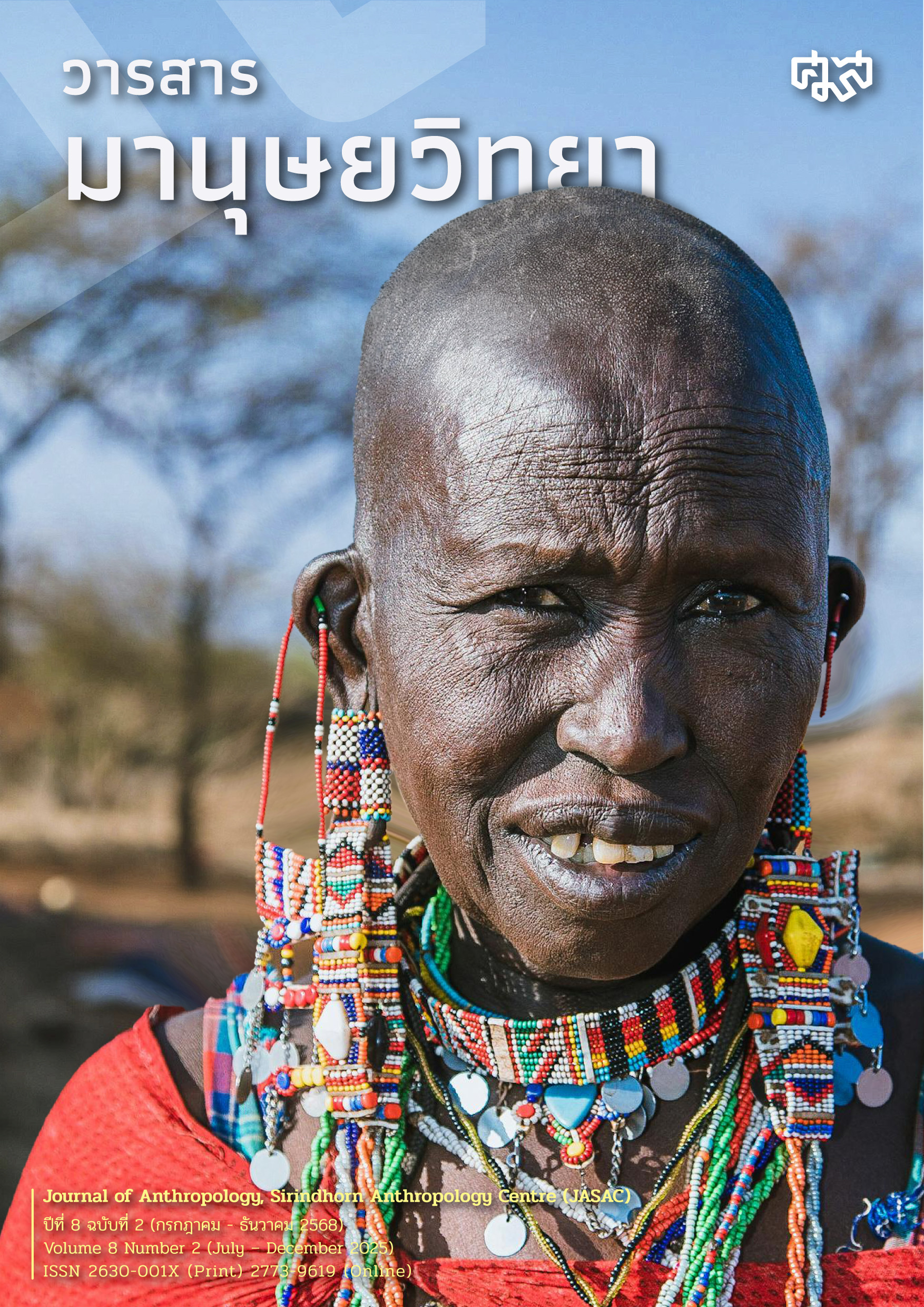
บทความนี้เสนอแนวคิดเรื่อง “การปลดแอกจากภูมิอากาศ” ผ่านกรอบนิเวศวิทยาหลังอาณานิคม โดยสร้างการถกเถียงเชิงวิชาการกับวาทกรรมภูมิอากาศกระแสหลักที่มุ่งลดการเลี้ยงสัตว์และการบริโภคเนื้อทั่วโลกในฐานะมาตรการลดคาร์บอน โดยไม่คำนึงถึงความแตกต่างทางวัฒนธรรม ภูมิศาสตร์ และประวัติศาสตร์ โดยใช้กรณีศึกษาจากชุมชนเลี้ยงสัตว์ในเคนยา ข้อมูลจากการทบทวนวรรณกรรมและภาคสนามในช่วง พ.ศ. 2565–2567 แสดงให้เห็นว่าระบบปศุสัตว์เร่ร่อนเป็นกลไกปรับตัวต่อภัยแล้ง อัตลักษณ์ทางวัฒนธรรม และญาณวิทยาท้องถิ่น บทความท้าทายแนวคิดสากลที่ลดทอนปศุสัตว์เหลือเพียง “แหล่งคาร์บอน” และชี้ว่าวาทกรรมเช่นนี้สืบทอดโครงสร้างอาณานิคมในการจัดการที่ดินและสิ่งแวดล้อม พร้อมเสนอให้ยอมรับเสียงและความรู้ของผู้หญิงและชุมชนท้องถิ่นในฐานะผู้ร่วมออกแบบอนาคตด้านสิ่งแวดล้อมอย่างเท่าเทียม
Article Details

อนุญาตภายใต้เงื่อนไข Creative Commons Attribution-NonCommercial-NoDerivatives 4.0 International License.
ลิขสิทธิ์@ของวารสารมานุษยวิทยา
ศูนย์มานุษยวิทยาสิรินธร (องค์การมหาชน), กรุงเทพฯ, ประเทศไทย
ข้อมูลเพิ่มเติม:
https://creativecommons.org/licenses/by-nc-nd/4.0/
เอกสารอ้างอิง
Humanitarians. (2023). The role of livestock in Kenyan pastoralist
communities. https://www.100humanitarians.org
Agyeman-Boaten, A., Fumey, M. A., & Norman, S. K. (2022). Agriculture and economic
transformation in Africa: A review of linkages and policies. African Journal of Economic Policy, 29(1), 43–62.
Amatsimbi, H. M. (2024). The Swynnerton Plan: Lessons from Kenya’s colonial
agricultural policy. African Social Science and Humanities Journal, 5(3), 241–249. https://dx.doi.org/10.4314/asshj.v5i3.4
Ajwang, B., Otieno, F. O., & Okello, J. (2020). Colonial agricultural policy and its impact in Kenya.
African Social Science and Humanities Journal, 1(1), 5–6.
Ajwang, B., Otieno, F. O., & Okello, J. (2020). Colonial agricultural policy and its impact in Kenya.
African Social Science and Humanities Journal, 1(1), 5–6.
Benjaminsen, T. A., Goldman, M. J., Minwary, M. Y., & Maganga, F. P. (2013). Wildlife management
in Tanzania: State control, rent seeking and community resistance. Development and Change, 44(5), 1087–1109. https://doi.org/10.1111/dech.12055
Branch, D. (2011). Kenya: Between hope and despair, 1963–2011. Yale University Press.
Büscher, B., & Ramutsindela, M. (2023). Conservation coloniality: The new colonialism of
conservation. Journal of Political Ecology, 30(1), 1–17.
Cheeseman, N. (2008). The Kenyan elections of 2007: An introduction. Journal of Eastern African
Studies, 2(2), 166–184. https://doi.org/10.1080/17531050802058401
Cronk, L. (1999). That Complex Whole: Culture and the Evolution of Human Behavior. Westview
Press.
Dempsey, J, (2022). Conservation and capital in Kenya, The Architectural Reviews.
https://www.architectural-review.com/essays/conservation-and-capital-in-kenya
Devereux, S. (2022). Food security and agricultural policy in postcolonial Africa. African Affairs,
(484), 123–145.
Elkins, C. (2005). Imperial reckoning: The untold story of Britain’s gulag in Kenya. New York: Henry
Holt.
FAO. (2006). Livestock’s long shadow: Environmental issues and options. Food and Agriculture
Organization of the United Nations.
Fratkin, E. (1991). Surviving Drought and Development: Ariaal Pastoralists of Northern Kenya.
Westview Press.
Gandhi, L. (2015). The common cause: Postcolonial ethics and the practice of democracy.
University of Chicago Press.
Gwala, M., Mkhize, M., & Hadebe, S. (2022). Gendered vulnerabilities and adaptation to climate
change in African pastoralist communities. Climate and Development, 14(3), 205–217.
Hickey, S., & Bukenya, B. (Eds.). (2016). The politics of inclusive development: Interrogating the
evidence. Oxford University Press.
Hodgson, D. L. (2011). Being Maasai, becoming Indigenous: Postcolonial politics in a neoliberal
world. Bloomington: Indiana University Press.
Hodgson, D. L. (2001). Once Intrepid Warriors: Gender, Ethnicity, and the Cultural Politics of
Maasai Development. Indiana University Press.
Kariuki, J., & Little, P. D. (2023). Gender dynamics in climate adaptation: Evidence from East African
pastoralism. Pastoralism, 13(1), 12–29.
Kenya Colony and Protectorate. (1954). African land development in Kenya: Report of the
Swynnerton Committee. Government Printer.
Kenya National Bureau of Statistics. (2020). 2019 Kenya population and housing census: Analytical
report on poverty. https://www.knbs.or.ke
Kenya Colony and Protectorate. (1949). Annual report of the Department of Agriculture: North
Nyanza District. Nairobi: Government Printer.
Kenya Colony and Protectorate. (1954). African land development in Kenya: Report of the
Swynnerton Committee. Nairobi: Government Printer.
Kenya Colony and Protectorate. (1955). Annual report of the Department of Agriculture. Nairobi:
Government Printer.
Kungu, J., Chacha, M., & Gichobi, M. (2022). Agricultural resistance and reform in colonial
Kenya. African Social Science and Humanities Journal, 1(2), 35–39.
King, W. R., & He, J. (2006). Understanding the role and methods of meta-analysis in IS
research. Communications of the Association for Information Systems, 16, Article 32. https://doi.org/10.17705/1CAIS.01632
Leal F, W., Ogugu, N., Adelake, L., Azeiteiro, U., & Azul, A. (2021). Indigenous communities,
climate change and traditional knowledge in Africa. International Journal of Climate Change Strategies and Management, 13(2), 140–157.
Llewelyn-Davies, M. (Director). (1974). Maasai Women [Film]. Royal Anthropological Institute.
Mokku, J. (2023). Drought, death, and displacement in Kenya’s north. Africa
Renewal. https://www.un.org/africarenewal
Murunga, G. R. (2022). The Swynnerton Plan: Lessons from Kenya’s colonial agricultural
development. African Social Science and Humanities Journal, 1(1), 1–20.
Neumann, R. P. (1998). Imposing wilderness: Struggles over livelihood and nature preservation in
Africa. University of California Press.
North Nyanza District. (1949). District agricultural annual report. Nairobi: Government Printer.
Nyanchoga, S. A., & Lilechi, J. (2020). The evolution of agricultural policy in colonial Kenya. African
Social Science and Humanities Journal, 1(1), 18–20.
Nixon, R. (2011). Slow violence and the environmentalism of the poor. Harvard University Press.
Odhiambo, M. O., Arora, A., Atela, J., Onyango, P., & Kyari, F. (2020). Towards inclusive agricultural
transformation in Kenya: Insights from the political economy of the maize and cotton value chains. ACTS Press.
Oloo, A. (2020). The legacy of settler agriculture in Kenya. African Social Science and Humanities
Journal, 1(1), 3–4.
Ogot, B. A. (1995). Ethnicity, nationalism and democracy in Africa. Maseno University College.
Ojeda, D. (2023). Charismatic conservation and green colonialism in Laikipia, Kenya. Journal of
Environment and Planning E: Nature and Space, 6(1), 55–74.
Paré, G., Trudel, M.-C., Jaana, M., & Kitsiou, S. (2015). Synthesizing information systems knowledge:
A typology of literature reviews. Information & Management, 52(2), 183–199. https://doi.org/10.1016/j.im.2014.08.008
Poore, J., & Nemecek, T. (2018). Reducing food’s environmental impacts through producers and
consumers. Science, 360(6392), 987–992.
Republic of Kenya. (2021). Economic survey 2021. Kenya National Bureau of Statistics.
Southworld. (2023). Cattle, climate, and culture: The lives of Kenyan pastoralists. https://www.southworld.net
Republic of Kenya. (2021a). Ministry of Agriculture, Livestock, Fisheries and Cooperatives:
Agricultural Policy, Nairobi: Government Printer.
Spencer, P. (1988). The Maasai of Matapato: A Study of Rituals of Rebellion. Manchester
University Press.
Wachira, G. M. (2023). Fortress conservation and the displacement of Indigenous pastoralists in
Kenya. Journal of African Studies, 45(2), 89–108.
World Bank. (2019). Unbundling the slack in private sector investment. Transforming agriculture
sector productivity and linkages to poverty reduction. A Kenya Economic Update Report. Washington DC.
World Bank. (2023). Kenya Overview. https://www.worldbank.org/en/country/kenya/overview.
UNDP. (2023). Indigenous peoples and climate action: Empowering local leadership and
knowledge. United Nations Development Programme. https://www.undp.org
UNESCO. (2021). Local and Indigenous knowledge systems: Protecting knowledge for resilience
and sustainability. United Nations Educational, Scientific and Cultural Organization. https://www.unesco.org
