BUDDHISM AND POLITICAL SCIENCE
Keywords:
Buddhism, Political Science, GovernmentAbstract
This academic journal studies about the relation between Buddhist and political science that Buddhist, Thai culture, being Thai or identity of Thai nation in the part of society and politics which one is the foundation of Thai society. The lifestyle of Thai people, their concept, their mind, and their activities since they were born until died, has had relationship with Buddhist. Also, the kings of Thailand have been bringing the dharma principle of Buddhist to administrate the reign to be the honest reign. Thai citizens also bring this principle in ways of the practice of their life, the moral in their occupations, living with one another and helping each other, so this is the principle of administration of our nation. Every king of Thailand has been bringing this principle to administrate the country and gather the Thais moral because Buddhist educates Thai people to love, to harmonize and to have mercy with each other, this is the foundation of Thai society. Therefore, the administration of country to be peacef ully and civilized, the chief, the leaders and the citizens must have virtues and morality. This is the science of Buddhist and political science that bring them together for learning how to manage and administrate the country, we know as political science in the way of Buddhist from tenfold virtues of the ruler (Dasavidha-rajadhamma) or ten virtues of practice that the kings have been bringing to be the principle or the virtue of administer to administrate the country to be honest, to make the good things happen to all citizens and to make them have the happiness. In actually, it is not only the kings or the administer, but also the people who are the chiefs in organizations should learn to use these virtues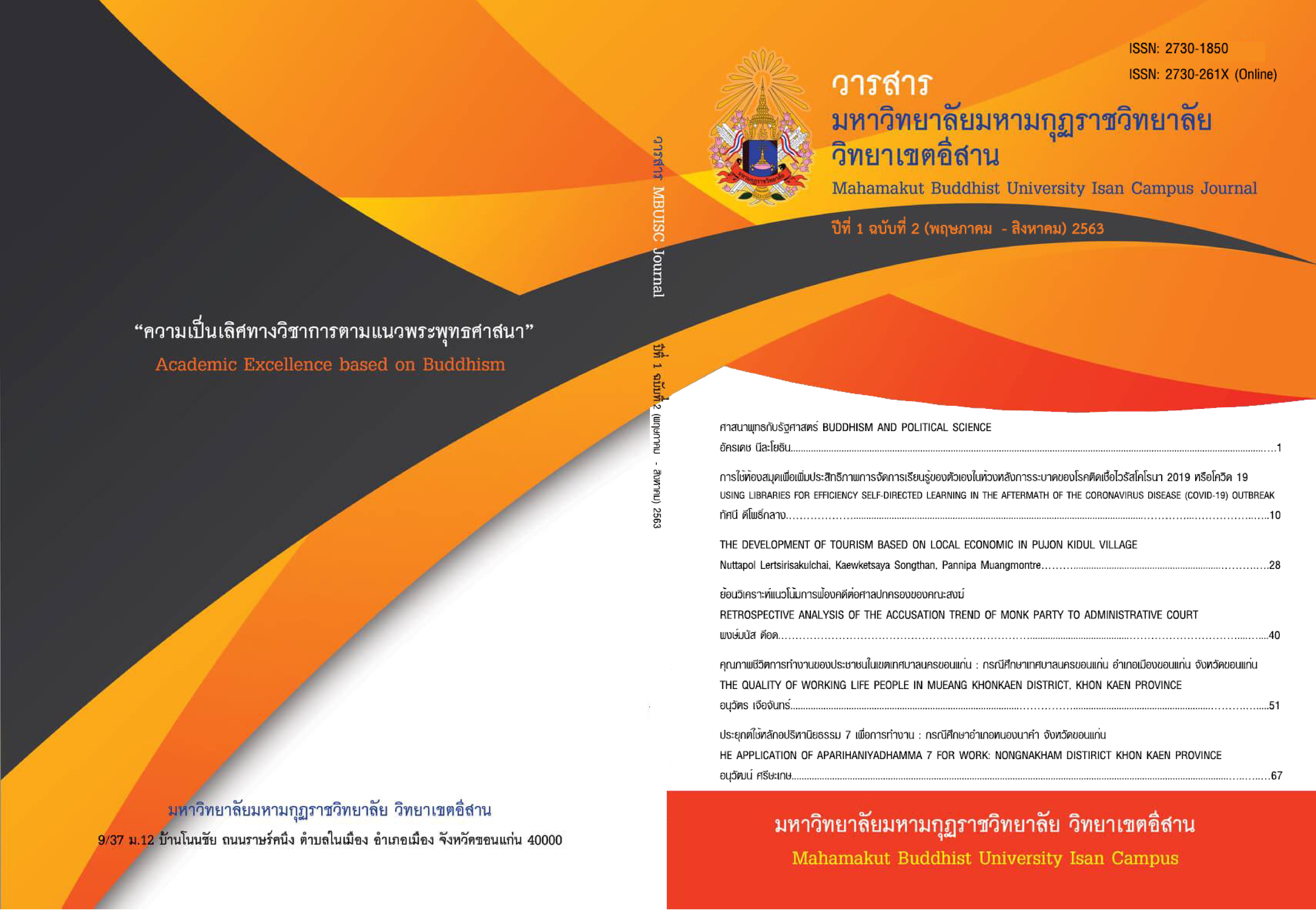
Downloads
Published
2020-08-31
How to Cite
Neelayothin, A. (2020). BUDDHISM AND POLITICAL SCIENCE. Mahamakut Buddhist University Isan Campus Journal, 1(2), 1–9. retrieved from https://so06.tci-thaijo.org/index.php/jmi/article/view/274647
Issue
Section
Articles
License

This work is licensed under a Creative Commons Attribution-NonCommercial-NoDerivatives 4.0 International License.
The Mahamakut Buddhist University Isan Campus Journal is licensed under a Creative Commons Attribution-NonCommercial-NoDerivatives 4.0 International (CC BY-NC-ND 4.0), unless otherwise specified. For more information about open access, copyright, and permissions, please refer to our policy page.