
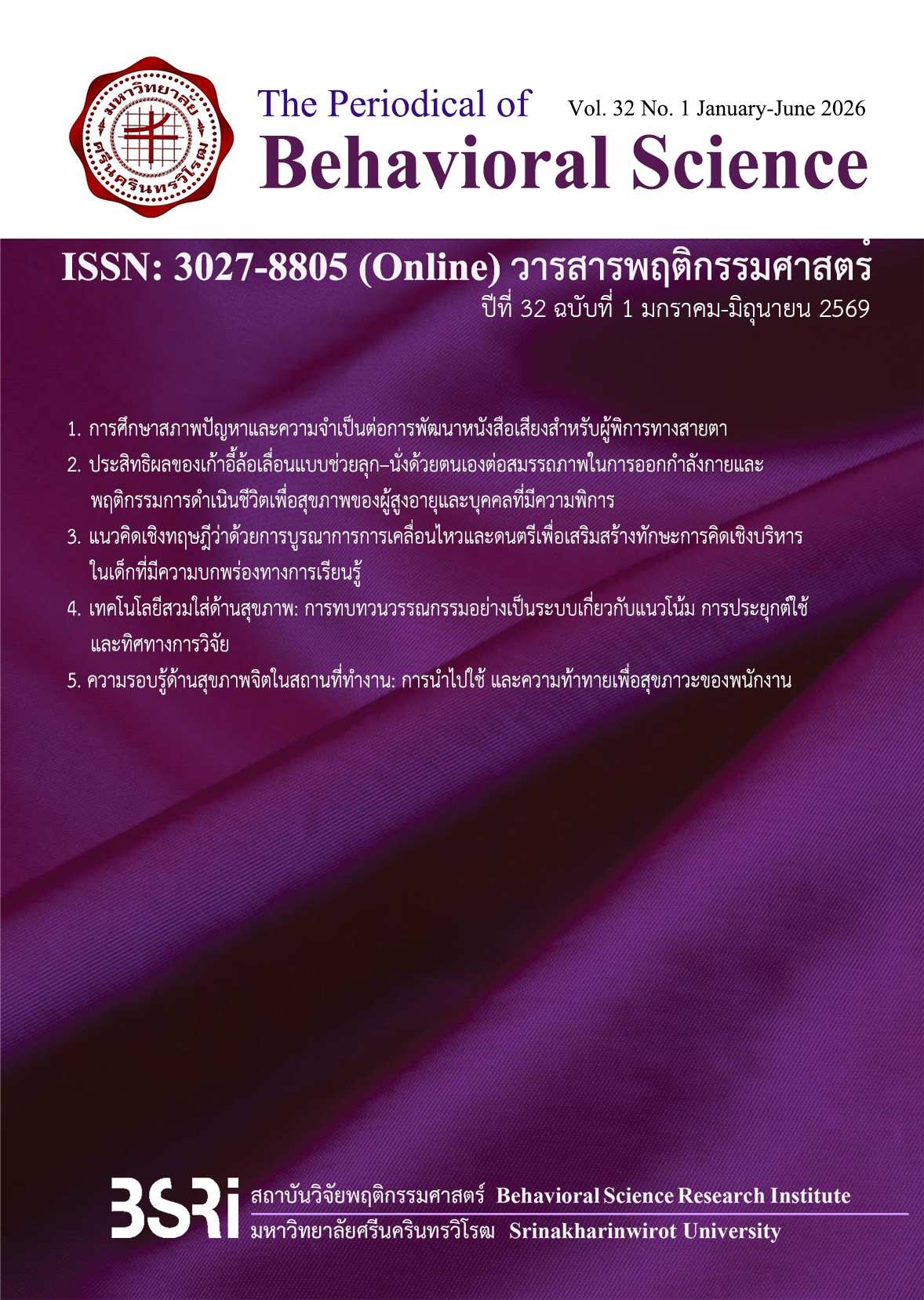
Theoretical Perspectives on the Integration of Movement and Music for Enhancing Executive Functions in Children with Learning Difficulties
Keywords:
Movement–Music Integration, Executive Functions, Children with Learning DifficultiesAbstract
This study aims to develop a theoretical framework integrating movement and music to explain the mechanisms underlying the development of executive functions (EF) in children with learning difficulties. Specifically, it analyzes the interactive influences of physical movement and musical elements in stimulating prefrontal cortex functioning and proposes practical implications for designing intervention programs. A qualitative research design combined with a theoretical synthesis approach was employed, consisting of three phases: (1) systematic review and thematic synthesis of interdisciplinary literature in cognitive psychology, neuroscience, special education, and music to construct an integrative conceptual framework; (2) analysis of mechanisms of influence using evidence from neurocognitive and experimental studies; and (3) derivation of practical implications through the development of conceptual prototypes and expert validation. The findings highlight the synergistic roles of embodied cognition and music therapy: movement provides a physical scaffold for sequencing and self-regulation, while music contributes temporal structure and emotional motivation. Three key mechanisms were identified—rhythmic entrainment, motor–cognitive coupling, and emotional regulation through music—all of which collectively stimulate prefrontal activation associated with EF. The study concludes that integrating movement and music offers a robust theoretical foundation with high potential for EF enhancement in children with learning difficulties. It is recommended that the model be applied to the design of educational and therapeutic interventions to promote learning, adaptability, and sustainable quality of life.
Downloads
References
Ahokas, R. (2015). Music therapy interventions and executive functions. Nordic Journal of Music Therapy, 24(3), 234–251. https://doi.org/10.1080/08098131.2014.987003
Barsalou, L. W. (2008). Grounded cognition. Annual Review of Psychology, 59, 617–645. https://doi.org/10.1146/annurev.psych.59.103006.093639
Best, J. R., & Miller, P. H. (2010). A developmental perspective on executive function. Child Development, 81(6), 1641–1660. https://doi.org/10.1111/j.1467-8624.2010.01499.x
Dackermann, T., Fischer, K., Kliegl, M. K., & Hasselhorn, M. (2020). The effects of physical activity interventions on children’s executive functions: A meta-analysis. Psychological Research, 84(6), 1373–1392. https://doi.org/10.1007/s00426-019-01182-8
Daniel, R. (2019). Music therapy techniques for enhancing cognitive and emotional functioning in children with learning disabilities. Canadian Music Therapy Press.
Diamond, A. (2013). Executive functions. Annual Review of Psychology, 64, 135–168. https://doi.org/10.1146/annurev-psych-113011-143750
Glenberg, A. M. (2010). Embodiment as a unifying perspective for psychology. Wiley Interdisciplinary Reviews: Cognitive Science, 1(4), 586–596. https://doi.org/10.1002/wcs.55
Gooding, L. (2014). Music therapy and executive function. Music Therapy Perspectives, 32(2), 129–137. https://doi.org/10.1093/mtp/miu022
Gooding, L. (2014). Music therapy interventions for executive function training. Journal of Music Therapy, 51(2), 168–193. https://doi.org/10.1093/jmt/thu003
Kirk, S. A., Gallagher, J. J., & Coleman, M. R. (2006). Educating exceptional children (11th ed.). Houghton Mifflin.
Meltzer, L. (2018). Executive function in education: From theory to practice. Guilford Press.
Moreno, S., Bialystok, E., Barac, R., Schellenberg, E. G., Cepeda, N. J., & Chau, T. (2011). Short-term music training enhances verbal intelligence and executive function. Psychological Science, 22(11), 1425–1433. https://doi.org/10.1177/0956797611416999
Thaut, M. H., & Hoemberg, V. (2014). Handbook of neurologic music therapy. Oxford University Press.
Wilson, M. (2002). Six views of embodied cognition. Psychonomic Bulletin & Review, 9(4), 625–636. https://doi.org/10.3758/BF03196322
World Federation of Music Therapy. (2011). What is music therapy? Retrieved from https://www.wfmt.info
Zuk, J., Benjamin, C., Kenyon, A., & Gaab, N. (2014). Behavioral and neural correlates of executive functioning in musicians and non-musicians. PLoS ONE, 9(6), e99868. https://doi.org/10.1371/journal.pone.0099868
Zuk, J., Benjamin, C., Kenyon, A., & Gaab, N. (2021). Behavioral and neural correlates of executive functioning in musicians and non-musicians. PLoS ONE, 16(4), e0249546. https://doi.org/10.1371/journal.pone.0249546
Zuk, J., Benjamin, C., Kenyon, A., & Gaab, N. (2021). Neuroplasticity in children engaged in music training: Evidence from MRI and EEG. Developmental Cognitive Neuroscience, 47, 100894. https://doi.org/10.1016/j.dcn.2020.100894
Downloads
Published
How to Cite
Issue
Section
License
Copyright (c) 2026 The Periodical of Behavioral Science

This work is licensed under a Creative Commons Attribution-NonCommercial-NoDerivatives 4.0 International License.
Behavioral Science Research Institute, SWU
114 Sukhumvit 23, Bangkok 10110, Thailand.
Tel.02-649-5000 # 17600


