
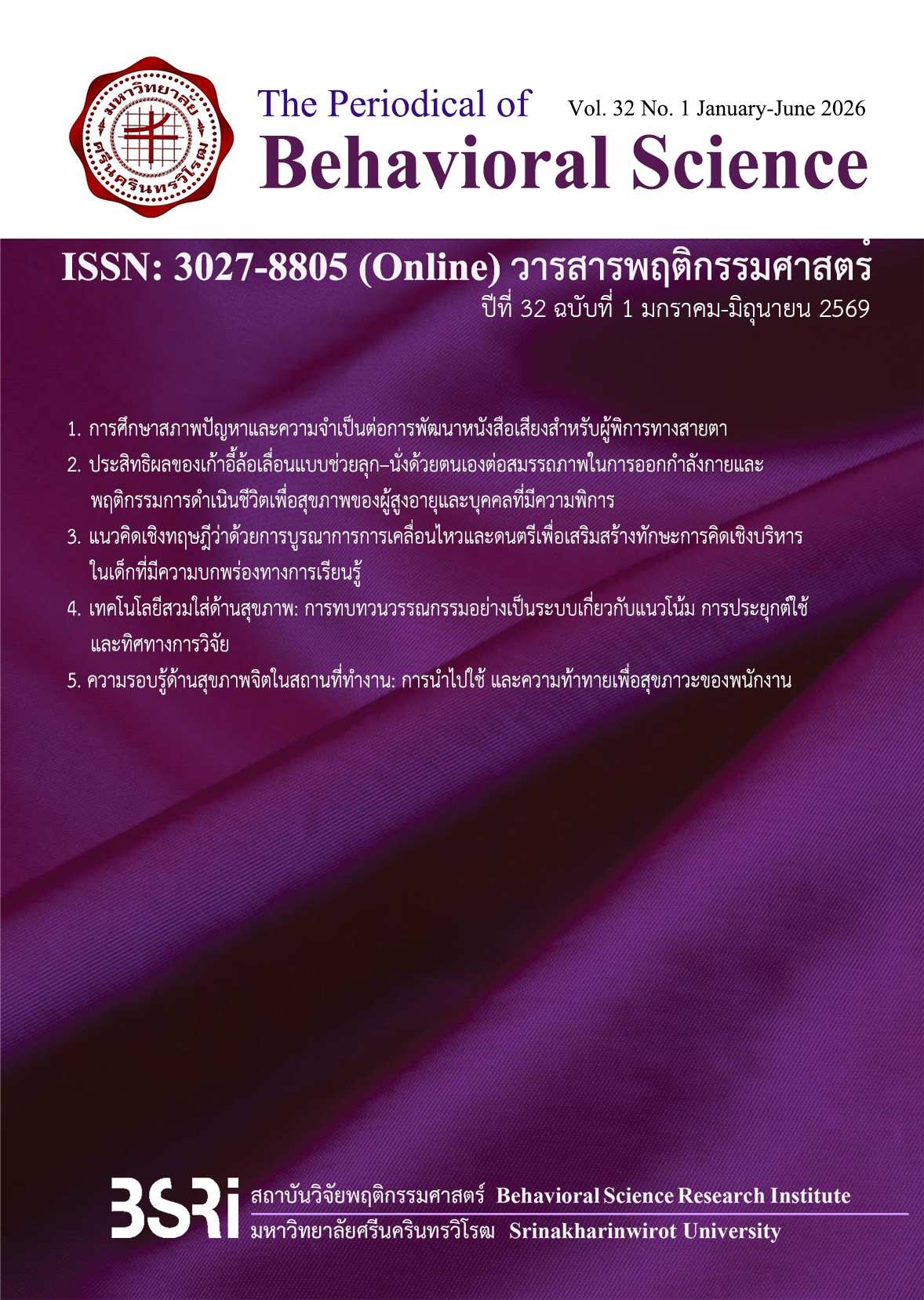
A Study of Problems and Needs Assessment for Developing Audiobooks for Visually Impaired Persons
Keywords:
Audiobooks, Visually impaired persons, Needs assessmentAbstract
Audiobooks are media that help promote educational opportunities and learning for visually impaired persons. However, visually impaired persons in Thailand still face problems in accessing these media in terms of quality, content, and supporting technology. This research aimed to study these problems and assess the priority needs for developing audiobooks to promote life skills for visually impaired persons. The sample comprised 1,080 visually impaired persons and 20 experts, selected through purposive sampling, with expert data collected through focus group discussions. The research instrument was a 42-item questionnaire with an Item-Objective Congruence (IOC) index of 0.84 and a reliability coefficient of 0.82. Data were analyzed using frequency, percentage, mean, standard deviation, modified Priority Needs Index (PNI modified), and content analysis. The research findings revealed that most participants had used audiobooks (67.5%). The major problems identified included unclear audio quality (27.2%), lack of descriptive narration for important details (25.8%), and content not aligning with users’ needs (18.1%). The participants had the highest level of expectations toward audiobooks, particularly regarding the naturalness of narration voices, accessibility via mobile phones, and the promotion of mental health. The results of the priority needs assessment showed that audio characteristics had the highest priority need (PNI modified = 0.49), followed by content types (PNI modified = 0.43) and needs for audio media usage (PNI modified = 0.36). The experts suggested developing audiobooks with clear audio quality, support for a variety of digital devices, and compliance with DAISY standards in order to promote effective and sustainable access to information for visually impaired persons.
Downloads
References
Barnes, C., & Mercer, G. (2010). Exploring disability. Polity Press.
Center for Applied Special Technology. (2018). Universal design for learning guidelines version 2.2. https://udlguidelines.cast.org/static/udlg2.2-text-a11y.pdf
Cochran, W. G. (1977). Sampling techniques (3rd ed.). John Wiley & Sons.
Connell, B. R., Jones, M., Mace, R., Mueller, J., Mullick, A., Ostroff, E., Sanford, J., Steinfeld, E., Story, M., & Vanderheiden, G. (1997, April 1). The principles of universal design (Version 2.0). The Center for Universal Design, North Carolina State University. https://design.ncsu.edu/research/center-for-universal-design/
Creswell, J. W., & Plano Clark, V. L. (2018). Designing and conducting mixed methods research (3rd ed.). Sage Publications.
Department of Empowerment of Persons with Disabilities. (2026). Statistical report on the registration of persons with disabilities in Thailand: February 2026. Ministry of Social Development and Human Security. https://efiling.dep.go.th/stat/2569/stat_Feb69.pdf [in Thai]
Faul, F., Erdfelder, E., Buchner, A., & Lang, A.-G. (2009). Statistical power analyses using G*Power 3.1: Tests for correlation and regression analyses. Behavior Research Methods, 41(4), 1149–1160. https://doi.org/10.3758/BRM.41.4.1149
Groenveld, M. (1993). Effects of visual disability on behaviour and the family. In A. R. Fielder, A. B. Best, & M. C. O. Bax (Eds.), The management of visual impairment in childhood (pp. 64–77). Mac Keith Press.
Gunn, D. (2023, May 25). DAISY Consortium Showcase 2023. The DAISY Consortium. https://daisy.org/news-events/articles/daisy-consortium-showcase-2023/
Kerscher, G., & Fruchterman, J. (2002). The soundproof book: Exploration of rights conflict and access to commercial ebooks for people with disabilities. First Monday, 7(6). https://doi.org/10.5210/fm.v7i6.959
Lazar, J., Goldstein, D., & Taylor, A. (2015). Ensuring digital accessibility through process and policy. Morgan Kaufmann.
Manager Online. (2024, April 8). Book fair generates 400 million baht, attracts 1.3 million visitors; Thais read two hours a day, and boys' love novels are bestsellers [News article]. https://mgronline.com/business/detail/9670000030927 [in Thai]
National Council on Aging. (2024, May 1). Understanding older adults with vision loss and how to help. https://www.ncoa.org/article/understanding-older-adults-with-vision-loss-and-how-to-help/
Oliver, M. (2013). The social model of disability: Thirty years on. Disability & Society, 28(7), 1024–
https://doi.org/10.1080/09687599.2013.818773
Padberg-Schmitt, B. (2020). Increasing reading fluency in young adult readers using audiobooks. CLELEjournal, 8(1), 31–51. https://clelejournal.org/article-2-increasing-reading-fluency/
Redpath, A. (2024, July 18). Top audiobook production tips for authors. Spines. https://spines.com/top-audiobook-production-tips-for-authors/
Shakespeare, T. (2013). Disability rights and wrongs revisited (2nd ed.). Routledge. https://doi.org/10.4324/9781315887456
Tan, X., Qin, T., Soong, F., & Liu, T. Y. (2021). A survey on neural speech synthesis. Cornell University https://doi.org/10.48550/arXiv.2106.15561
Vicente-Yagüe Jara, M. I., García Guirao, P., Jiménez-Pérez, E. P., & López Martínez, O. (2023). Editorial:
Reading and writing skills: Cognitive, emotional, creative, and digital approaches. Frontiers in
Psychology, 14, 1279276. https://doi.org/10.3389/fpsyg.2023.1279276
Wolf, M. (2019). Reader, come home: The reading brain in a digital world. HarperCollins.
World Health Organization. (2019). World report on vision. https://www.who.int/publications/i/item/world-report-on-vision
World Health Organization. (2022). Global report on assistive technology. https://www.who.int/publications/i/item/9789240049451
Zafar, S., Asif, M., Ahmad, M. B., Ghazal, T. M., Faiz, T., Ahmad, M., & Khan, M. A. (2022). Assistive devices analysis for visually impaired persons: A review on taxonomy. Institute of Electrical and Electronics Engineers, 10, 13354–13366. https://doi.org/10.1109/ACCESS.2022.3146728
Downloads
Published
How to Cite
Issue
Section
License
Copyright (c) 2026 The Periodical of Behavioral Science

This work is licensed under a Creative Commons Attribution-NonCommercial-NoDerivatives 4.0 International License.
Behavioral Science Research Institute, SWU
114 Sukhumvit 23, Bangkok 10110, Thailand.
Tel.02-649-5000 # 17600


