
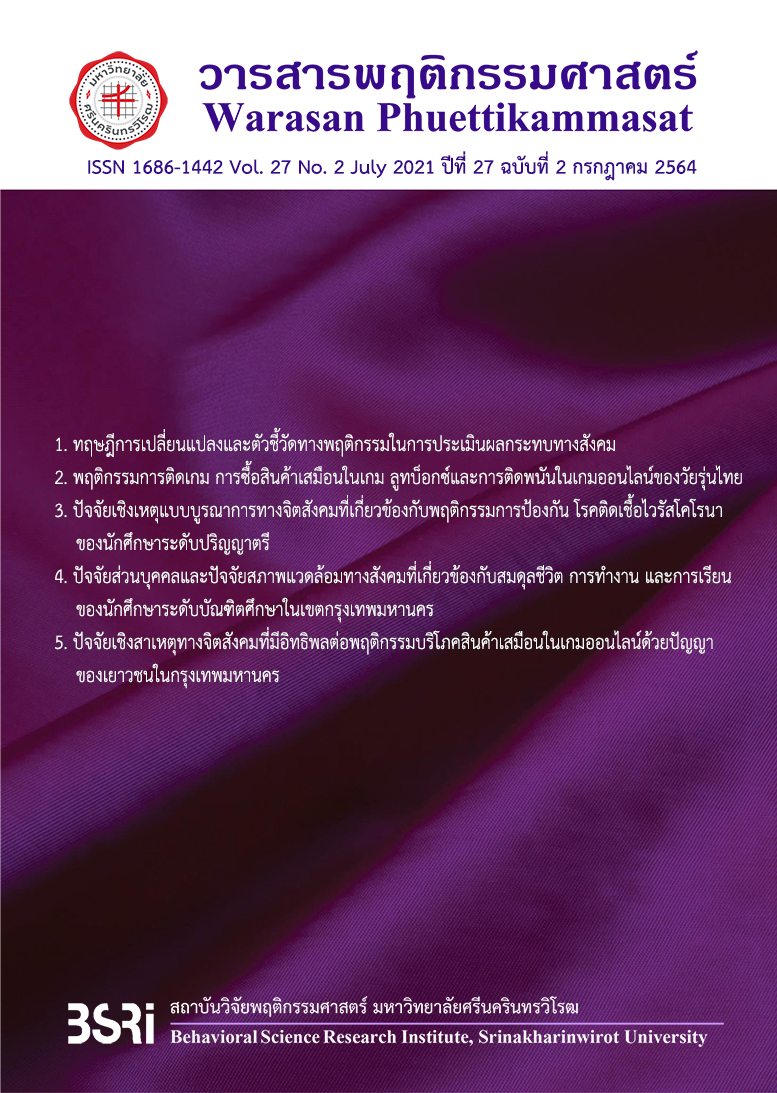
ปัจจัยเชิงสาเหตุทางจิตสังคมที่มีอิทธิพลต่อพฤติกรรมบริโภคสินค้าเสมือนในเกมออนไลน์ด้วยปัญญาของเยาวชนในกรุงเทพมหานคร
คำสำคัญ:
พฤติกรรมบริโภคด้วยปัญญา, สินค้าเสมือน, เกมออนไลน์บทคัดย่อ
เกมออนไลน์เป็นธุรกิจบริการเพื่อความบันเทิงและยังมีสินค้าเสมือนให้ผู้เล่นซื้อ การบริโภคสินค้าเสมือนในเกมออนไลน์ด้วยปัญญาจะช่วยให้เยาวชนไม่เบียดเบียนตนเองและผู้อื่น การศึกษานี้มีวัตถุประสงค์เพื่อศึกษารูปแบบความสัมพันธ์ของแบบจำลองความสัมพันธ์ปัจจัยเชิงสาเหตุทางจิตสังคมต่อพฤติกรรมบริโภคสินค้าเสมือนในเกมออนไลน์ด้วยปัญญา โดยกลุ่มตัวอย่างเป็นเยาวชนในกรุงเทพฯ ที่มีการบริโภคสินค้าเสมือนในเกมออนไลน์ด้วยเงินจริง จำนวน 452 คน ทำการสุ่มกลุ่มตัวอย่างแบบหลายขั้นตอน เก็บข้อมูลโดยใช้แบบสอบถาม ตรวจสอบคุณภาพด้วยการวิเคราะห์องค์ประกอบเชิงยืนยัน มีค่าความเชื่อมั่นเชิงโครงสร้างอยู่ระหว่าง 0.78 - 0.95 ผลการวิเคราะห์แบบจำลองความสัมพันธ์โครงสร้างเชิงเส้น พบว่า แบบจำลองมีความกลมกลืนกับข้อมูลเชิงประจักษ์ = 267.77, df = 85, p < .001, RMSEA = 0.069, SRMR = 0.058, CFI = 0.094, GFI = 0.935, NFI = 0.923 และ /df = 3.105 จากผลแสดงให้เห็นว่าควรสร้างแนวทางสำหรับการส่งเสริมให้เยาวชนมีเจตคติต่อการบริโภคสินค้าเสมือนในเกมออนไลน์ควบคู่กับการรู้เท่าทันเกมออนไลน์ การคิดแบบรู้คุณค่าแท้ และลักษณะมุ่งอนาคตควบคุมตน และให้รู้จักหลีกเลี่ยงเพื่อนที่เป็นแบบอย่างที่ไม่ดีในการเล่นเกมออนไลน์ รวมทั้งส่งเสริมให้ผู้ปกครองรู้วิธีในการควบคุมการเล่นเกมอย่างเหมาะสม
Downloads
เอกสารอ้างอิง
Allport, G. W. (1935). Attitudes. In Handbook of Social Psychology. Clark University Press.
Bandura, A. (1997). Self – Efficacy: The Exercise of Control. W. H. Freeman and Company.
Boonyasana, P., & Punnarong, S. (2011). Kān wikhro̜ phrưttikam kānchai čhāi ngœ̄n khō̜ng dek læ yaowachon thī tit kēm: Kō̜ranī sưksā yaowachon nai phư̄nthī čhangwat Chīang Mai læ lamphūn [An analysis of payaying behavior for game playing in game addicted child and youth groups: A case study of child and youth groups in Chiang Mai and Lamphun provinces]. Journal of Humanities and Social Sciences, 3(5), 51-62.
Charoenwanit, S. (2012). Phrưttikam kān tit kēm: Phonkrathop læ kān pō̜ngkan [Game addiction behaviors: Impacts and preventions]. Thai Science and Technology Journal, 22(6), 871-879.
ChooChom, O., Tanachanan, S., & Thongpukdee, T. (2009). Patčhai chœ̄ng hēt læ phon khō̜ng phūmkhumkan thāng čhit khō̜ng yaowachon [Antecedents and consequences of youths’ psychological immunity]. Warasarn Phuettikammasat, 18(2), 1-15.
Christ, W. G., & Potter, W. J. (1998). Media Literacy, Media Education and the Academy. Journal of Communication, 48(1), 5-15.
Intasuwan, P., Parkbongkoch, C., Satrathpat, D., Vanindananda, N., Soadmanee, O., Bhookang, S., & Srijindarat, U. (2005). kānwičhai læ phatthanā phrưttikam kān bō̜riphōk dūai panyā khō̜ng yaowachon [Research and development of youths’ appropriate consumption behavior]. Journal of Srinakharinwirot University, 1(1), 11-27.
Kaewkangwan, S. (2010). Chittawitthayā phatthanākān chīwit thuk chūang wai Phim khrang thī kao [Developmental Psychology of Life at all Ages (9th ed.)]. Thammasat Printing house.
Kline, R. B. (2005). Methodology in the Social Sciences: Principles and Practice of Structural Equation Modeling (2nd ed.). Guilford Press.
Lehdonvirta, V. (2009). Virtual item sales as a revenue model: Identifying attributes that drive purchase decisions. Electronic Commerce Research, 9(1), 97-113.
Lehtiniemi, T. (2008). Macroeconomic indicators in a virtual economy [Unpublished master’s thesis]. University of Helsinki.
Lianyang, T., Pimthong, S., & Peungposop, N. (2018). Kānsưksā klum sīang læ patčhai pokpō̜ng phrưttikam kān len kēm ʻō̜nlai yāng mo̜som khō̜ng nakrīan chan matthayommasưksā tō̜n ton [A study of the ai-risk groups and factors to protect the pro online gaming behaviors of lower secondary school students]. Panyapiwat Journal, 10(2), 165-175.
Majumdar, R. (2010). Consumer Behaviour: Insights from Indian Market. PHI Learning.
Marketeer Team. (2015, October 12). GAME ONLINE khrai tœ̄m ngœ̄n khon nan thēp [GAME ONLINE Whoever pay, that Person is Cool]. Metketeer. https://marketeeronline.co/archives/26431
Marlithong, P., & Hirunchalothorn, P. (2014). Phon khō̜ng kānčhat kitčhakam tām nǣokhit yōnisōmanasikān bǣp rūkhun khā thǣ - rūkhun khā thīam thī mī tō̜ phrưttikam bō̜riphōk niyom khō̜ng dek pathommawai [The effect of activities provision based on Yonisomanasikara thinking: true and artificial values on consumerism behavior of preschool children]. Kasetsart Educational Review, 30(1), 55-61
McGuire, W. J., & Millman, S. (1965). Anticipatory belief lowering following forewarning of a persuasive attack. Journal of Personality and Social Psychology, 2(4), 471-479.
Mischel, W. (1974). Process in Delay of Gratification in Advance in Experimental Social Psychology. Academic Press.
Nanthanasit, A. (2014, November 27). Watthuniyom nai lōk kēm ʻō̜nlai [Materialism in the game online world]. http://natthapholjuve.blogspot.com/2014/11/blog-post_44.html
Piamdee, M., & Junprasert, T. (2015). Laksana thāng sangkhom læ laksana thāng čhit thī kīeokhō̜ng kap phrưttikam līklīang ʻabāiyamuk khō̜ng nakrīan radap matthayommasưksā nai phāk tawanʻō̜k chīang nư̄a [Social and Psychological factors related to temptation avoidance behaviors of students in secondary school in The North - East Region]. The 6th National & International Conference 2015 (pp 375-386). National Institute of Development Administration.
Pimthong, S. (2015). Psychosocial factors correlated with sufficient consumption behavior of students in Thailand and Malaysia. Asian Social Science, 11(4), 169-179.
Prayudh Payutto, P. (2012). kānsưksā rœ̄mton mư̄a khon kin yū pen [True education begins with wise consumption]. Buddhism for Peace Journal, 1(1), 152-162.
Saetier, S., & Intarakamhang, U. (2015). Kānsưksā bǣpčhamlō̜ng chœ̄ng sāhēt khō̜ng phrưttikam kān bō̜riphōk dūai panyā khō̜ng nakrīan prathom sưksā pī thī hok rōngrīan sangkat samnakngān khēt Krung Thēp Mahā Nakhō̜n [The causal model Study of Intelligent consumption behaviors for Grade 6 students under the department of bangkok metropolitan]. Journal of Behavioral Science for Development, 8(1), 229-240.
Saipin, N. (2020). Phrưttikam kān tit kēm kān sư̄ sinkhā samư̄an nai kēm lūthabo̜k læ kān tit phanan nai kēm ʻō̜nlai khō̜ng wairun Thai [Gaming addiction behavior, Virtual goods purchases in game, Loot boxes and Gambling in online game of Thai adolescent] (Research report). Centre for Addiction Studies.
Schumacker, R. E., & Lomax, R. G. (2010). A Beginner’s Guide to Structural Equation Modeling (3rd ed.). Lawrence Erlbaum Associates.
Shaver, K. G. (1997). Principle of Social Psychology. Wintrop Publisher.
Sittipornanan, P. (2009). Rǣng čhūngčhai nai kān bō̜riphōk sinkhā samư̄an nai kēm ʻō̜nlai [Motivation forconsumption of virtual prodxts in online games] [Unpublished master’s thesis]. Chulalongkorn University.
Sohsoongnnern, S., & Bhanthumnawin, D. (2016). Patčhai chœ̄ng hēt thāng čhit sangkhom thī kīeokhō̜ng kap phrưttikam chalāt lư̄ak kin khō̜ng nakrīan matthayommasưksā tō̜n plāi [Psychosocial factors as correlate of smart eating choice behavior of secondary school students]. The 9th National Conference 2016 (pp. 147-158). National Institute of Development Administration.
Sukcharoen, W. (2012). phrưttikam phūbō̜riphōk [Consumer Behavior]. G.P. CYBERPRINT.
Tananchai, S. (2001). rūpbǣp kāndamnœ̄n chīwit thī song phon tō̜ thatsanakhati læ krabūankān tatsinčhai sư̄ sinkhā sēmư̄ [Lifestyle affecting attitude and decision making process toward the purchase of virtual goods]. Journal of Public Relations and Advertising, 5(1), 121-142.
Tangney, J., Baumeister, R. F., & Boone, A. L. (2004). High self-control predicts good adjustment, less pathology, better grades, and interpersonal success. Journal of Personality, 72(2), 271-324.
Tansuwannond, C. (2008). Phonkān fưk ʻoprom phư̄a phatthanākān rūthao than sư̄ khō̜ng naksưksā mahāwitthayālai rātchaphat sūan Dusit [Effects of Training on Media Literacy Development of Suan Dusit Rajabhat University Students]. Warasarn Phuettikammasat, 14(1), 21–32.
Tansuwannond, C., Wongpinpech, P., & Leesattrupa, C. (2010). Phrưttikam kān bō̜riphōk sư̄ dūai panyā khō̜ng naksưksā radap ʻudomsưksā nai khēt Krung Thēp Mahā Nakhō̜n [Factors related to intellectual media consumption behavior of undergraduate students in Bangkok]. Warasarn Phuettikammasat, 16(1), 122–135.
Thongkambunjong, W., ChooChom, O., Intasuwan, P., & Suppareakchaisakul, N. (2010). Patčhai chœ̄ng hēt læ phon khō̜ng phrưttikam tit ʻinthœ̄net khō̜ng nakrīan matthayommasưksā nai khēt Krung Thēp Mahā Nakhō̜n [Causal factors and effect of internet dependency behavior of high school students in bangkok metropolis]. Warasarn Phuettikammasat, 17(2), 103-119.
Wallace, P. (2001). The Psychology of the Internet. Cambridge University.
Waranusantikul, S. (2003). čhittawitthayā sangkhom: Thritsadī læ kān prayuk [Social Psychology: Theories and Applications]. SE-ED.
Yenjabok, P. (2015). Dek Thai rūthao than sư̄ chalāt rū chalāt lư̄ak [Thai Children know the Media Smart Knowledge, Smart Choice]. Office of the Permanent Secretary.
ดาวน์โหลด
เผยแพร่แล้ว
รูปแบบการอ้างอิง
ฉบับ
ประเภทบทความ
สัญญาอนุญาต
สถาบันวิจัยพฤติกรรมศาสตร์ มหาวิทยาลัยศรีนครินทรวิโรฒ
114 ซอยสุขุมวิท 23 ถนนสุขุมวิท แขวงคลองเตยเหนือ เขตวัฒนา กรุงเทพฯ 10110
โทร 02-649-5000 ต่อ 17600


