
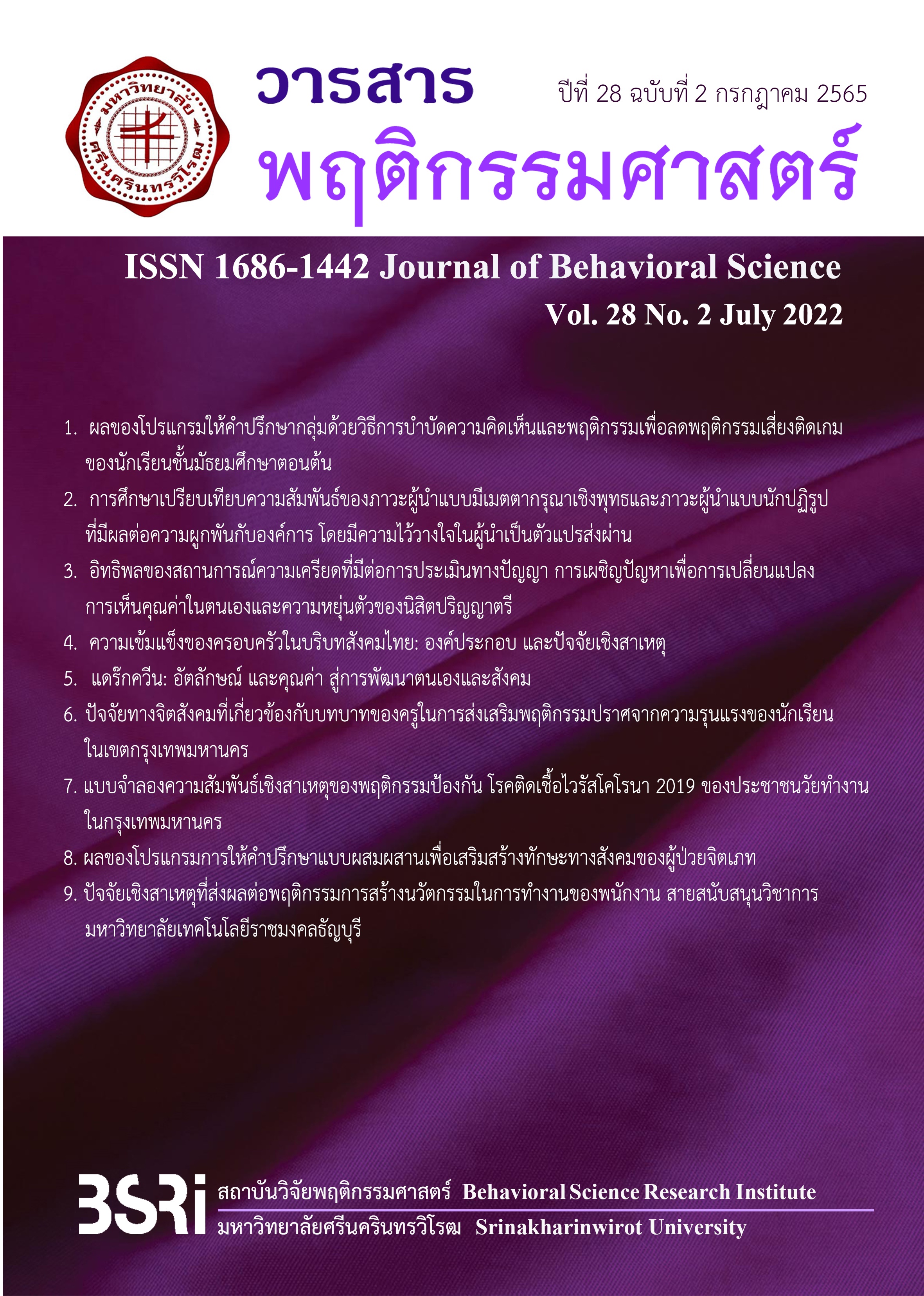
Family Strength in the Context of Thai Society: Components and Casual Factors
Keywords:
Family strength in the context of Thai society, components of family strength, casual factors affecting family strengthAbstract
The primary objectives of this research were to develop components of family strength and to examine casual factors affecting family strength in the context of Thai society. The research methodology was divided into two phases: Phase I: Development of family strength components through a qualitative research methodology, by in-depth interviews with family leaders of eleven families, thereafter, along with a quantitative research methodology, by questionnaires on 380 family heads. Research findings were: Seven components of family strength acquired in descending order, as follows: 1) Adherence to Moral Ways of Life, 2) Cultivation of Values to be Passed on, 3) Intent to Build a Wholesome New Family, 4) Balance in Asset Management, 5) Attention on the Importance of Family, 6) Mutual Adjustment to Moderate Conflict, and 7) Determination to Fulfill Roles and Responsibilities and obtain one measuring instrument of family strength, comprising 45 items; overall Reliability equaled .88; and possessed Construct validity. Phase II: The study of casual factors affecting family strength, by questionnaires with Reliability between .64 - .98 on 300 family heads. Structural Equation Modeling (SEM) was used to analyze the data. Research findings were: The structural equation model was valid and consistent with the empirical data, which accounted for 96% of variance in family strength. The variables with a maximum direct effect on family strength were Family leadership, followed by Intention to strengthen family, respectively.
Downloads
References
Asay, S. M., & DeFrain, J. (2012). The International Family Strengths Model. Marriage and Family, Future of Society (pp. 1-29). World Congress of Families.
Berkowitz, L. (1993). Aggression: Its causes, consequences, and control. Mcgraw-Hill Book Company.
Chareonwongsak, K. (2014). Wansuk...thukwanthamngān [Wan Suk...Thuk Wan Tham Ngan]. Success Publishing.
Charupoonphol, P., Sujirarat, D., Tachaboonsermsak, P., Munsawangsub, C., & Pikkultang, S. (2009). phāwa sukkhaphāp čhit læ samphanthaphāp nai khrō̜pkhrūa khō̜ng naksưksā phayābān lang khưn fưk patibat wichākān phayābān [Model development of Thai family situation assessment]. Ministry of Social Development and Human Security and Faculty of Public health, Mahidol.
Creswell, J. W. (1998). Qualitative inquiry and research design: Choosing among five traditions. Sage Publications.
Garcia-Cadena, C. (2014). Effect of family strength over the psychological well-being and internal locus of control. Journal of Behavior, Health & Social Issues, 5(2), 33 - 46.
Goddard, H. W., & Dennis, S. A. (2005). A parenting journey. University of Arkansas Cooperative Extension Service.
Jamieson, S. (2015). Family strength. University of Missouri.
Jinnge, P., Chaijukul, Y., Srijindarat, U., Kramanont, S., Kasemnetr, L., Wongratana, C., Kaochim, P., Thongpakdee, T., Kesonpat, P. (2021). kānsāng ʻongprakō̜p khwāmkhēmkhæng khō̜ng khrō̜pkhrūa tām bō̜ribot sangkhom Thai [Construction of family strength components in the context of Thai society]. Warasan Phuettikammasat, 27(1), 18-40. https://so06.tci-thaijo.org/index.php/BSRI/article/view/246007
Kirdpitak, P. (2012). kānsāng bǣp wat khwāmkhēmkhæng khō̜ng khrō̜pkhrūa [Family strength scale construction]. Kasem Bundit Journal, 13(2), 1-10.
Kirdpitak, P. (2014). rūpbǣp kān fưk ʻoprom thāng čhittawitthayā phư̄a phatthanā chīwit khrō̜pkhrūa thī khemkhæng khō̜ng phū tit yāsēptit [A psychological training model for developing family life strengths of drug addicts]. Journal of Psychology Kasem Bundit University, 4, 1-13.
Kotchabhakdi, N. (2003). Network joining in building indicators and databases for family-life well-being, In The supporting documents for the meeting on the direction for integrated development of family institution. Bangkok
Ministry of Social Development and Human Security. (2018). Thai Family. Photocopy.
Moore, K. A., Chalk, R., Scarpa, J., & Vandivere, S. (2002). Family strengths: Often overlooked, But real. https://www.childtrends.org/wp-content/uploads/2002/08/Overlooked-Family-Strengths.pdf
Moss, T. W., Loor, A. D., & Parada, F. D. (2022). Partnerships as an enabler of resourcefulness in generating sustainable outcomes. Journal of Business Venturing, 37(1), 106089.
Office of the National Economic & Social Development Council. (2017). The 20-Year national strategy draft (2017-2036). https://www.dga.or.th/wp-content/uploads/2018/08/file_32600e26a233b3fc9c88e48300c10334.pdf
Phramaha Anan Anuttaro (Aunwises), & Phra Suchat Abhassaro (Phuengphai). (2021). Karma in theravada buddhist philosophy. The Journal of Pacific Institute of Management Science, 7(1), 117 – 128.
Phramaha Phuen Kitisobhano, Srikruadong, S., & Srivijitvorakul, S. (2017), The Causal Model of Family Strength in Thai Society. http://mcuir.mcu.ac.th:8080/jspui/handle/123456789/269
Pinwiset, M. (2007). Thai life and culture. Aimphan Press.
Somdet Phra Buddhakosajarn (P. A. Payutto). (2019). Buddha-Dharma Extended Edition (53rd ed.). Southeast Asia University Press.
Sujjanun, J. (2013). Education and community development in the 21st Century. Odien Store.
Suparp, J. (2009). Thai family, happiness, strength conference on family health Thai family: From diversity to harmony, happiness and healthy [Conference session]. Bangkok: Department of family health, Faculty of public health, Mahidol University in cooperation with Family Network Foundation and Women's Affairs and Family Development Ministry of Social Development and Human Security.
Surinya, T. (2015). ʻitthiphon khō̜ng khwāmrū sưk hen khunkhā nai tonʻēng kān khūapkhum khwām krōt phrưttikam kānčhatkān kap panhā læ thatsanakhati tō̜ kānchai khwāmrunrǣng tō̜ phrưttikam kāorāo khō̜ng dek wairun chāi Thai [The effects of self-esteem, anger control, coping behavior and attitudes toward the violence on aggressive behavior of Thai male adolescence]. Songklanakarin Journal of Social Sciences and Humanities, 21(2), 193-244.
Suvannathat, C. (2011). Set of knowledge on promoting family strengthening under the family strength standards (for family-related workers). Department of Women's Affairs and Family Development, Ministry of Social Development and Human Security.
Swit, C. S., McMaugh, A., & Warburton, W. A. (2016). Preschool children’s beliefs about the acceptability of relational and physical aggression. International Journal of Early Childhood, 48(1), 111-127.
Thongsa-ard, B., & Bunchup, S. (2008). Forms of strong and sustainable family institution: A case study of three communities in UbonRatchathani province. Ministry of Social Development and Human Security.
Tichy, N. M., & Devanna, M. A. (1986). The transformational leader. Training & Development Journal, 40(7), 19-32.
Vichit-Vadakan. (2011). Loose structure: A form of Thai society. https://sites.google.com/site/gaiusjustthink/nida-mpa/pa601/part2/rupbaebthangsangkhm
Downloads
Published
How to Cite
Issue
Section
License
Copyright (c) 2022 Warasan Phuettikammasat

This work is licensed under a Creative Commons Attribution-NonCommercial-NoDerivatives 4.0 International License.
Behavioral Science Research Institute, SWU
114 Sukhumvit 23, Bangkok 10110, Thailand.
Tel.02-649-5000 # 17600


