
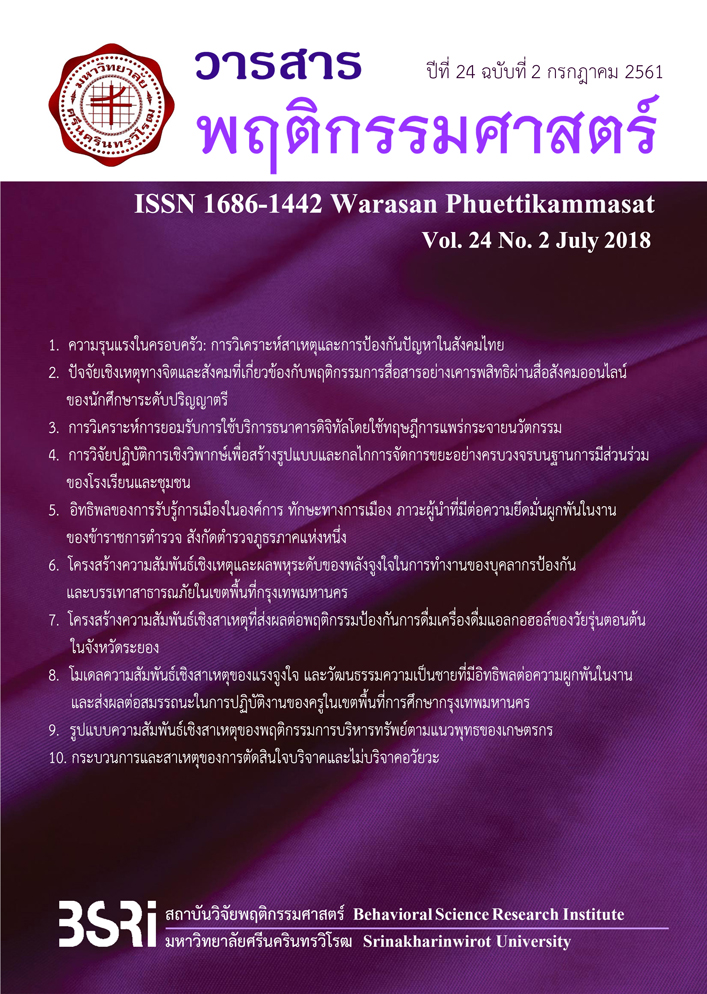
The Impact of Perceptions of Organizational Politics, Political Skill, Leadership, on Work Engagement of Police Officers in a Provincial Police Region
คำสำคัญ:
perceptions of organizational politics, political skill, leadership, work engagementบทคัดย่อ
The objectives of the research were to study: 1) the level of perceptions of organizational politics, political skill, leadership, and work engagement of police officers in Provincial Police Region; and 2) to determine the variables that could impact work engagement of police officers in Provincial Police Regions. The samples of the research consisted of 208 police officers working in the service of General Staff Division and Training Center of a Provincial Police Region; selected using multi-stage sampling. The statistical methods used in analyses of the obtained data were percentage, mean, standard deviation, Pearson’s product moment correlation coefficient, and multiple regression analysis. The test validation results found that: content validity, using index of item-objective congruence, was between .60 to 1; reliability, using Pearson’s correlation coefficient, was between .938 to .991; and discrimination– using corrected item-total correlation – was contained values between .376 to .957. The research results revealed that 1) the police officers showed a high level of political skill, the leadership, and work engagement, while perceptions of the organizational politics was at average level; and 2) political skill and leadership could jointly predict work engagement of police officers at .01 level of significance. The most interesting findings of this research were the impacts of the variables which are not extensively studied with work engagement, especially in the context of Thailand’s Police Officers in a Provincial Police Regions.
Downloads
เอกสารอ้างอิง
ยุทธการ ก้านจักร. (2554). การรับรู้วัฒนธรรมองค์การ การบริหารทรัพยากรมนุษย์ ความยึดมั่นผูกพันในงานกับผลการปฏิบัติงานของพนักงานการท่าเรือแห่งประเทศไทย. (วิทยานิพนธ์วิทยาศาสตรมหาบัณฑิต), มหาวิทยาลัยเกษตรศาสตร์, คณะสังคมศาสตร์, สาขาจิตวิทยาอุตสาหกรรมและองค์การ.
สำนักงานตำรวจแห่งชาติ. (2554). ประวัติ. สืบค้นจาก www.royalthaipolice.go.th/history.php
รัตติกรณ์ จงวิศาล. (2017). อิทธิพลของจิตวิญญาณในสถานที่ทำงาน สุขภาวะทางจิตวิญญาณ และภาวะผู้นำที่มีต่อผลลัพธ์ขององค์การ. Kasetsart Journal of Social Sciences, 38, 644-654.
รัตติกรณ์ จงวิศาล. (2556). ภาวะผู้นำ: ทฤษฎี การวิจัย และแนวทางสู่การพัฒนา (พิมพ์ครั้งที่ 2). กรุงเทพมหานคร: สำนักพิมพ์แห่งจุฬาลงกรณ์มหาวิทยาลัย.
Bhagirath, L. D. (2004). An Introduction to Globalisation and its Impacts (2nd ed.). Penang: Third World Network.
Crabtree, S. (2013). Worldwide, 13% of employees are engaged at work. Retrieved Jul 8, 2016 from www.gallup.com/poll/165269/worldwide-employees-engaged-work.aspx
Den Hartog, D. N., & Belschak, F. D. (2012). Work engagement and Machiavellianism in the ethical leadership process. Journal of Business Ethics, 107(1), 35-47.
Eldor, L. (2016). Looking on the bright side: The positive role of organizational politics in the relationship between employee engagement and work performance. In E. Vigodo-Gadot & A. Drory (Eds.), Handbook of Organizational Politics: Looking Back and to the Future (pp. 217-243). Cheltenham: Edward Elgar Publishing.
Fairholm, G. W. (1996). Spiritual leadership: fulfilling whole‐self needs at work. Leadership & Organization Development Journal, 17(5), 11-17.
Ferris, G. R., Adams, G., Kolodinsky, R. W., Hochwarter, W. A., & Ammeter, A. P. (2002). Perceptions of organizational politics: Theory and research directions. In F. J. Yammarino & F. Dansereau. (Eds.), The Many Faces of Multi-level Issues (pp. 179-254). Oxford: Elsevier Science/JAI Press.
Ferris, G. R., Davidson, S. L., & Perrewé, P. L. (2005). Political Skill at Work: Impact on Work Effectiveness. California: Davies-Black Publishing.
Ferris, G. R., & Kacmar, K. M. (1992). Perceptions of organizational politics. Journal of Management, 18(1), 93-116.
Ferris, G. R., Perrewé, P. L., Anthony, W. P., & Gilmore, D. C. (2000). Political skill at work. Organizational Dynamics, 28(4), 25-37.
Ferris, G. R., Treadway, D. C., Perrewé, P. L., Brouer, R. L., Douglas, C., & Lux, S. (2007). Political skill in organizations. Journal of Management, 33(3), 290-320.
Fry, L. W. (2003). Toward a theory of spiritual leadership. The Leadership Quarterly, 14(6), 693-727.
Fry, L. W., Vitucci, S., & Cedillo, M. (2005). Spiritual leadership and army transformation: Theory, measurement, and establishing a baseline. The Leadership Quarterly, 16(5), 835-862.
Garden, R., Hu, X., Zhan, Y., & Wei, F. (2018). The Role of workplace popularity: Links to employee characteristics and supervisor-rated outcomes. Journal of Leadership & Organizational Studies, 25(1), 19-29.
Georgiades, S. (2015). Employee Engagement in Media Management: Creativeness and Organizational Development. Cham: Springer.
Hair Jr, J. F., Black, W. C., Babin, B. J., & Anderson, R. E. (2010). Multivariate Data Analysis (7th ed.). Upper Saddle River: Pearson Prentice Hall.
Harter, J. K., Schmidt, F. L., & Hayes, T. L. (2002). Business-unit-level relationship between employee satisfaction, employee engagement, and business outcomes: A meta-analysis. Journal of Applied Psychology, 87(2), 268-279.
He, H., Zhu, W., & Zheng, X. (2014). Procedural justice and employee engagement: roles of organizational identification and moral identity centrality. Journal of Business Ethics, 122(4), 681-695.
Kacmar, K. M., & Carlson, D. S. (1997). Further validation of the perceptions of politics scale (POPS): A multiple sample investigation. Journal of Management, 23(5), 627-658.
Kahn, W. A. (1990). Psychological conditions of personal engagement. Academy of Management Journal, 33(4), 692-724.
Kimura, T. (2013). The moderating effects of political skill and leader–member exchange on the relationship between organizational politics and affective commitment. Journal of Business Ethics, 116(3), 587-599. DOI:10.1007/s10551-012-1497-x
Kimura, T. (2015). A review of political skill: Current research trend and directions for future research. International Journal of Management Reviews, 17(3), 312-332.
Krejcie, R. V., & Morgan, D. W. (1970). Determining sample size for research activities. Educational and Psychological Measurement, 607-610.
Leiter, M. P., & Bakker, A. B. (2010). Work engagement: Introduction. In A. B. Bakker & M. P. Leiter (Eds.), Work Engagement: A Handbook of Essential Theory and Research (pp. 1-7). Hove: Psychology Press.
Macey, W. H., & Schneider, B. (2008). The meaning of employee engagement. Industrial and Organizational Psychology, 1, 3-30.
Munyon, T. P., Summers, J. K., Thompson, K. M., & Ferris, G. R. (2015). Political skill and work outcomes: A theoretical extension, meta-analytic investigation, and agenda for the future. Personnel Psychology, 68(1), 143-184. DOI:10.1111/peps.12066
Noe, R. A. (2013). Employee Training and Development (6th ed.). New York: McGraw-Hill.
Robinson, D., Perryman, S., & Hayday, S. (2004). The Drivers of Employee Engagement. Brighton: Institute for Employment Studies.
Saks, A. M. (2006). Antecedents and consequences of employee engagement. Journal of Managerial Psychology, 21(7), 600-619. DOI:10.1108/02683940610690169
Schaufeli, W. B., & Bakker, A. B. (2010). Defining and measuring work engagement: Bringing clarity to the concept. In A. B. Bakker & M. P. Leiter (Eds.), Work Engagement: A Handbook of Essential Theory and Research (pp. 10-24). Hove: Psychology Press.
Sharoni, G., Shkoler, O., & Tziner, A. (2015). Job engagement: Antecedents and outcomes. Journal of Organizational Psychology, 15(1), 34-48.
Silverster, J. (2008). The Good, the bad, and the ugly politics and politicians at work. International Review of Industrial and Organizational Psychology, 23, 107-148.
Solano, B. R. (2009). Organizational politics, personality, and willingness to share knowledge: The mediational role of employee engagement. (Doctoral dissertation). Alliant International University, Faculty of the Marshall Goldsmith School of Management, Organizational Psychology Division.
Sousa, M., & van Dierendonck, D. (2015). Servant leadership and the effect of the Interaction between humility, action, and hierarchical power on follower engagement. Journal of Business Ethics, 1-13.
Vigoda-Gadot, E., & Drory, A. (2006). Handbook of Organizational Politics. Cheltenham: Edward Elgar.
Yukl, G. (2013). Leadership in organizations (8th ed.). New Jersey: Pearson Education.
ดาวน์โหลด
เผยแพร่แล้ว
รูปแบบการอ้างอิง
ฉบับ
ประเภทบทความ
สัญญาอนุญาต
สถาบันวิจัยพฤติกรรมศาสตร์ มหาวิทยาลัยศรีนครินทรวิโรฒ
114 ซอยสุขุมวิท 23 ถนนสุขุมวิท แขวงคลองเตยเหนือ เขตวัฒนา กรุงเทพฯ 10110
โทร 02-649-5000 ต่อ 17600


