
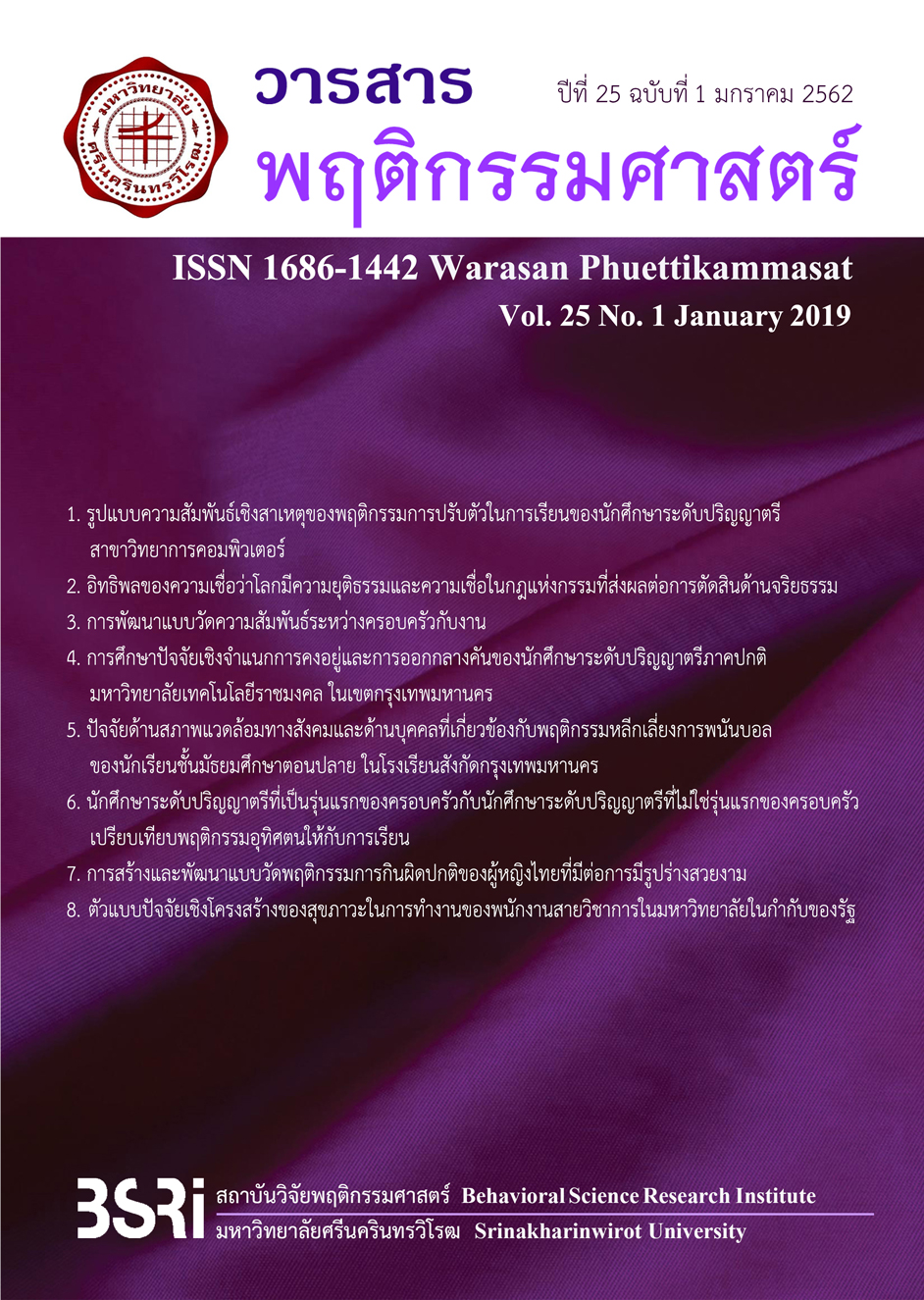
การสร้างและพัฒนาแบบวัดพฤติกรรมการกินผิดปกติของผู้หญิงไทย ที่มีต่อการมีรูปร่างสวยงาม
Keywords:
eating disorder behavior, scale, women, good figure shapeAbstract
This study aimed to construct and develop a validated and reliable of eating disorder behaviors scale among Thai women. The subject were 1000 age ranged between 18-40 years old. The subjects were divided into two groups as follows: 1) the first group was 500 subjects in late adolescents’ ages ranged between 18-24 studying at universities of private and public and 2) the second group was 500 subjects in early adulthoods’ ages ranged between 25-40 working and living in Bangkok and vicinity area. The stratified random sampling was applied to include thosesamples. Then data was collected by utilizing the 19 items of eating disorder behavior among Thai women scale’ with six levels of rating scale, from (6) the most practical to (1) do not comply. Item-total correlation, cronbach’s alpha coefficient and confirmatory factor Analysis were employed to analyze the datathe research found that of eating disorder behaviors scale of Thai women. reliable quality. by Item-total correlation .302-.631, cronbach’s alpha coefficient 0.946 of confirmatory factor analysis. The structural model to measure the behavior of eating disorders include three aspects consistent with empirical data through acceptable. The results indicated that eating disorder behavior among Thai women scale was fitted with the empirical data (c2 =1059.88, df=149, p-value<.01, CFI=.97, NFI=.97, TLI=.97, GFI=.90 RMSEA=.078). The result found that the eating disorder behaviors scale demonstrated appropriate validity, reliability and theoretical concepts, and will be deployed as a standard measurement with other groups of women.
Downloads
References
Arcelus, J., Mitchell, A. J., Wales, J., & Nielsen, S. (2011). Mortality rates in patients with anorexia nervosa
and other eating disorders: A meta-analysis of 36 studies. Arch Gen Psychiatry, 68(7), 724-731. DOI: 10.1001/archgenpsychiatry.2011.74
Bollen, K. A. (1989). Structural Equations with Latent Variables. New York: Wiley, 108.
Campbell, K., & Peebles, R. (2014). Eating disorders in children and adolescents state of the art review,
Pediatrics, 134, 582-592. DOI: 10.1542/peds.2014-0194
Dancyger, I., Krakower, S., & Fomari, V. (2013). Eating disorders in adolescent: Review of treatment studies that include psychodynamically informed therapy. Child and Adolescent Psychiatric Clinics of North America, 22(1), 97-117. DOI: 10.1016/j.chc.2012.08.006
Garner, D. M., & Garfinkel, P. E. (1979). The eating attitudes test: An index of the symptoms of
anorexia nervosa. psychological medicine, 9(2), 273-279. DOI: 10.1017/S0033291700030762
Garner, D. M., Olmsted, M. P., Bohr, Y., & Garfinkel, P. E. (1982). The eating attitudes test: Psychometric features and clinical correlates. psychological medicine, 12(4), 871-878. DOI: 10.1017/S0033291700049163
Hair, J. F., Black, W. C., Babin, B. J., & Anderson, R. E. (2010). Multivariate Data Analysis: A Global
Perspective, New Jersey: Pearson Prentice Hall.
Hongsanguansri, S. (2012). “Eating disorder in psychiatry” [Eating disorder in psychiatry].
Ramathibodi 3rd edition, Bangkok, 532-539.
Kaewporndawan, T., Pariwatcharakul, P., & Pimratana, W. (2013). “Criterion validity study of the
eating attitude test - yīsiphok ( Eat - yīsiphok Thai version ) among Thai females”
[Criterion Validity Study of The Eating Attitude Test-26 (Eat-26 Thai Version) among Thai
Females]. Warasan Smakhmcitphaethy haeng prathesthia, 58(3), 283-296.
Keski-Rahkonen, A., & Mustelin, L. (2016). Epidemiology of eating disorders in europe: Prevalence,
incidence, comorbidity, course, consequences and risk factors. Current Opinion in Psychiatry,
29(6), 340-345. DOI: 10.1097/YCO.0000000000000278
Lotrakul, M. (1999). “Atypical features in some Asian anorexia nervosa: report of sō̜ng cases”
[Atypical Features in Some Asian Anorexia Nervosa: Report of 2 Cases]. Siriraj Hospital Gaz,
51, 49-55.
Pike, K. M., Hoek, H. W., & Dunne, P. E. (2014). Recent cultural trends and eating disorders.
Current opinion in psychiatry, 27, 436-442. DOI: 10.1097/YCO.0000000000000100
Puengyod, A., & Sukanich, P. (2011). “Prevalence of abnormal eating attitudes and behaviors
among Thai female high school students in Bangkok” [Prevalence of Abnormal Eating
Attitudes and Behaviors among Thai Female High School Students in Bangkok]. Warasan
Smakhmcitphaethy haeng prathesthia, 56(2), 149-158.
Sadock, B. J., Sadock, V. A., & Ruiz, P. (2015). Kaplan & Sadock’s synopsis of psychiatry:
BehavioralSciences/Clinical Psychiatry. 11th ed, Philadelphia: Lippincott Williams & Wilkins, 509-532.
Solmi, F., Hotopf, M., Hatch, S. L., Treasure, J., & Micali, N. (2016). Eating disorders in a multiethnic inner-city UK sample: Prevalence, comorbidity and service use. Social Psychiatric Epidemiology, 51(3), 369-381. DOI: 10.1007/s00127-015-1146-7
Schumacker, R. E., & Lomax, R. G. (2010). A Beginner’s Guide to Structural Equation Modeling.
3rd ed. New Jersey: Lawrence Erlbaum Associates, 20.
The National Eating Disorders Collaboration. (2011). NEDC Fact Sheet-Body Image. Retrieved from https://www.nedc.com.au/assets/Fact-Sheets/NEDC-Fact-Sheet-Body-Image.pdf
Thomas, J. J., Lee, S., & Becker, A. E. (2016). Updates in the epidemiology of eating disorders in Asia and The Pacific. Current opinion in psychiatry, 29(6), 354-362. DOI: 10.1097/YCO.0000000000000288
Watson, H. J., & Bulik, C. M. (2013). Update on the treatment of anorexia nervosa: Review of clinical trials, Practice Guidelines and Emerging Intervention. In Psychological Medicine, 43(12), 2477-2500. DOI: 10.1017/S0033291712002620
Downloads
Published
How to Cite
Issue
Section
License
Copyright (c) 2019 วารสารพฤติกรรมศาสตร์ (Warasan Phuettikammasat)

This work is licensed under a Creative Commons Attribution-NonCommercial-NoDerivatives 4.0 International License.
Behavioral Science Research Institute, SWU
114 Sukhumvit 23, Bangkok 10110, Thailand.
Tel.02-649-5000 # 17600


