
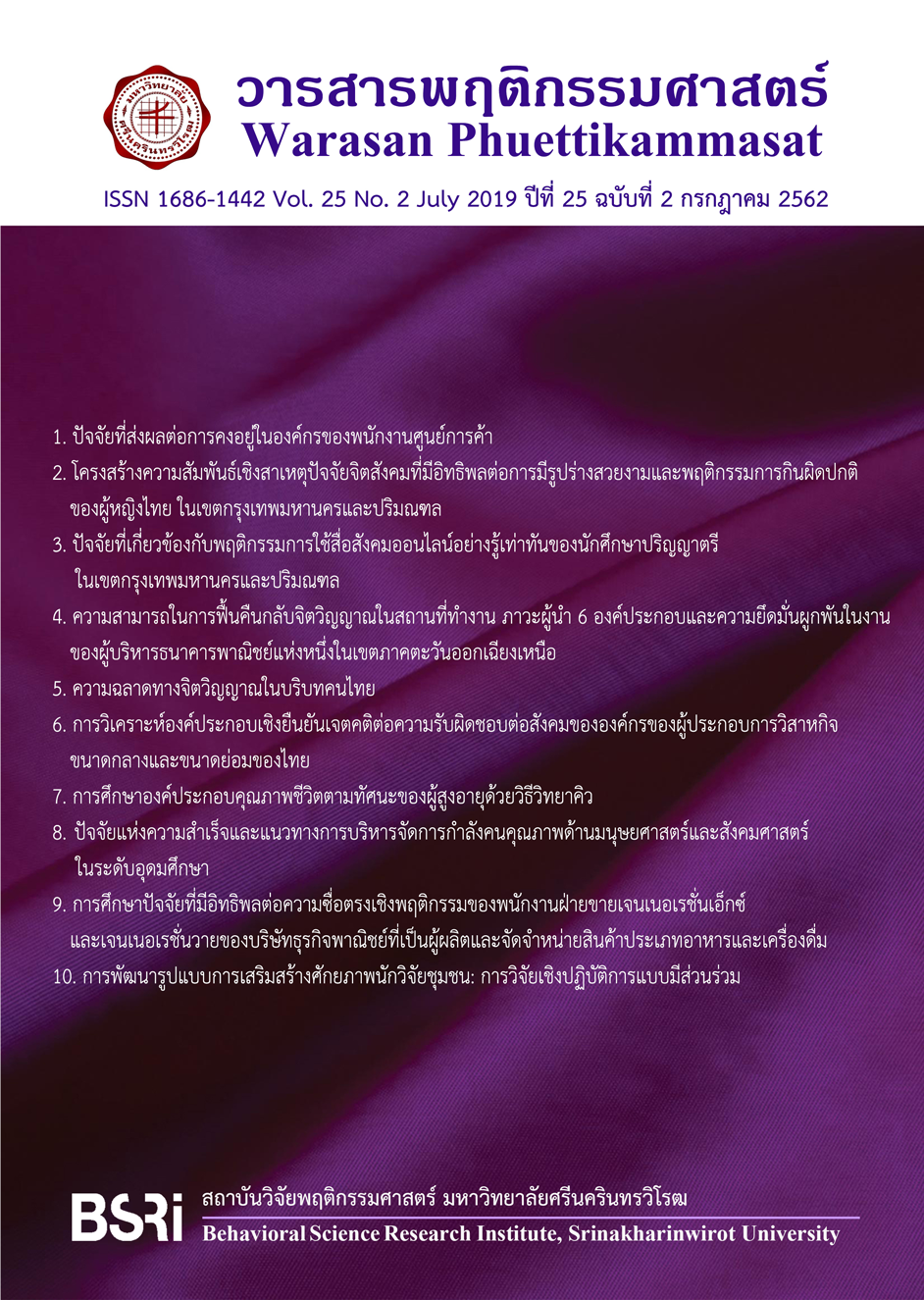
A Confirmatory Factors Analysis of Attitude toward Corporate Social Responsibility of Thailand Small and Medium Size Enterprise Entrepreneurs
คำสำคัญ:
ความรับผิดชอบต่อสังคมขององค์กร เจตคติ การวิเคราะห์องค์ประกอบเชิงยืนยันบทคัดย่อ
The purposes of this research are to conduct confirmatory analysis and verify the construct validity of the beliefs under attitude for corporate social responsibility (CSR) of small and medium sized entrepreneurs (SMEs) in Thailand. The samples are obtained from of 510 SMEs entrepreneurs in 6 most important industrial sector in term of income. The questionnaire concerning beliefs under attitude to the CSR of SMEs is utilized as the research tool. Additionally, the components in the questionnaire were confirmed by the in-depth interviews and the data were analyzed by the Confirmatory Factor Analysis techniques. The results indicate that the component of the CSR beliefs under attitude of SMEs in Thailand consisted of 8 indicators, namely, company image, product differentiation, labor benefit, company performance, economic benefit resulting from better society, benefits about regulation and community’s resistance, citizen’s duty, and beneficence. The standardized factor loading of these components are between 0.58 to 0.88 consistent with the empirical data considering the chi-square values =17.82, df = 14, GFI = 0.99, CFI = 1.00, GFI = 0.99, TLI = 1.00, RMSEA = 0.023 and SRMR = 0.014.
Downloads
เอกสารอ้างอิง
Ajzen, I. (2011). behavioral interventions: design and evaluation guided by the theory of planned behavior. In the Social psychology for program and policy evaluation (pp. 74–100). New York: Guilford.
Campbell, J. L. (2007). Why would corporations behave in socially responsible ways? an institutional theory of corporate social responsibility. Academy of Management Review, 32(3), 946–967.
Carroll, A. B. (1979). A Three-dimensional conceptual model of corporate performance. The Academy of Management Review. 4(4): 497–505.
Commission of the European Communities. (2001). Promoting a European framework for corporate social responsibility. Green Paper, Commission of the European Communities, Brussels.
Costello, A. & Osborne, J. 2005. Best practices in exploratory factor analysis: four recommendations for getting the most from your analysis. Practical Assessment Research & Evaluation, 10 (7): 1-9.
Davis, K. (1973). The case for and against business assumption of social responsibilities. Academy of Management Journal, 16(2), 312-322.
Donaldson, T. (1982). Constructing a social contract for business. in corporations and morality. pp. 36-58. New Jersey: Prentice-Hall.
Egels-Zandén, Niklas.; & Kallifatides, Markus. (2009). The UN Global Compact and the enlightenment tradition: a rural electrification project under the aegis of the UN Global Compact. Corporate Social Responsibility and Environmental Management. 16(5): 264–277.
Graafland, J., & Schouten, C. M.-V. (2012). Motives for corporate social responsibility. De Economist, 160(4), 377-396.
Frederick, William C. (1994, August). From CSR1 to CSR2: the maturing of business-anti-society thought. Business & Society. 33(2): 150–164.
Friedman, Milton. (1970, September 13). The social responsibility of business is to increase its profits. The New York Times. pp. 32–33.
Garriga, E., & Melé, D. (2004). Corporate social responsibility theories: mapping the territory. Journal of Business Ethics, 53(1/2), 51-71.
Hair, J. F., Black, W. C., Babin, B. J., & Anderson, R. E. (2010). Multivariate data analysis: A global perspective. (7th ed.). Upper Saddle River, NJ: Prentice-Hall.
Hay, Robert.; & Gray, Ed. (1974). Social responsibilities of business managers. Academy of Management Journal. 17(1): 135–143.
Kiatfaungfu S. (n.d.). Rœ̄m dūai čhai tham dūai mư̄ krom rōngngān ʻutsāhakam kap khrōngkān khwāmrapphitchō̜p tō̜ sangkhom [Start with heart, made by hand, Department of Industrial Work and social responsibility,] Retrieved from https://www.diw.go.th/km/other/ pdf/CSR.DIW.pdf
McWilliams, A.; & Siegel, D. (2001). Corporate social responsibility: a theory of the firm perspective. The Academy of Management Review. 26(1): 117–127.
Nunnally, J. C., & Bernstein, I. H. (1994). Psychometric theory. (3rd ed.). New York: McGraw-Hill.
Porter, M. E., & Kramer, M. R. (2006). Strategy and society: the link between competitive advantage and corporate social responsibility. Harvard Business Review, 84(12), 78-92.
Office of Small and Medium Enterprises Promotion. (2011). Phǣnkān songsœ̄m wisāhakit khanāt klāng læ khanāt yō̜m chabap thī sām ( Phō̜.Sō̜. 2555 - 2559) [The third small and medium entreprise promotion plan (Year 2012-2016)]. Bangkok: Office of Small and Medium Enterprises Promotion.
Votaw, Dow. (1972, Winter). Genius becomes rare: a confinement on the doctrine of social responsibility Pt . I. California Management Review. 15(2): 25–32.
ดาวน์โหลด
เผยแพร่แล้ว
รูปแบบการอ้างอิง
ฉบับ
ประเภทบทความ
สัญญาอนุญาต
สถาบันวิจัยพฤติกรรมศาสตร์ มหาวิทยาลัยศรีนครินทรวิโรฒ
114 ซอยสุขุมวิท 23 ถนนสุขุมวิท แขวงคลองเตยเหนือ เขตวัฒนา กรุงเทพฯ 10110
โทร 02-649-5000 ต่อ 17600


