
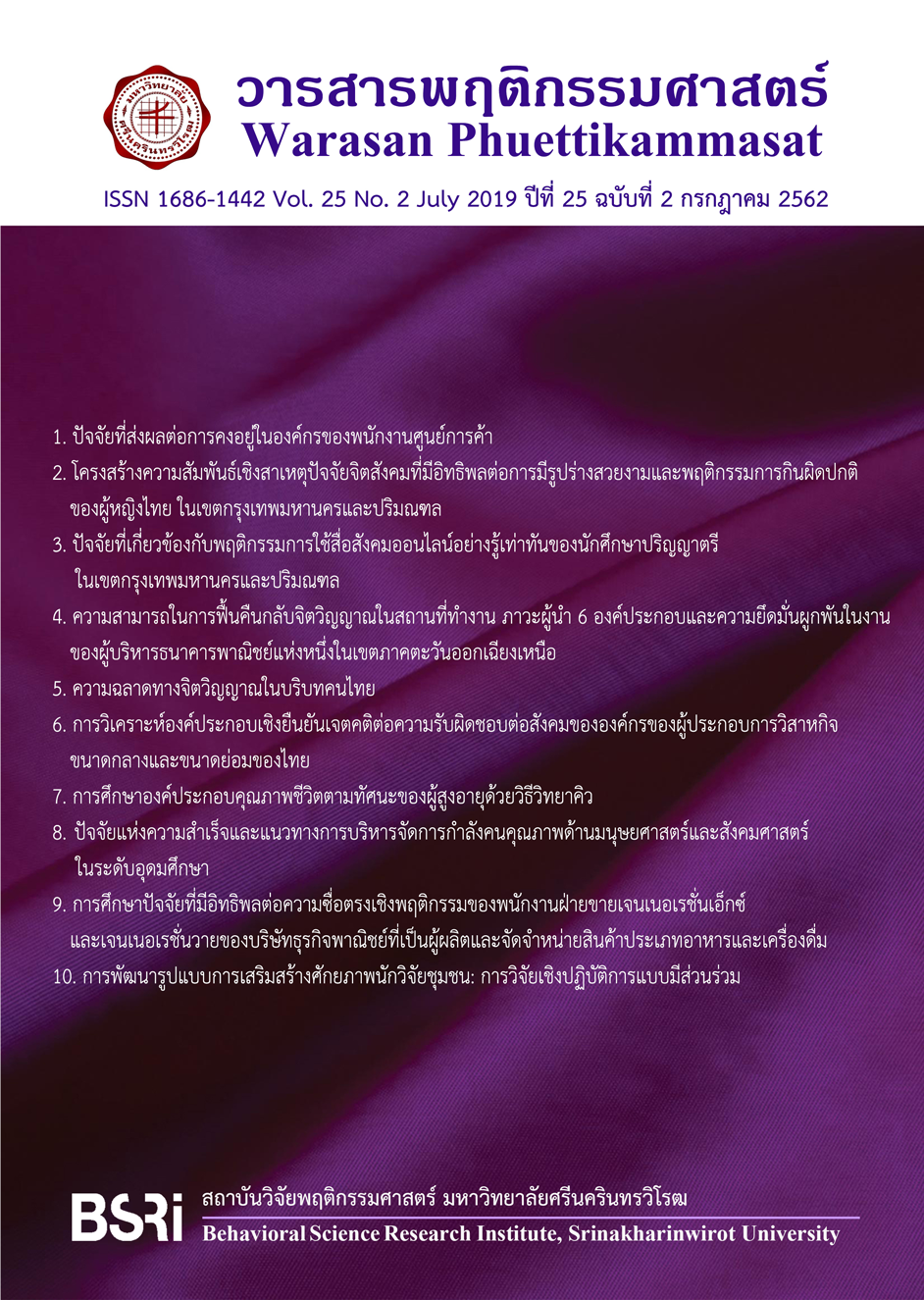
The study of factors integrity of different generations in sales departments of food and beverage distributions and manufacturing companies
คำสำคัญ:
การวิจัยด้านพฤติกรรมศาสตร์ สาขาวิชาจิตวิทยาประยุกต์ ความซื่อตรงเชิงพฤติกรรม รูปแบบทฤษฎีปฏิสัมพันธ์นิยม (Interactionism Model)บทคัดย่อ
At present, the progress of information technology affecting growth in business operations. But behavioral integrity issues, which are important factors of business operations, continue to increase. This research aims to study the investigate predictive power of behavioral integrity of the variables in situational factors, psychological traits, psychological states of sales department staff in Generation X and Generation Y within the organization. By using a mixed methods approach in this research between quantitative and qualitative research. The samples consisted of four hundred number of Generation X and Y in sales departments selected by random sampling Stratified Random Sampling. The research employed six instruments in the form of summated rating scale. The reliability values ranged from .80 to .98. The data was analyzed by multiple regression analysis : Hierarchical analysis .The research found that variables affecting behavioral integrity the most included predicted percentage increased between 1.6 percent to 1.9 percent by predicting the highest increase in Generation Y are intellect personality (β = .22). ,variables that affect behavioral integrity, consistency between The speech and the actions of individuals were attitudes towards behavioral integrity predictive percentage that increases between 1.1 percent and 2.3 percent, with the highest increase in Generation X are conscientiousness personality (β = .25) and The variables affecting behavioral integrity in terms of consistency between established principles and the promise of treatment predicted percentages that increased by 1.7 percent by predicting the highest increase in the collective group and Generation Y intellect personality (β = .26)
Downloads
เอกสารอ้างอิง
จริยา สายวารี ภมร แช่มรักษา ประสบสุข อินทรักษา และ นิตยา ไกรวงศ์.(2560). บรรยากาศจริยธรรมในสถานที่ทำงานตามการรับรู้ของพยาบาลวิชาชีพที่ปฏิบัติงานในโรงพยาบาลสงขลานครินทร์. วารสารมหาวิทยาลัยนราธิวาสราชนครินทร. 9(2): 52-64.
ดุจเดือน พันธุมนาวิน. (2538). ทฤษฎีต้นไม้จริยธรรม : การวิจัยและการพัฒนาบุคคล. กรุงเทพฯ: จุฬาลงกรณ์มหาวิทยาลัย.
________________. (2538). พฤติกรรมศาสตร์ เล่ม 1 พื้นฐานความเข้าใจทางจิตวิทยา. กรุงเทพมหานคร :
ไทยวัฒนาพานิช.
________________. (2550, ตุลาคม). รูปแบบทฤษฎีปฏิสัมพันธ์นิยม (Interactional model) และ แนวทางการตั้งสมมติฐานในการวิจัยสาขาจิตพฤติกรรมศาสตร์ในประเทศไทย. วารสารพัฒนาสังคม. 9(1): 85-117.
ทัศนี ศรีกิตติศักดิ์. (2554). เจนเนอเรชั่นในองค์กร บุคลิกภาพห้าองค์ประกอบ และปัจจัยจูงใจในการทํางาน : กรณีศึกษาพนักงานบริษัทประกันภัยแห่งหนึ่ง. ปริญญามหาบัณฑิต .กรุงเทพฯ : มหาวิทยาลัยธรรมศาสตร์.
ธรรมรัตน์ อยู่พรต. (2556). ค่านิยมในการทำงานที่ส่งผลต่อพฤติกรรมการเป็นสมาชิกที่ดีขององค์กรของเจนเนอเรชั่นต่างๆ. วารสารบริหารธุรกิจปีที่ 36 (ฉบับที่138), หน้า 40-62.
ปวลัย วรสูต. (2547). การศึกษาความไม่แปรเปลี่ยนของโมเดลบุคลิกภาพห้าองค์ประกอบที่สำคัญของนักเรียนชั้นมัธยมศึกษาปีที่4 ของโรงเรียนในสังกัดกรมสามัญศึกษา เขตกรุงเทพมหานคร. ปริญญาการศึกษามหาบัณฑิต สาขาวิชาการวิจัยและสถิติทางการศึกษา. กรุงเทพฯ:บัณฑิตวิทยาลัย มหาวิทยาลัยศรีนครินทรวิโรฒ.
ปิยะรัฐ ธรรมพิทักษ์. (2558). โครงสร้างความสัมพันธ์เชิงสาเหตุพหุระดับของตัวแปรเชิงสาเหตุและภาวะผู้นำเชิงจริยธรรมของผู้บริหารที่มีผลต่อจิตลักษณะและพฤติกรรมที่เกี่ยวกับการทำงานของพานในองค์การมหาชน. ปริญญานิพนธ์ วท.ด. (การวิจัยพฤติกรรมศาสตร์ประยุกต์). กรุงเทพฯมหาวิทยาลัยศรีนครินทรวิโรฒ. ถ่ายเอกสาร.
พจนานุกรมฉบับราชบัณฑิตยสถาน. (2542). ความหมาย. สืบค้นจาก https://rirs3.royin.go.th/ dictionary.asp.
รัตติกรณ์ จงวิศาล. (2554). เอกสารประกอบการบรรยาย ทฤษฎีและการจัดการองค์การ: จากแง่มุมทางจิตวิทยา. ภาควิชาจิตวิทยา คณะสังคมศาสตร์ มหาวิทยาลัยเกษตรศาสตร์.
วิทย์ เที่ยงบูรณธรรม. (2536). พจนานุกรมไทย-ไทย. สืบค้นจาก https://board.dserver.org/easydharma/ 00000210.html.
สมยศ นาวีการ. (2544). การบริหารเพื่อความเป็นเลิศ. พิมพ์ครั้งที่ 2. กรุงเทพฯ : บรรณกิจ.
สมยศ นาวีการ และผุสดี รุมาคม. (2520). องค์กร ทฤษฎีและพฤติกรรม. กรุงเทพฯ: ดวงกมล.
สมสิทธิ์ อัสดรนิธี และ กาญจนา ภูครองนาค. (2555). การศึกษาวิเคราะห์ความรู้เกี่ยวกับการเรียนรู้สู่การเปลี่ยนแปลงตามแนวจิตตปัญญาศึกษาเพื่อการบ่มเพาะความซื่อตรง. คณะกรรมาธิการการศาสนา คุณธรรม จริยธรรม ศิลปะ และวัฒนธรรม วุฒิสภาและศูนย์จิตตปัญญาศึกษา. กรุงเทพฯ:มหาวิทยาลัยมหิดล.
สิวลี ศิริไล. (2550). จริยศาสตร์สำหรับพยาบาล. กรุงเทพมหานคร : จุฬาลงกรณ์มหาวิทยาลัย.
สุธาสินี แม้นญาติ. (2554). โมเดลความสัมพันธ์โครงสร้างปัจจัยที่ส่งผลต่อภาวะผู้นำเชิงจริยธรรมของผู้บริหารสถานศึกษา สังกัดกรมส่งเสริมการปกครองท้องถิ่น. วิทยานิพนธ์ปรัชญาดุษฎีบัณฑิต, สาขาวิชาการบริหารการศึกษา. ขอนแก่น:บัณฑิตวิทยาลัย มหาวิทยาลัยขอนแก่น.
Adeline, Jol. (2015). Integrity and ethics and its effect on employees in organization. University Malaysia Sarawak.
Bandura, A. (1977).Social Learning Theory. Englewood Cliffs, New Jersey : Prentice-Hall.
Bandura, A. (1989). Social cognitive theory. Annals of Child Development. 6: 1–60
Brown, R. (1978). Social Psychology. New York : The Free Press.
Brown,M.E.; Trevino,L.K.. (2006).Ethical Leadership : A Review and Future Directions. The Leadership Quarterly.
Brown,M.E.; Trevino,L.K; & Harrison,D. (2005). Ethical Leadership : A Social Learning Perspective for Construct Development and Testing. Organization Behavior and Human Decision Processes.
Dawn, H. (2007). 10 Commandment of ethical leadership: The secret to becoming a trusted and respected leader. Retrieved May 17, 2014, from https://www.dawnfrail.com/ index.html.
Denison, D.R. (1990). Corporate culture and organizational effectiveness. England: Oxford.
Denison, D. R. and Mishra, A. K. (1995). Toward a Theory of a Organizational Culture And Effectiveness Organization Science. 6(2): 204-233.
Digman, John M. (1989). "Five Robust Trait Dimensions : Development, Stability and Utility,". Journal of Personality. Duke University. 2 (57) : 195 - 214.
Glass, A. (2007). Understanding generation differences for competitive success’, Industrial and commercial training, vol. 2 : 98-103.
Hair, J.F., Black, W.C., Babin, B.J., Anderson, R.E. & Andersen, R.E. (2010). Multivariate data analysis (Seventh edition). Upper Saddle River, New Jersey: Pearson Education, Inc.
Hurtz,G.M.,and Donovan,J.J. (2000). "Personality and Job Performance The Big Five Revisited." Journal of Applied Psychology 85.
Keith,D.(1974).Human Behavior at work. New York : McGraw Hill.
Kohlberg. L. (1976). Moral stages and moralization: The cognitive development approach. In T. Liekone (ed.) Moral development and behavior: Theory, research and social issues. New York: Holt, Rinehart and Winston, pp. 31-53.
Lennick,D.and Kiel,F.(2005).Moral Intelligence : Enhancing Business Performance and Leadership success. Upper Saddle River NJ:Prentice Education Wharton School Publishing.
Macky, K., Gardner, D., & Forsyth, S. (2008). Generational differences at work: introduction and overview. Journal of Managerial Psychology, 28(8). Fromhttps://dx.doi.org/ 10.1108/ 02683940810904358.
McGuire, W. J. (1985). "Feeling and Knowing, Attitude and Attitude Change". In G. Lindzeyand Elliot Aronson (Eds.), The Handbook of Social Psychology (3rd edition, Vol. 2, pp.
233-246), Reading: Addison-Wesley Publishing Company.
Piaget, J. (1960). The Moral Judgement of the Child. lllionis: The Free Press.
Ponnu, C.; & Tennakoon, G. (2009). The Association between Ethical Leadership and Employee Outcomes - the Malaysian Case. Electronic Journal of Business Ethics and Organization Studies.
Rovinelli, R. J.; & Hambleton, R. K. (1977). On the use of content specialists in the assessment of criterion-referenced test item validity. Dutch Journal of Educational Research. 2: 49-60.
Schein, Edgar H. (1999). The Corporate Culture Survival Guide: Sense and Nonsense about Culture Change. California: Jossey-Bass.
Steers, R.M. & L.W. Porter. (1979). Motivation and Work Behavior. New York :McGraw-HallBook Company.
Victor,B., & Cullen, J.B. (1987). A Theory and measure of ethical..
climate in organizations. In W.C.Frederick (ed.) Business ethics : Research issues and empirical studies : Greenwich : JAI Press.
Victor, B.; & Cullen, J. (1988). The Organizational Bases of Ethical Work Climates. Administrative Science Quarterly.
Victor, B.; & Cullen, J. (1990). A Theory and Measure of Ethical Climate in Organization In Business. Ethics: Research Issues and Empirical Studies.Edited by W.C. Frederick; & L. E. Press
ดาวน์โหลด
เผยแพร่แล้ว
รูปแบบการอ้างอิง
ฉบับ
ประเภทบทความ
สัญญาอนุญาต
ลิขสิทธิ์ (c) 2019 Journal of Behavioral Science

อนุญาตภายใต้เงื่อนไข Creative Commons Attribution-NonCommercial-NoDerivatives 4.0 International License.
สถาบันวิจัยพฤติกรรมศาสตร์ มหาวิทยาลัยศรีนครินทรวิโรฒ
114 ซอยสุขุมวิท 23 ถนนสุขุมวิท แขวงคลองเตยเหนือ เขตวัฒนา กรุงเทพฯ 10110
โทร 02-649-5000 ต่อ 17600


