
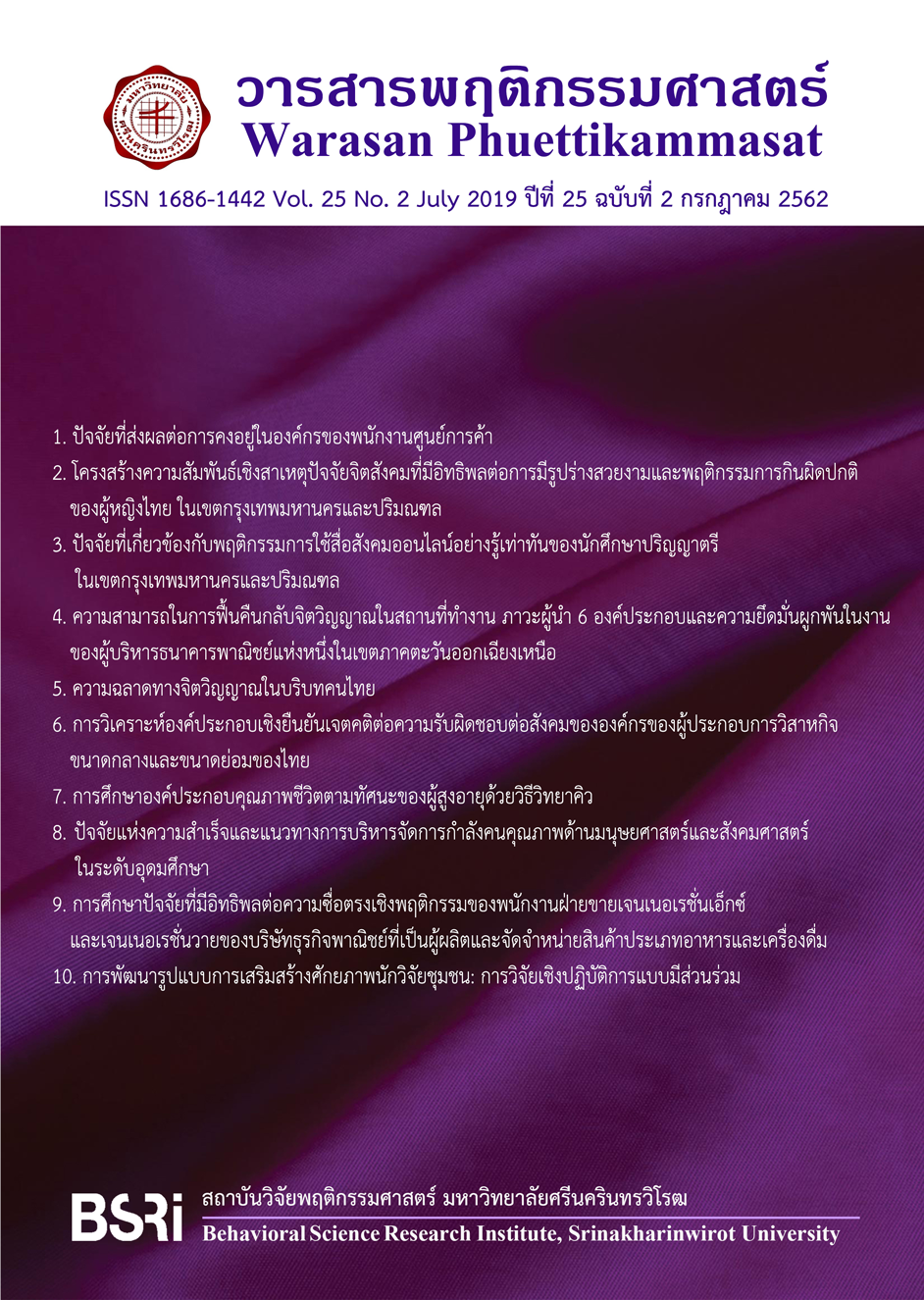
Success Factors and guidelines of Human Resources Development in Humanities and Social Sciences in Higher Education
คำสำคัญ:
การบริหารจัดการกำลังคนคุณภาพ, มนุษยศาสตร์, สังคมศาสตร์, พฤติกรรมการทำงาน, ระดับอุดมศึกษาบทคัดย่อ
The purposes of this study were to explore success factors of human resources development in Humanities and Social Sciences programs and to study guidelines of how to increase human resources performance in humanities and social sciences programs. The qualitative study collect data from semi structured interviews with purposive sampling includes 1) scholarship recipients who are either current scholarship recipients or former scholarship recipients who currently are employed 12 persons 2) management and representatives of universities where scholarship recipients have worked 11 persons 3) Office of the Civil Service Commission officers who oversee the scholarship recipients 4 persons. The participants from qualitative design consist of 27 participants from 12 universities. The result found success factors to develop talent management in humanities and social sciences was performance of human resource development included context was to establish subcommittees to manage the program effectively, input was to recruit suitable candidates for the program, process was to select candidates fairly and properly, outcome was the scholarship recipients have ability to work, outcome and impact were the scholarship recipients have opportunity to work in their fields of study. The former scholarship recipients who currently are employed in higher education institutions shown positive work behavioral that benefit to higher education institutions and Thailand. The development of management guideline is effective from planning, recruiting and selection, institutionalizing and coaching, developing and experience accumulation, motivation, monitoring and evaluation. This research is beneficial for work behavior, especially for managing performance of human resources development more efficiently.
Downloads
เอกสารอ้างอิง
Intarakamhang, U. & Peungposop, N. (2013). Effective Improvement of Talents Management for Continuing of Managing Government. Bangkok: Behavioral Science Research Institute.
McLean, G. N. & McLean, L. D. (2001). If we can’t define HRD in one country, how can we define it in an international context? Human Resource Development International, 4(3), 313-326.
Nĕmečková, T. & Krylova, P. (2014). The Czech government scholarship programme for students from developing countries- Evaluation findings and policy reflections. Evaluation and Program Planning, 43, 83-92.
Pankratz, D. (2008). Program evaluation and community schools of the Arts, Purposes, Concepts, and Tools. Retrieved on May 20, 207 from https://www.nationalguild.org/pdfs/ProgramEval.pdf.
Perna, L. W., Orosz, K. & Jumakulov, Z. (2015). Understanding the human capital benefits of a government-funded international scholarship program: An exploration of Kazakhstan’s Bolashak program. International Journal of Educational Development, 40, 85-97.
Stufflebleam, D. L. & Shinkfield, A. J. (2007). Evaluation theory, models, & application. San Francisco: John Wiley & Sons, Inc.
Swanson, R. A. & Holton, E. F. (2008). Foundations of Human Resource Development. San Francisco: Berrett-Koehler Publishers.
Tarique, I. & Schuler, R. S. (2010). Global Talent management: Literature, Integrative framework and suggestions for future research. Journal of world business, 45,122-133.
Taylor-Powel, E. & Henert E. (2008). Developing a logic model: Teaching and training guide handout. Madison: University of Wisconsin Extension. Retrieved from https://www.uwex.edu/ces/pdande/evaluation/pdf/Imguidecomplete.pdf
ดาวน์โหลด
เผยแพร่แล้ว
รูปแบบการอ้างอิง
ฉบับ
ประเภทบทความ
สัญญาอนุญาต
ลิขสิทธิ์ (c) 2019 Journal of Behavioral Science

อนุญาตภายใต้เงื่อนไข Creative Commons Attribution-NonCommercial-NoDerivatives 4.0 International License.
สถาบันวิจัยพฤติกรรมศาสตร์ มหาวิทยาลัยศรีนครินทรวิโรฒ
114 ซอยสุขุมวิท 23 ถนนสุขุมวิท แขวงคลองเตยเหนือ เขตวัฒนา กรุงเทพฯ 10110
โทร 02-649-5000 ต่อ 17600


