
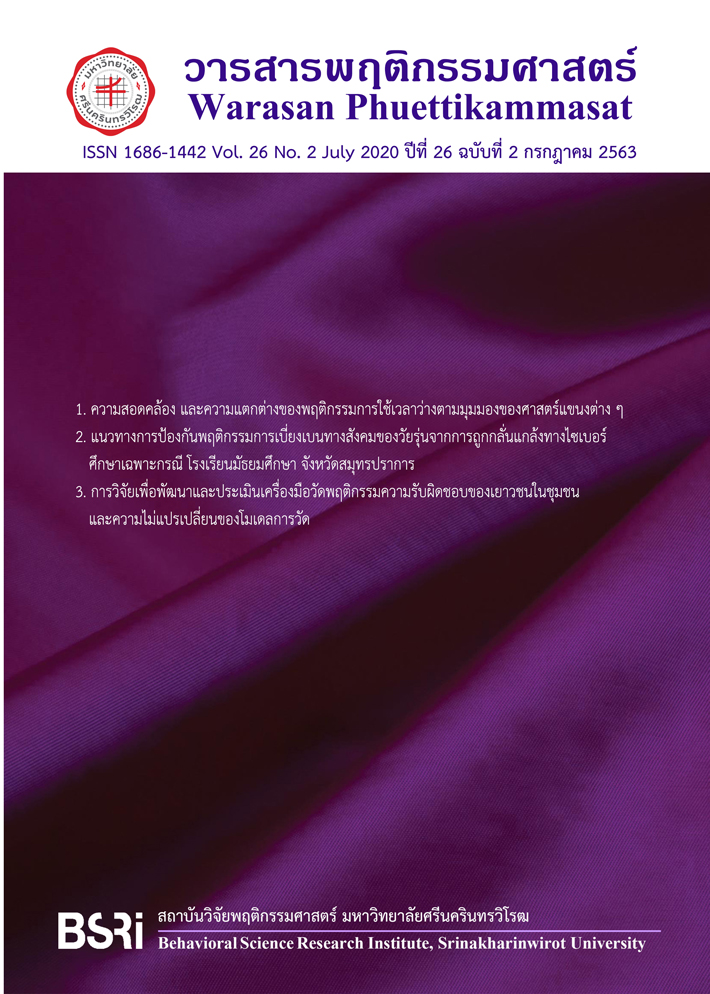
ความสอดคล้อง และความแตกต่างของพฤติกรรมการใช้เวลาว่างตามมุมมอง ของศาสตร์แขนงต่าง ๆ
คำสำคัญ:
การใช้เวลาว่าง, สังคมวิทยา, มานุษยวิทยา, ศึกษาศาสตร์บทคัดย่อ
ในการศึกษาทางพฤติกรรมศาสตร์ พบว่ามีศาสตร์ที่เกี่ยวข้องกับการใช้เวลาว่างที่สำคัญ 3 แขนง ได้แก่ สังคมวิทยา มานุษยวิทยา และศึกษาศาสตร์ ซึ่งมุมมองของแต่ละศาสตร์มีทั้งความสอดคล้อง และความแตกต่างกัน ความหมายคำว่า การใช้เวลาว่างตามมุมมองของแต่ละศาสตร์ จะประกอบไปด้วย 2 ส่วน ได้แก่ ความหมายในส่วนที่เป็นแก่นของคำว่าการใช้เวลาว่าง และความหมายตามความสนใจในมุมมองของศาสตร์นั้น ๆ การศึกษาครั้งนี้เป็นการรวบรวมแนวคิดจากบทความ งานวิจัยต่าง ๆ นำมาสรุป ก่อให้เกิดประโยชน์ 3 ข้อ ได้แก่ 1) สามารถเข้าใจบริบทคำว่า การใช้เวลาว่างตามศาสตร์แต่ละแขนง 2) สามารถนำมาใช้เป็นแนวทางในการกำหนดความหมาย นิยามปฏิบัติการของคำว่าการใช้เวลาว่างให้สอดคล้องตามบริบทของศาสตร์นั้น ๆ 3) สามารถนำมาสรุปความหมายในทางพฤติกรรมศาสตร์ จากการศึกษาพบว่า การใช้เวลาว่างในมุมมองทางด้านสังคมวิทยา มีมุมมองเน้นไปที่การทำกิจกรรมทางสังคม ซึ่งมีผลมาจากกลไกทางสังคม ส่วนมุมมองทางด้านมานุษยวิทยา มีมุมมองไปที่การทำกิจกรรมที่เกิดความบันเทิง ผ่อนคลาย สนุกสนาน ตามความต้องการของตนเองเป็นหลัก และมุมมองทางด้านศึกษาศาสตร์จะเน้นไปที่เยาวชนในวัยเรียน เป็นการใช้เวลาที่อยู่นอกเหนือจากเวลาเรียน การใช้เวลาว่างให้เป็นประโยชน์ และเป็นการพัฒนาตนเองในด้านต่าง ๆ ให้สัมพันธ์กับความต้องการของหลักสูตร ดังนั้นการใช้เวลาว่างในทางพฤติกรรมศาสตร์ จะมีความหมายครอบคลุมศาสตร์ทั้ง 3 แขนง โดยมีทั้งรูปแบบทั้งการทำกิจกรรมร่วมกับผู้อื่น หรือทำกิจกรรมเฉพาะตัวบุคคล โดยอาจเป็นไปตามที่สังคมคาดหวัง หรือเพียงเพื่อการผ่อนคลาย หรือเพื่อเป็นการศึกษาพัฒนาตนเองก็ได้
Downloads
เอกสารอ้างอิง
communities. Dublin: Children’s Research Centre, Trinity College. Dublin & Combat
Poverty Agency.
Chaloemphuthiphong, S. (2013). khwāmtō̜ngkānkitkamkānchaiwēlāwānglækhunnaphāpchīwit
khō̜ngphūsūngʻāyunaichomromphūsūngʻāyukrungthēpmahānakhō̜n. [Activity needs,
leisure time and quality of life of Elderly in the Bangkok Elderly Club]. Bangkok:
Kasetsart University.
Chick, Garry. (2009). Leisure and culture. Leisure Sciences An Interdisciplinary Journal.
Volume 20, : Issues for an anthropology of leisure.
Chua, Steven. (2001). The Sociology of Leisure: An Examination of the Relationship Between
Perceived Experience and Leisure Participation. Doctoral thesis, University of Surrey.
Chuangmaneechote, T. (2011). Withīchīwitkānchaiwēlāwāngkhō̜ngbuklākō̜nnaimahāwitthayālai
kasētsāt. [Way of life and leisure time usage of personnel at Kasetsart University].
Bangkok: Kasetsart University.
Crawford, Duane. W. &Godbey, Geoffrey. (1987). A hierarchical model of leisure constraints.Published online: 13 Jul 2009. Download citation. https://doi.org/10.1080/
01490409109513147
Deci, E. L., & Ryan, R. M. (2000). The “what” and “why” of goal pursuits: Human needs and the self-determination of behavior. Psychological Inquiry, 11, 227-268.
Fawcett, Lillian M. (2007). School's Out: Adolescent Leisure Time Activities, Inuences and Consequences. Faculty of Computing, Health and Science, Edith Cowan University. Australia.
Freysinger, V.J. (1995). The dialectics of leisure and development for women and men in midlife: An interpretive study. Journal of Leisure Research, 27, 61-84.
Henderson. (2017). Leisure and Active Lifestyles: Research Reflections Leisure Sciences.
Leisure Sciences website.
Hong, S. M. & Giannakopoulos E, (1994). The relationship of satisfaction with life to personality characteristics. Journal of J Psychol. 1994. Sep;128(5):547-58.
Hutchinson, Susan L. (2012). Leisure as a Resource for Successful Aging by Older Adults with Chronic Health Conditions. The International Journal of Aging and Human Development First Published April 11, 2012.
Inchan, D. (2018). Mānusayawitthayā Phatthanā-kān. [Developmental anthropology – Interim].
Bangkok: Sirindhorn Anthropology Center.
Jinesh, Soumya . (2018). The prediction that people living in 21st century will have more free
time because of the improvements in technology has come true. Copyright © 2005-2019 TestPrep Communities by testbig.com, All rights reserved.
Kelly, R John. (2012). Leisure. Sagamore Pub. Llc; 4th Revised edition. USA.
Kelly, J. & Freysinger, V. (2000) 21st century leisure: Current issues. Allyn & Bacon, Boston.
Ken, Roberts. (2013). Sociology of leisure. University of Liverpool, UK.
Kraus, R. (2001), Recreation and Leisure in Modern Society. 6th edn, Jones & Bartlett, Sudbury, MA.
Lidija, Vujačić . (2018). Národopisná revue (Journal of Ethnology) 2018.
Anthropology of everyday life and a phenomenon of leisure. P.87 – 93.
Mannell, Roger C. & Kleiber, Douglas A. (1997). A Social Psychology of Leisure. Venture Publishing. Inc.
Mlinarevic, V. (2006). Leisure time as a predicator of students' behaviour disorder, Phd
disertation, Zagreb, Sveuciliste u Zagrebu.
Omerdic, Nusreta. (2015). Leisure time of primary school students as an important factor of
education and personal development. Educational Faculty; University in Travnik.
Bosnia and Herzegovina.
Pesavento, C. & Ashton, Candace. (2011). Leisure Education In the Schools. A Position Paper
of the American Association for Physical Activity and Recreation (AAPAR). California
AAHPERD Convention March 29 – April 2, 2011.
Phatphongphan, K. (2010). Patčhaithīsongphontō̜ kānchaiwēlāthī mo̜somkhō̜ngnakrīan
chūangchanthīSāmRōngrīansāthitMahāwitthayālairāmkhamhǣng.[ Factors affecting
the appropriate use of time for students in the 3rd level of the Demonstration School
Ramkhamhaeng University]. Bangkok: Kasetsart University.
Previsic, V. (2000). Leisure time between pedagogical theory and educational practice,
Napredak 141 (4)
Russell,R. (2013). Pastimes: The context of contemporary Leisure (5th ed.). Dubuque, IA:
Brown & Benchmark.
Samdahl, Diane M. & Jekubovich, Nancy. J. (1993). A Critique of Leisure Constraints:
Comparative Analyses and Understandings. Journal of Leisure Research 1997,
Vol. 29, No. 4, pp. 430-452.
Sukkul, B. (2009). Kānchaiwēlāwāngkhō̜ngwairuntō̜ntonthīmīphrưttikamkāorāo. [The use of
leisure of early adolescents with aggressive behavior]. Bangkok: Kasetsart University.
Sungsomsakul, A. (2014). Rūpbǣpkānkhaorō̜wō̜makānchaiwēlāwāngkhō̜ngprachāchonnai
čhangwatnaiphāktawanʻō̜kchīangnư̄a. [Participation patterns, leisure usage of people in
provinces in the region North east]. Bangkok: Kasetsart University.
Tantimala, C. (2017). Kānsāngʻatlakkhō̜ngtalātnatphāinaimahāwitthayālaikhō̜ngratkhēt
Krungthēpmahānakhō̜n. [Establishing the identity of the flea market within the state
university Bangkok]. Bangkok: Srinakharinwirot University.
Thiamphet, P. (2005). Kānsưksākānchaiwēlāwāngkhō̜ngnakrīanchanmatthayomsưksātō̜nton
naisathānsưksākhanphư̄nthān Khēttrūatrātchakānthī Sām. [A study of leisure usage of
lower secondary school students in Basic school Government Inspection Area 3].
Bangkok: Srinakharinwirot University.
Thipboonsab, J. (2010). Kānprīapthīaplæwikhro̜khwāmsamphanrūpbǣpkānchaiwēlāwāng
khō̜ngnaksưksāwitthayālainānāchātmahāwitthayālaimahidon. [Comparison and
analysis of relationships between leisure patterns of international college
students Mahidol University] Bangkok : Silpakorn University.
Turner & Risjord. (2007). Philosophy of anthropology and sociology. Leisure
Sciences. Leisure. Sciences website.
Tylor Edward B. (1881).Anthropology an introduction to the study of man and civilization.
London: Macmillan and Co..
ดาวน์โหลด
เผยแพร่แล้ว
รูปแบบการอ้างอิง
ฉบับ
ประเภทบทความ
สัญญาอนุญาต
สถาบันวิจัยพฤติกรรมศาสตร์ มหาวิทยาลัยศรีนครินทรวิโรฒ
114 ซอยสุขุมวิท 23 ถนนสุขุมวิท แขวงคลองเตยเหนือ เขตวัฒนา กรุงเทพฯ 10110
โทร 02-649-5000 ต่อ 17600


