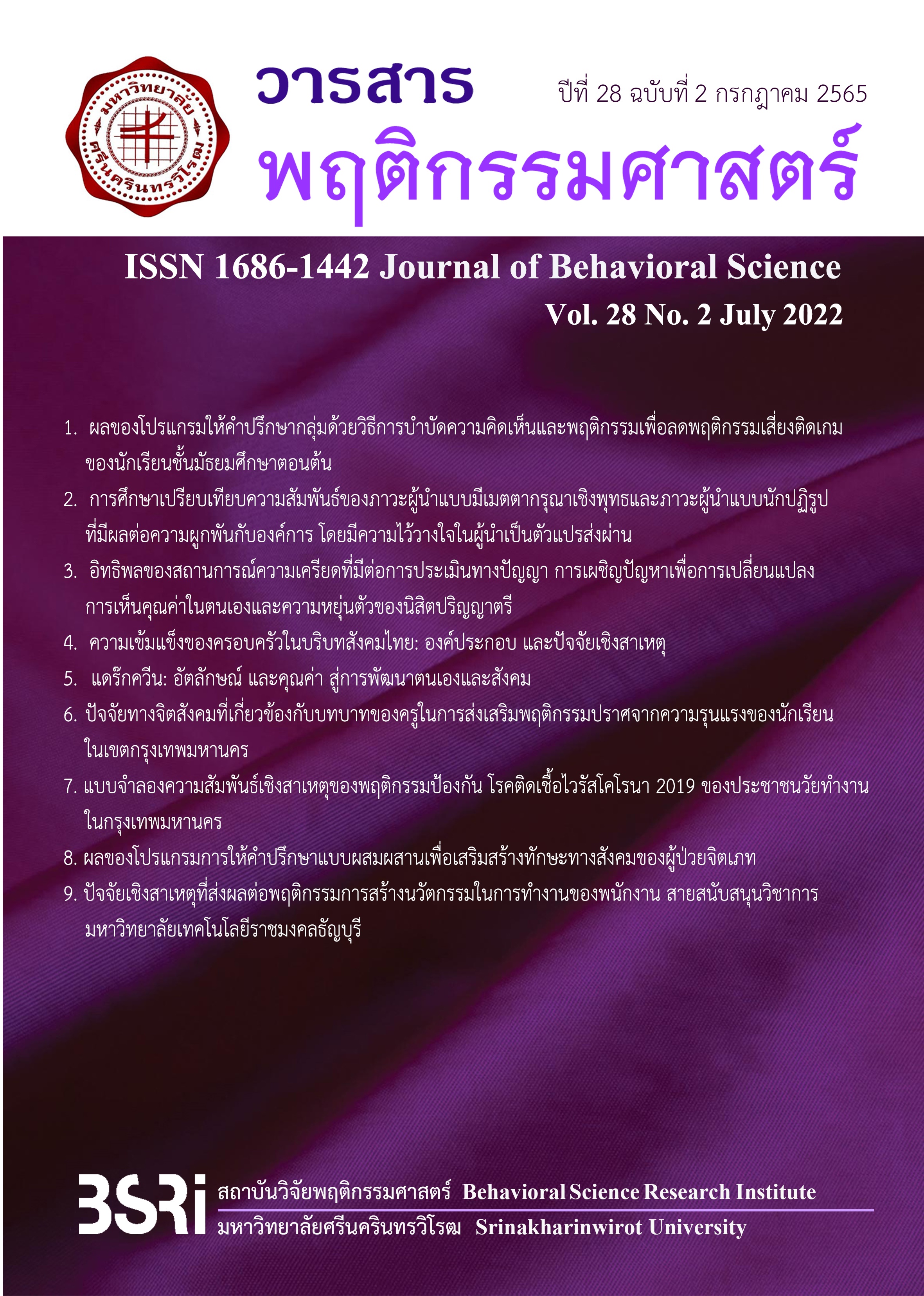
ปัจจัยเชิงสาเหตุที่ส่งผลต่อพฤติกรรมการสร้างนวัตกรรมในการทำงานของพนักงาน สายสนับสนุนวิชาการ มหาวิทยาลัยเทคโนโลยีราชมงคลธัญบุรี
คำสำคัญ:
พฤติกรรมการสร้างนวัตกรรมในการทำงาน, ความยึดมั่นผูกพันในการทำงาน, การมอบอำนาจด้านจิตใจในงาน, ภาวะผู้นำการเปลี่ยนแปลงบทคัดย่อ
การศึกษามีวัตถุประสงค์เพื่อศึกษาปัจจัยเชิงสาเหตุที่ส่งผลต่อพฤติกรรมการสร้างนวัตกรรมในการทำงานของพนักงานสายสนับสนุนวิชาการ มหาวิทยาลัยเทคโนโลยีราชมงคลธัญบุรี กลุ่มตัวอย่างในการวิจัยเป็นพนักงานสายสนับสนุนวิชาการ จำนวน 514 คน ที่ได้จากการสุ่มแบบแบ่งชั้นภูมิ เก็บข้อมูลโดยใช้แบบวัด 6 ฉบับ มีค่าความเชื่อมั่นแบบสอดคล้องภายในอยู่ระหว่าง 0.923-0.984 ในการวิเคราะห์ข้อมูลใช้สถิติเชิงบรรยาย การวิเคราะห์ความเที่ยงตรงเชิงโครงสร้างโดยการวิเคราะห์องค์ประกอบเชิงยืนยัน และการวิเคราะห์โครงสร้างความสัมพันธ์ปัจจัยเชิงสาเหตุ ผลการวิจัยสรุปได้ว่า โครงสร้างความสัมพันธ์ปัจจัยเชิงสาเหตุของพฤติกรรม การสร้างนวัตกรรมในการทำงานของพนักงานสายสนับสนุนวิชาการ มหาวิทยาลัยเทคโนโลยีราชมงคลธัญบุรี มีความกลมกลืนกับข้อมูลเชิงประจักษ์หลังการปรับโมเดลในระดับที่ยอมรับได้ (χ^2=597.30, df= 155; p< 0.01, SRMR= 0.046, RMSEA= 0.075, GFI= 0.90, NFI= 0.98, CFI= 0.99, NNFI= 0.98, PNFI= 0.73) ผลการทดสอบเส้นอิทธิพลพบว่า พฤติกรรมการสร้างนวัตกรรมในการทำงานได้รับอิทธิพลทางบวกโดยตรงจากความยึดมั่นผูกพันในการทำงาน และการมอบอำนาจด้านจิตใจในงาน รวมทั้งได้รับอิทธิพลทางบวกโดยอ้อมจากภาวะผู้นำการเปลี่ยนแปลง ทุนทางจิตวิทยาเชิงบวก และการมอบอำนาจด้านจิตใจในงาน ซึ่งตัวแปรเหล่านี้ร่วมกันอธิบายพฤติกรรมการสร้างนวัตกรรมในการทำงาน ได้ร้อยละ 58.8
Downloads
เอกสารอ้างอิง
Aiken, L. R. (2003). Psychological testing and assessment (11th ed.). Allyn and Bacon.
Alkhodary, D. (2016). The relationship between employees’ empowerment and innovative work behavior. International Journal of Managerial Studies and Research, 4(2), 1-15. https://www.arcjournals.org/pdfs/ijmsr/v4-i2/1.pdf
Arin, N. (2012). kānsưksā patčhai chœ̄ng hēt læ phon khō̜ng thun thāng čhittawitthayā chœ̄ng būak thī mī tō̜ sukphāwa thāng čhit læ phrưttikam kān patibat ngān phāitai sathānakān khwām mai sangop khō̜ng bukkhalākō̜n sāthāranasuk nai čhangwat chāidǣn tai [The study of antecedents and consequences of psychological capital affecting psychological outcomes and work performance under adverse situation of public health officers in southern border provinces] [Doctoral dissertation, Srinakharinwirot University]. http://bsris.swu.ac.th/thesis/50199060053RB999.pdf
Attari, M. (2013). The impact of transformational leadership on nurse psychological empowerment. International Journal of Hospital Research, 2(2), 71-76.
Bakker, A. B., & Demerouti, E. (2007). The job demands-resources model: State of the art. Journal of Managerial Psychology, 22, 309-328.
Chen, C. J., & Huang, J. W. (2007). How organizational climate and structure affect knowledge management-The Social interaction perspective. International Journal of Information Management, 27, 104-118. https://doi.org/10.1016/j.ijinfomgt.2006.11.001
Chen, W., Zhu, X., Sun, S., Liao, S., & Guo, Z. (2021). The impact of employees’ psychological capital on innovative work behavior: The chain mediating effect of knowledge donating and knowledge collecting. Frontiers in Psychology, 12, 1-13. https://doi.org/10.3389/fpsyg.2021.761399
Chongvisal, R. (2000). phonkān fưk ʻoprom phāwa phū nam kān plīanplǣng khō̜ng phū nam nisit mahāwitthayālai kasētsāt [The Effect of Transformational Leadership Training on Kasetsart University Student Leaders] [Doctoral dissertation, Srinakharinwirot University]. http://bsris.swu.ac.th/thesis/401996043RB999f.pdf
De Jong, J. P. J., & Hartog, D. N. D. (2010). Measuring innovative work behavior. Creativity and Innovation Management, 19, 23–36. https://doi.org/10.1111/j.1467-8691.2010.00547.x
Dixita, A., & Upadhyay, Y. (2021). Role of JD-R Model in up ticking innovative work behavior among higher education faculty. RAUSP Management Journal, 56(2), 156-169. https://doi.org/10.1108/RAUSP-03-2020-0060
Fitrialdi, S., Syahrizal, F., & Abror, A. (2020). The influence of psychological capital, employee engagement, organizational commitment to creativity of civil servants in the government of bukittinggi city. Advances in Economics, Business and Management Research, 152, 993-1005.
Ghadi, M. Y., Fernando, M., & Caputi, P. (2013). Transformational leadership and work engagement the mediating effect of meaning in work. Leadership & Organization Development Journal, 34(6), 532-550. https://doi.org/10.1108/LODJ-10-2011-0110
He, P. X., Wu, T. J., Zhao, H. D., & Yang, Y. (2019). How to motivate employees for sustained innovation behavior in job stressors? A cross-level analysis of organizational innovation climate. International Journal of Environmental Research and Public Health, 16, 1-14. https://doi.org/10.3390/ijerph16234608
Joo, B. K., Lim, D. H., & Kim, S. (2016). Enhancing work engagement the roles of psychological capital, authentic leadership, and work empowerment. Leadership & Organization Development Journal, 37(8), 1117 - 1134.
Luthans, F., Avolio, B. J., Avey, J. B., & Norman, S. M. (2007). Positive psychological capital: measurement and relationship with performance and satisfaction. Personnel Psychology, 60, 541-572. https://digitalcommons.unl.edu/cgi/viewcontent.cgi?referer=&httpsredir=1& article=1010&context=leadershipfacpub
National Science and Technology Development Agency (NSTDA). (1998). nawattakam : kunčhǣ sū khwāmsamret khō̜ng prathēt Thai nai satawat thī yīsipʻet [Innovation: The key to Thailand's success in the 21st century]. National Science and Technology Development Agency.
Nulty, D. D. (2008). The adequacy of response rates to online and paper surveys: what can be done? Assessment and Evaluation in Higher Education, 33(3), 301-314.
Paul, V. M. T., & Devi, N. U. (2018). Psychological capital, outcome expectation and job performance: A Mediated model of innovative work behavior. International Journal for Research in Engineering Application & Management, 1(1), 52-60. https://doi.org/10.18231/2454-9150.2019.0460
Phina, O. N., Ogechukwuand, N. N., & Shallom, A. A. (2021). Organizational climate and employee engagement: A commercial bank perspective in Southeast Nigeria. Annals of Management and Organization Research, 2(3), 161-173.
Phuaphromyot, P., Lohlohakan, S., & Phonmanuchathip, P. (2010). kānčhatkān nawattakam samrap phūbō̜rihān. [Innovation Management for Executives] (3th ed.). National Innovation Agency.
Policy and Planning Division. (2020). nayōbāi læ yutthasāt mahāwitthayālai theknōlōyī rāt mongkhon than burī Phō̜.Sō̜. sō̜ngphanhārō̜ihoksipsām - sō̜ngphanhārō̜ipǣtsip [Policy and Strategy Rajamangala University of Technology Thanyaburi 2020-2037]. http://www.agr.rmutt.ac.th/download/action-plan-agr-rmutt/RMUTT-moving-towards-innovative-university-63-80.pdf
Qin, K., Jia, Z., Lu, T., Liu, S., Lan, J., You, X., & Li, Y. (2021). The role of work engagement in the association between psychological capital and safety citizenship behavior in coal miners: A mediation analysis. International Journal of Environmental Research and Public Health, 18, 1-12.
Quiñones, M., den Broeck, A. V., & Witte, H. D. (2013). Do job resources affect work engagement via psychological empowerment? A mediation analysis. Journal of Work and Organizational Psychology, 29, 127-134. http://dx.doi.org/10.5093/tr2013a18
Ratnaningsih, I. Z., Prasetyo, A. R., & Prihatsanti, U. (2016). Predicting innovative behavior among employees in a manufacturing company: The role of psychological capital. Anima Indonesian Psychological Journal, 31(2), 84-90. https://doi.org/10.24123/aipj.v31i2.567
Reijseger, G., Peeters, M. C., Taris, T. W., & Schaufeli, W. B. (2017). From motivation to activation: Why engaged workers are better performers. Journal of Business and Psychology, 32(2), 117–130. https://doi.org/10.1007/s10869-016-9435-z
Sagnak, M., Kuruoz, M., Polat, B, & Soylu, A. (2015). Transformational leadership and innovative climate: An examination of the mediating effect of psychological empowerment. Eurasian Journal of Educational Research, 60, 149-162. https://doi.org/10.14689/ejer.2015.60.9
SaiChai, K. (2018). saphāp kānbō̜rihān sathāban ʻudomsưksā kap khwāmpen ʻongkō̜n songsœ̄m kānsāng nawattakam [The condition of the administration of higher education institutions and the organization that promotes innovation]. Research and Development Journal Suan Sunandha Rajabhat University, 10(1), 1-12.
Schaufeli, W. B., Bakker, A. B., & Salanova, M. (2006). The measurement of work engagement with a short questionnaire: A cross-national study. Journal of Educational and Psychological Measurement, 66(4), 701-716. https://doi.org/10.1177/013164405282471
Schumacker, R. E., & Lomax, R. G. (2004). A beginner's guide to structural equation modeling. Lawrence Erlbaum Associates.
Shanker, R., Bhanugopan, R., van der Heijden, B. I. J. M., & Farrell, M. (2017). Organizational climate for innovation and organizational performance: The mediating effect of innovative work behavior. Journal of Vocational Behavior, 100, 67-77, http://dx.doi.org/10.1016/j.jvb.2017.02.004
Sisathitnarakun, B. (2012). kānphatthanā læ trūat sō̜p khunnaphāp khrư̄angmư̄ wičhai : khunnasombat kān wat chœ̄ng čhittawitthayā [Developing and validating the quality of research instruments: psychological measurement properties]. Chulalongkorn University.
Siwaphithak, S., Siwonrawilai, N., & Na ubon, A. (2012). patčhai dān kānčhatkān nawattakam khō̜ng ʻongkō̜n thurakit thī mī phon tō̜ phrưttikamkān sāngsan nawattakam khō̜ng phanakngān [Innovation Management of Business Organization Affecting Employees’Innovative Work Behavior]. BU Academic Review, 11(1), 37-51. https://so01.tci-thaijo.org/index.php/buacademicreview/article/view/81061
Soetantyo, T. I., & Ardiyanti, N. (2018). Innovative behavior, learning organization, and the mediating role of work engagement in it sector. Asia Pacific Institute of Advanced Research (APIAR), 1-12. https://apiar.org.au/wp-content/uploads/2018/10/2_ APCCR_Aug18_BRR754_Bus_1-12.pdf
Spreitzer, G. M. (1995). Psychological empowerment in the workplace: Dimensions, measurement, and validation. The Academy of Management Journal, 38(5), 1442-1465. https://doi.org/10.2307/256865
Steers, R. M. (1977). Organizational effectiveness: A behavioral view. Goodyear.
Tan, A. B. C., Dun, D. H. V., & Wilderom, C. P. M. (2021). Innovative work behavior in Singapore evoked by transformational leaders through innovation support and readiness. Creativity and Innovation Management, 30, 697-712. https://doi.org/10.1111/caim.12462
Tummers, L. G. & Bakker, A. B. (2021). Leadership and job demands-resources theory: A systematic review, Frontiers in Psychology, 12, 1-13. https://doi.org/10.3389/fpsyg.2021.722080
ดาวน์โหลด
เผยแพร่แล้ว
รูปแบบการอ้างอิง
ฉบับ
ประเภทบทความ
สัญญาอนุญาต
ลิขสิทธิ์ (c) 2022 วารสารพฤติกรรมศาสตร์

อนุญาตภายใต้เงื่อนไข Creative Commons Attribution-NonCommercial-NoDerivatives 4.0 International License.
สถาบันวิจัยพฤติกรรมศาสตร์ มหาวิทยาลัยศรีนครินทรวิโรฒ
114 ซอยสุขุมวิท 23 ถนนสุขุมวิท แขวงคลองเตยเหนือ เขตวัฒนา กรุงเทพฯ 10110
โทร 02-649-5000 ต่อ 17600


