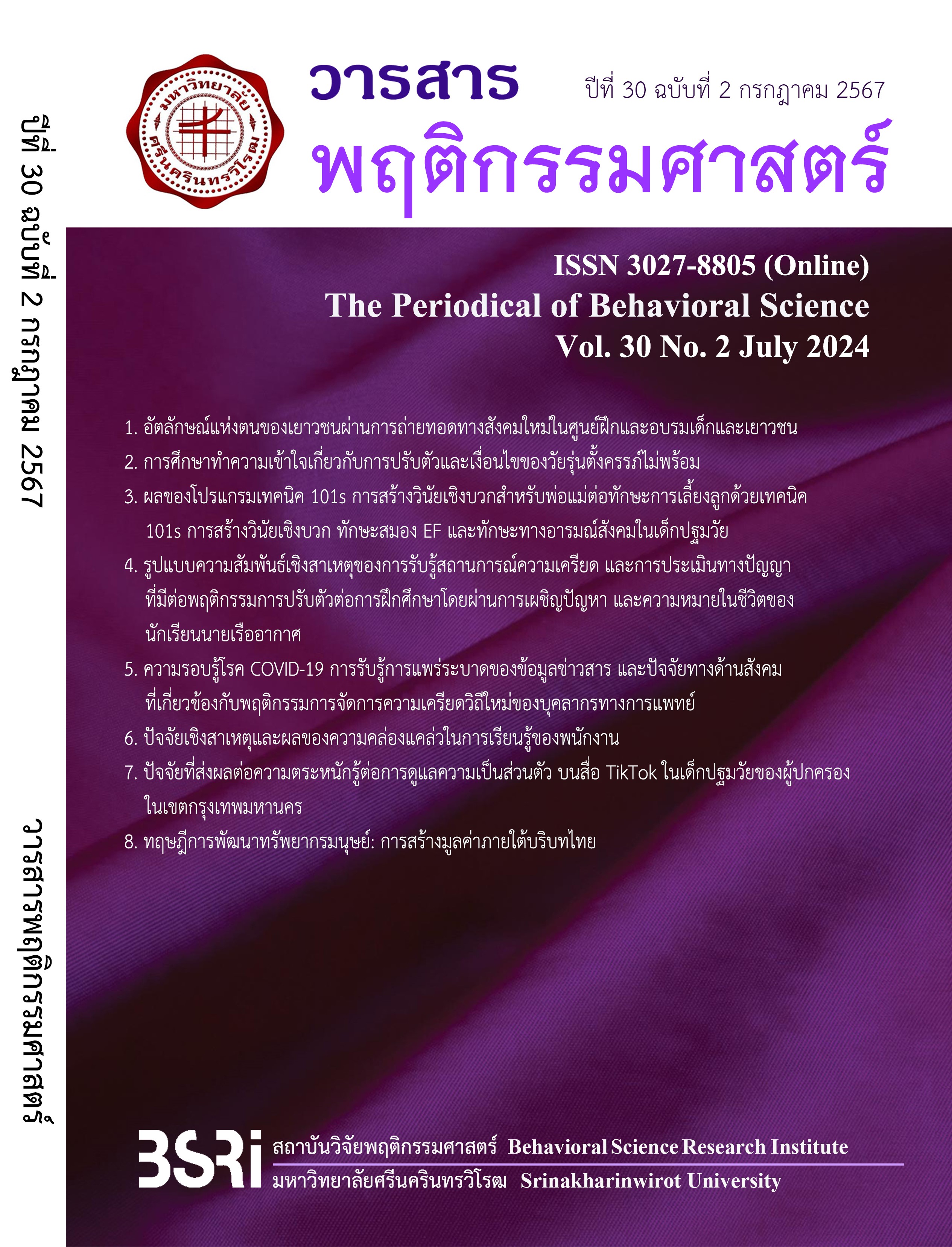
ความรอบรู้โรค COVID-19 การรับรู้การแพร่ระบาดของข้อมูลข่าวสาร และปัจจัยทางด้านสังคมที่เกี่ยวข้องกับพฤติกรรมการจัดการความเครียดวิถีใหม่ของบุคลากรทางการแพทย์
คำสำคัญ:
พฤติกรรมการจัดการความเครียดวิถีใหม่, โรค COVID-19 บุคลากรทางการแพทย์บทคัดย่อ
การศึกษาครั้งนี้ เป็นการวิจัยเชิงปริมาณ มีความมุ่งหมาย เพื่อค้นหาตัวแปรที่มีบทบาทสำคัญในการทำนายพฤติกรรมการจัดการความเครียดวิถีใหม่ของปัจจัยด้านการรู้คิด ปัจจัยทางด้านสังคม โดยกลุ่มตัวอย่างในการศึกษา คือ บุคลากรทางการแพทย์ที่ปฏิบัติงานในโรงพยาบาลระดับตติยภูมิในจังหวัดนครราชสีมา 3 แห่ง โดยการเลือกกลุ่มตัวอย่างแบบกำหนดโควต้า จำนวน 409 คน รวบรวมข้อมูลโดยใช้แบบสอบถามมาตรส่วนประเมินค่า 6 ระดับ ได้แก่ แบบวัดพฤติกรรมการจัดการความเครียดวิถีใหม่ แบบวัดปัจจัยด้านการรู้คิด และปัจจัยทางด้านสังคม โดย มีค่าความเชื่อมั่นสัมประสิทธิ์แอลฟาครอนบาค ระหว่าง 0.692 - 0.918 ในการวิจัยครั้งนี้ ผู้วิจัยใช้สถิติเชิงพรรณนาและการวิเคราะห์ด้วยสถิติถดถอยแบบขั้นตอน ผลการศึกษา พบว่า 1) ปัจจัยที่มีผลต่อพฤติกรรมการจัดการความเครียดวิถีใหม่ในด้านรวม สามารถร่วมกันทำนายได้ร้อยละ 53.80 คือ การสนับสนุนทางสังคม ความรอบรู้โรค COVID-19 และการสื่อสารที่มีประสิทธิภาพในโรงพยาบาล 2) ปัจจัยที่มีผลต่อพฤติกรรมการจัดการปัญหาวิถีใหม่ สามารถร่วมกันทำนาย ได้ร้อยละ 52.60 คือ ความรอบรู้โรค COVID-19 การสนับสนุนทางสังคม และการสื่อสารที่มีประสิทธิภาพในโรงพยาบาล 3) ปัจจัยที่มีผลต่อพฤติกรรมการจัดการอารมณ์วิถีใหม่ สามารถร่วมกันทำนาย ได้ร้อยละ 42.20 คือ ความรอบรู้โรค COVID-19 การสนับสนุนทางสังคม การรับรู้การแพร่ระบาดของข้อมูลข่าวสาร และการสื่อสารที่มีประสิทธิภาพในโรงพยาบาล ทั้งนี้ จากผลการวิจัย ในการนำไปใช้เป็นแนวทางปฏิบัติ ในการเพิ่มพูนความรอบรู้เรื่องสุขภาพที่เกี่ยวข้องกับโรคอุบัติใหม่ให้แก่บุคลากรทางการแพทย์ และจัดหากิจกรรมเสริมสร้างพฤติกรรมการจัดการความเครียดที่ดีต่อไป
Downloads
เอกสารอ้างอิง
Aljassim, N., & Ostini, R. (2020). Health literacy in rural and urban populations: A systematic review. Patient Educ Couns, 103(10), 2142-2154. https://doi.org/10.1016/j.pec.2020.06.007
Berlo, D. K. (1977). Communication as Process: Review and Commentary. https://doi.org/10.1080/23808985.1977.11923667
Biggs, A., Brough, P., & Drummond, S. (2017). Lazarus and Folkman's Psychological Stress and Coping Theory. John Wiley & Sons.
Brennen, J., Simon, F., Howard, P., & Nielsen, R. (2020). Types, Sources, and Claims of COVID-19 Misinformation. https://www.publicmediaalliance.org/publications/types-sources-and-claims-of-covid-19-misinformation/
Chaikit, P., & Chitsawang, S. (2020). Situations and impacts of fake news 's infodemic about the coronavirus disease 2019 (COVID-19) pandemic and the preventive measurements in Thailand [Doctoral dissertation]. Chulalongkorn University.
Chalaemwong, Y., Chitsuchon, S., & Tharasang, K. (2020). Effect of COVID-19 to Labor market: Empirical data. https://tdri.or.th/2020/06/covid-19-labour-market-impact-in-thailand/
Chew, Q. H., Wei, K. C., Vasoo, S., Chua, H. C., & Sim, K. (2020). Narrative synthesis of psychological and coping responses towards emerging infectious disease outbreaks in the general population: Practical considerations for the COVID-19 pandemic. Singapore Med J, 61(7), 350-356. https://doi.org/10.11622/smedj.2020046.
Choomb, W. (2015). Ongoing crisis communications: Planning, managing and responding (4th ed.). Sage.
Constant, A., Conserved, D. F., Gallopel-Morvan, K., & Raude, J. (2020). Socio-Cognitive Factors Associated with Lifestyle Changes in Response to the COVID-19 Epidemic in the General Population: Results from a Cross-Sectional Study in France [Original Research]. https://doi.org/10.3389/fpsyg.2020.579460
Department of Disease Control. (2020). The situation of COVID-19 spreading, measure of public health and problems to disease prevention and control in travelers. https://ddc.moph.go.th/uploads/files/2017420210820025238.pdf
Department of Mental Health. (2020) Combat 4th Wave of COVID-19:C4 [Guideline of Mental Health Recovery in The Situation of COVID-19 Spreading]. Hanghunsuanchamkat Printing.
Fu, W., Wang, C., Zou, L., Guo, Y., Lu, Z., Yan, S., & Mao, J. (2020). Psychological health, sleep quality, and coping styles to stress facing the COVID-19 in Wuhan, China. Translational Psychiatry, 10(1), 225. https://doi.org/10.1038/s41398-020-00913-3
Ireton, C., & Posetti, J. (2018). Journalism, fake news & disinformation: Handbook for journalism education and training. UNESCO Publishing.
Islam, M. S., Sarkar, T., Khan, S. H., Kamal, A. H. M., Hasan, S. M., Kabir, A., & Anwar, K. S. (2020). COVID-19–related infodemic and its impact on public health: A global social media analysis. The American Journal of Tropical Medicine and Hygiene, 103(4), 1621-1629.
Kerdcharoen, N., Kolkijkovin, V., & Thaworn, J. (2021). Resilience, Mental Health Impact and COVID-19 Related Mental Health Determinants among Medical Students during COVID-19 Epidemic. Vajira Medical Journal: Journal of Urban Medicine, 65, S101-116. https://doi.org/10.14456/vmj.2021.56
Lazarus, R. S., & Folkman, S. (1984). Stress, appraisal, and coping. Springer.
Montano, R. L. T., & Acebes, K. M. L. (2020). Covid stress predicts depression, anxiety and stress symptoms of Filipino respondents. International Journal of Research in Business and Social Science (2147- 4478), 9(4), 78-103. https://doi.org/10.20525/ijrbs.v9i4.773
National Health. (2021). National Health create' Next Normal' values to reduce the risk of COVID-19). https://www.nationalhealth.or.th/th/node/3011
Nuallaong, P. (2022). Factors Affecting Quality of Life of Emergency Room Doctors and urses in Public and Private Hospitals Affected by COVID-19 in the Eastern Economic Corridor Area. Journal of Health Science of Thailand, 31, 177-184.
Phensinee, W., & Somdach, R. (2023). Orgnizational Communication in the Situation of COVID-19 Spreading: A Case study of Golden Jubilee Medical Center). Warasan Nawatkam Sangkhom Læ Thekmoloyi Susanmuanchon, 6(1), 23-32. https://doi.org/10.14456/jsmt.2023.3
Qi, M., Zhou, S.-J., Guo, Z.-C., Zhang, L.-G., Min, H.-J., Li, X.-M., & Chen, J.-X. (2020). The Effect of Social Support on Mental Health in Chinese Adolescents During the Outbreak of COVID-19. Journal of Adolescent Health, 67(4), 514-518. https://doi.org/10.1016/j.jadohealth.2020.07.001
Rawunit, W., & Tepjak, P. (2021). Exposure to Media about COVID-19 from the Department of Disease Control and Audience’s Fake New Literacy). National Academic Conference Rangsit University 2021, Rangsit University.
Rea, L. M., & Parker, R. A. (2014). Designing and Conducting Survey Research: A Comprehensive Guide (4th ed.). Jossey-Bass.
Rujivatanapong, W., & Jirapatarachotmanee, J. (2022). Compare the total worker health care of Nakhonpathom hospital personal before and when COVID-19 outbreak. Department of health Service Support Journal, 18(2), 57-66.
Saltzman, L. Y., Hansel, T. C., & Bordnick, P. S. (2020). Loneliness, isolation, and social support factors in post-COVID-19 mental health. Psychol Trauma, 12(S1), S55-s57. https://doi.org/10.1037/tra0000703
Schaefer, C., Coyne, J. C., & Lazarus, R. S. (1981). The health-related functions of social support. Journal of Behavioral Medicine, 4(4), 381-406. https://doi.org/10.1007/BF00846149
Sørensen, K., Van den Broucke, S., Fullam, J., Doyle, G., Pelikan, J., Slonska, Z., Brand, H., & Consortium Health Literacy Project European. (2012). Health literacy and public health: A systematic review and integration of definitions and models. BMC Public Health, 12(1), 80. https://doi.org/10.1186/1471-2458-12-80
Tagliabue, F., Galassi, L., & Mariani, P. (2020). The Pandemic of Disinformation in COVID-19. SN comprehensive clinical medicine, 1-3. https://doi.org/10.1007/s42399-020-00439-1
Talaee, N., Varahram, M., Jamaati, H., Salimi, A., Attarchi, M., Dizaji, M. Z., Sadr, M., Hassani, S., Farzanegan, B., Monjazebi, F., & Seyedmehdi, S. M. (2020). Stress and burnout in health care workers during COVID-19 pandemic: Validation of a questionnaire. Journal of Public Health: From Theory to Practice, 30, 531–536.
Tannukit, P., Sukkasi, S., & Kobsiriphat, W. (2023). Take lessons from human resources management and development in dealing with the COVID-19 situation. Journal of Charoenkrung Pracharak Hospital, 19(1), 9–15.
Thai Health. (2020). New Normal Life. https://www.thaihealth.or.th/?p=197928.
Thomas, G. F., Zolin, R., & Hartman, J. L. (2009). The Central Role of Communication in Developing Trust and Its Effect on Employee Involvement. The Journal of Business Communication (1973), 46(3), 287-310. https://doi.org/10.1177/0021943609333522
World Health Organization. (2024). Situation of coronavirus disease 2019 in Thailand: 2 May 2024. https://www.who.int/thailand/th/news/detail/02-05-2567-update-on-covid-19-in-thailand--02-may-2024
Xiao, H., Zhang, Y., Kong, D., Li, S., & Yang, N. (2020). The Effects of Social Support on Sleep Quality of Medical Staff Treating Patients with Coronavirus Disease 2019 (COVID-19) in January and February 2020 in China. Medical science monitor: international medical journal of experimental and clinical research, 26, e923549. https://doi.org/10.12659/MSM.923549
ดาวน์โหลด
เผยแพร่แล้ว
รูปแบบการอ้างอิง
ฉบับ
ประเภทบทความ
สัญญาอนุญาต
ลิขสิทธิ์ (c) 2024 วารสารพฤติกรรมศาสตร์

อนุญาตภายใต้เงื่อนไข Creative Commons Attribution-NonCommercial-NoDerivatives 4.0 International License.
สถาบันวิจัยพฤติกรรมศาสตร์ มหาวิทยาลัยศรีนครินทรวิโรฒ
114 ซอยสุขุมวิท 23 ถนนสุขุมวิท แขวงคลองเตยเหนือ เขตวัฒนา กรุงเทพฯ 10110
โทร 02-649-5000 ต่อ 17600


