
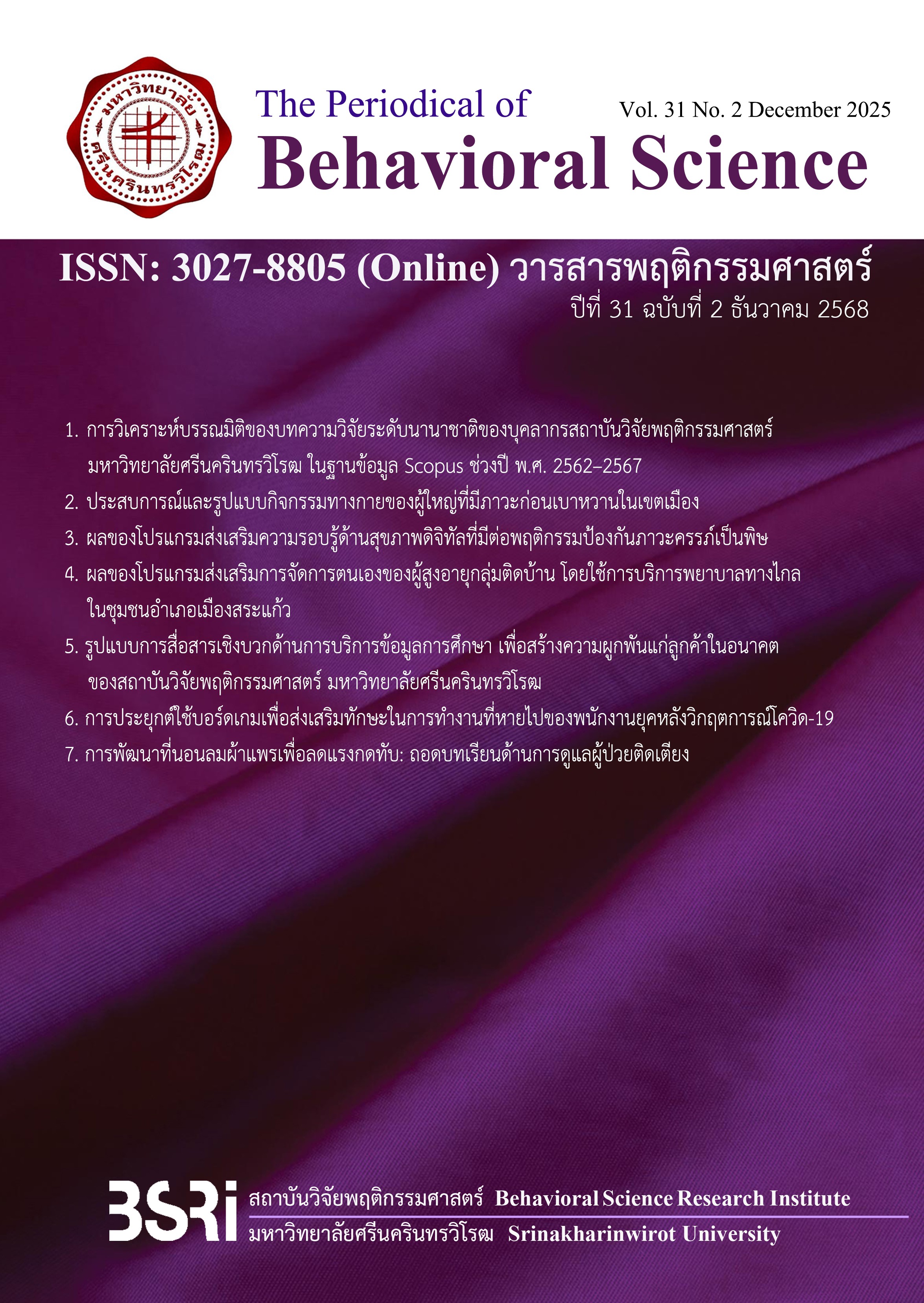
Experiences and Patterns of Physical Activity among Urban Adults with Prediabetes
Keywords:
Prediabetes, Physical activity, Urban health, Lifestyle behaviors, Social determinantsAbstract
Diabetes poses a pressing public health concern, with prevalence rising globally and in Thailand. Individuals with prediabetes are at elevated risk of progressing to type 2 diabetes within 5–10 years if preventive measures are not undertaken. Insufficient physical activity is a critical modifiable risk factor, particularly in urban contexts where sedentary occupations, constrained environments, and time-limited lifestyles restrict opportunities for movement. This study explored patterns of physical activity among adults with prediabetes living in an urban district of Bangkok. A qualitative case study design was employed, and data were collected between May and September 2024 through semi-structured in-depth interviews and participant observation with 15 participants diagnosed with prediabetes. Data were analyzed using thematic analysis. Four central themes emerged: (1) work demands and the rhythms of urban life as determinants of physical activity; (2) urban infrastructure and commuting challenges as constraints, with participants compensating through small bouts of activity; (3) limited leisure time, diverse meanings attached to physical activity, and social capital as factors influencing adherence; and (4) perceptions of prediabetes and external cues, including clinical results and family history, as triggers for incremental lifestyle changes. The results of this study therefore emphasize that interventions aimed at promoting physical activity among at-risk urban populations should transcend individual-level counseling. They should encompass policy reforms at the urban level to facilitate and ensure the safety of walking and cycling, in conjunction with the development of community-based support mechanisms designed to mitigate time constraints and environmental barriers commonly encountered by this population.
Downloads
References
Aekplakorn, W., Phakcharoen, H., & Sathiannoppakao, W. (2021). The 6th Thai national health examination survey 2019–2020. Aksorn Graphic and Design Publishing. https://www.hsri.or.th/printed-matter/399 [in Thai]
Braun, V., & Clarke, V. (2006). Using thematic analysis in psychology. Qualitative Research in Psychology, 3(2), 77–101. https://doi.org/10.1191/1478088706qp063oa
Colberg, S. R., Sigal, R. J., Yardley, J. E., Riddell, M. C., Dunstan, D. W., Dempsey, P. C., Horton, E. S., Castorino, K., & Tate, D. F. (2016). Physical activity/exercise and diabetes: A position statement of the American Diabetes Association. Diabetes Care, 39(11), 2065–2079. https://doi.org/10.2337/dc16-1728
Guest, G., Namey, E., & Chen, M. (2020). A simple method to assess and report thematic saturation in qualitative research. PloS One, 15(5), e0232076. https://doi.org/10.1371/journal.pone.0232076
Heaney, C. A., & Israel, B. A. (2008). Social networks and social support. In K. Glanz, B. K. Rimer, & K. Viswanath (Eds.), Health behavior and health education: Theory, research, and practice (4th ed., pp. 189–210). Jossey-Bass.
Kunno, J., Luangwilai, T., Manomaipiboon, B., Onklin, I., Ong-artborirak, P., Krainara, P., Chaichana, T., & Robson, M. G. (2024). The urban health themes and urban factors associated with health: A brief review. Vajira Medical Journal, 68(4), e269743. https://doi.org/10.62691/vmj.2024.269743
International Diabetes Federation. (2024). IDF Diabetes Atlas (11th ed.). https://diabetesatlas.org/media/uploads/sites/3/2025/04/IDF_Atlas_11th_Edition_2025.pdf
Levine J. A. (2002). Non-exercise activity thermogenesis (NEAT). Best Practice & Research Clinical Endocrinology & Metabolism, 16(4), 679–702. https://doi.org/10.1053/beem.2002.0227
Lincoln, Y. S., & Guba, E. G. (1985). Naturalistic inquiry. Sage.
Marmot, M., Friel, S., Bell, R., Houweling, T. A., & Taylor, S. (2008). Closing the gap in a generation: health equity through action on the social determinants of health. Lancet, 372(9650), 1661–1669. https://doi.org/10.1016/S0140-6736(08)61690-6
Michie, S., Abraham, C., Whittington, C., McAteer, J., & Gupta, S. (2009). Effective techniques in healthy eating and physical activity interventions: A meta-regression. Health Psychology, 30(6), 710–715. https://doi.org/10.1037/a0016136
Rosenstock, I. M. (1974). Historical origins of the health belief model. Health Education Monographs, 2(4), 328–335. https://doi.org/10.1177/109019817400200403
Stake, R. E. (1995). The art of case study research. Sage.
Tabák, A. G., Herder, C., Rathmann, W., Brunner, E. J., & Kivimäki, M. (2012). Prediabetes: A high-risk state for diabetes development. The Lancet, 379(9833), 2279–2290. https://doi.org/10.1016/S0140-6736(12)60283-9
Umpierre, D., Ribeiro, P. A. B., Kramer, C. K., Leitão, C. B., Zucatti, A. T. N., Azevedo, M. J., Gross, J. L., Ribeiro, J. P., & Schaan, B. D. (2011). Physical activity advice only or structured exercise training and association with HbA1c levels in type 2 diabetes: A systematic review and meta-analysis. JAMA, 305(17), 1790–1799. https://doi.org/10.1001/jama.2011.576
Vichitkunakorn, P., Bunyanukul, W., Apiwan, K., Tanasanchonnakul, D., & Sittisombut, M. (2025). Prevalence of non-communicable disease risk factors and their association with economic status: findings from the 2021 health behaviour of population survey in Thailand. Global Health Action, 18(1), 2485689. https://doi.org/10.1080/16549716.2025.2485689
World Health Organization. (2018). Global action plan on physical activity 2018–2030: More active people for a healthier world. WHO. https://www.who.int/publications/i/item/9789241514187
Yin, R. K. (2017). Case study research and applications: Design and methods (6th ed.). Sage.
Downloads
Published
How to Cite
Issue
Section
License
Copyright (c) 2025 The Periodical of Behavioral Science

This work is licensed under a Creative Commons Attribution-NonCommercial-NoDerivatives 4.0 International License.
Behavioral Science Research Institute, SWU
114 Sukhumvit 23, Bangkok 10110, Thailand.
Tel.02-649-5000 # 17600


