
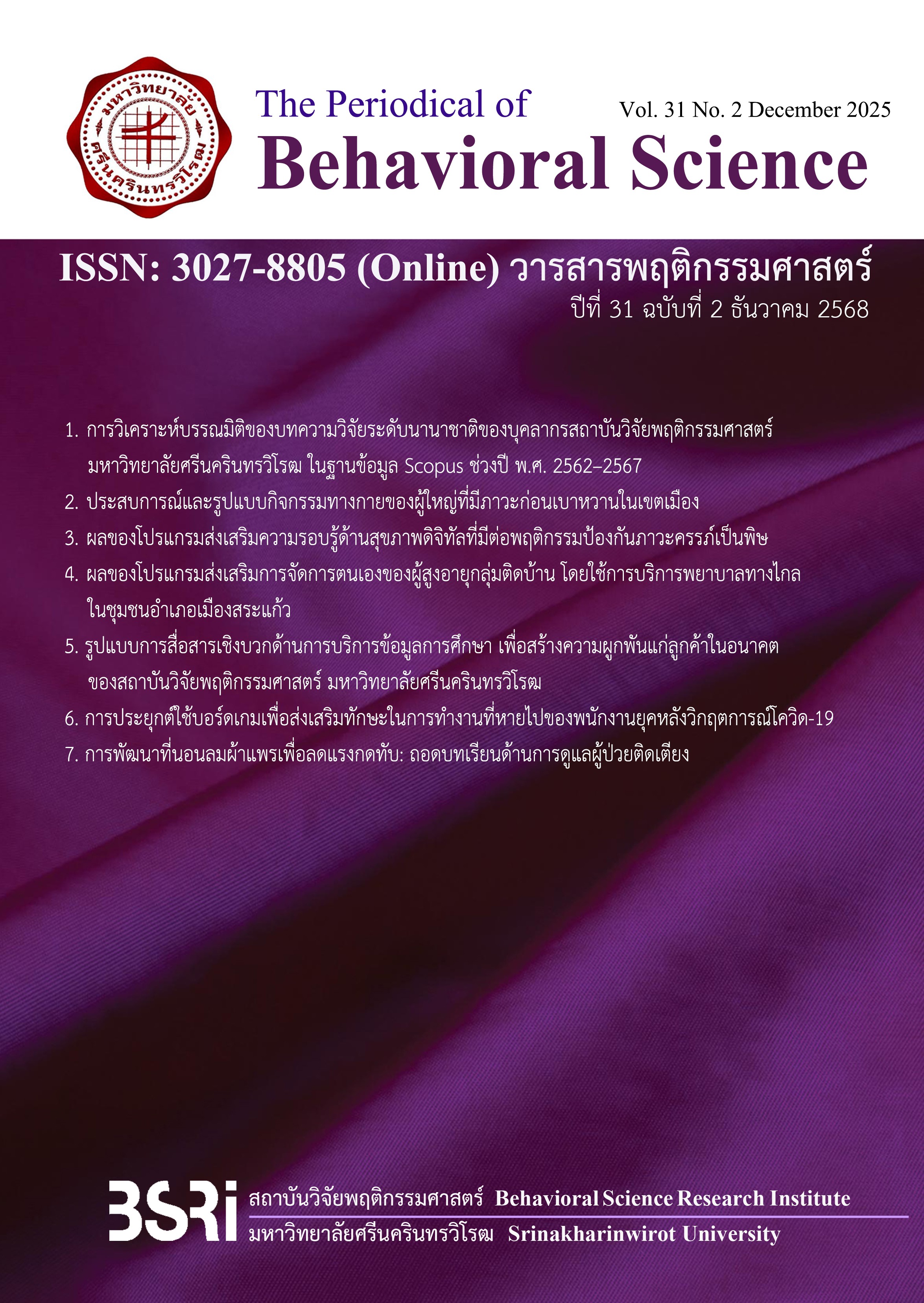
A Positive Communication Model of Educational Data Services for Building Engagement among future Customer at the Behavioral Science Research Institute, Srinakharinwirot University
Keywords:
Positive Communication, Customer Engagement, Educational Information Services, Prospective Student BehaviorAbstract
This study aimed to examine the current problems, needs, and educational information services in order to develop a positive communication model for educational information services and to test its effectiveness in enhancing engagement among prospective graduate students of the Behavioral Science Research Institute, Srinakharinwirot University. A mixed-methods approach was employed, consisting of qualitative research through focus group discussions with eight graduate students and quantitative research using a questionnaire administered to 32 participants to evaluate the model’s effectiveness. The findings revealed that prospective students encountered inconsistent information across channels, a lack of a centralized information system, and insufficient clarity of essential information required for decision-making. At the same time, they expressed the need for complete, easy-to-understand basic information and preferred communication channels that were convenient to access. They were also found to search for program information well in advance, typically 1–3 years before applying. Insights from the focus groups were used to develop a positive communication model comprising key components related to content, tone of communication, communication channels, interaction, and communication consistency. The model was grounded in principles of empathy, creative language use, value creation, trust building, and accessibility. The evaluation results showed that participants’ engagement scores significantly increased after receiving the positive communication model (t = 5.30, p < .01), demonstrating the model’s effectiveness in strengthening engagement among prospective graduate students. The study highlights the importance of an integrated communication system that provides accurate, reliable, and two-way information to enable educational institutions to function as decision-making facilitators. The positive communication model developed in this study offers practical and policy-level guidance for designing program communication systems, enhancing staff communication competencies, and improving the overall experience of prospective students. Ultimately, it supports increased recruitment opportunities, fosters long-term relationships, and strengthens institutional competitiveness in the digital era.
Downloads
References
AL Hilal, N. S. H. (2024). The relationship between the sustainability of brand marketing communications and the well-being of the Saudi Consumer. Sustainability, 16(21), 9233. https://doi.org/10.3390/su16219233
Blumer, H. (1969). Symbolic interactionism: Perspective and method. University of California Press.
Briggs, S. (2006). An exploratory study of the factors influencing undergraduate student choice: The case of higher education in Scotland. Studies in Higher Education, 31(6), 705–722. https://doi.org/10.1080/03075070601004333
Brodie, R. J., Hollebeek, L. D., Jurić, B., & Ilić, A. (2011). Customer engagement: Conceptual domain, fundamental propositions, and implications for research. Journal of Service Research, 14(3), 252–271. https://doi.org/10.1177/1094670511411703
Caferra, R., Schirone, D. A., Tiranzoni, P., & Morone, A. (2025). Exploring the impact of targeted communication on customer experience: A natural experiment. Journal of Retailing and Customer Services, 84, 104240. https://doi.org/10.1016/j.jretconser.2025.104240
Cameron, K. (2012). Positive leadership: Strategies for extraordinary performance. Berrett-Koehler Publishers.
Carlson, J. R., & Zmud, R. W. (1999). Channel expansion theory and the experiential nature of media richness perceptions. Academy of Management Journal, 42(2), 153–170. https://www.jstor.org/stable/257090
Deci, E. L., & Ryan, R. M. (2000). The "what" and "why" of goal pursuits: Human needs and the self-determination of behavior. Psychological Inquiry, 11(4), 227–268. https://doi.org/10.1207/S15327965PLI1104_01
Dutton, J. E., & Heaphy, E. D. (2003). The power of high-quality connections. In K. S. Cameron, J. E. Dutton, & R. E. Quinn (Eds.), Positive organizational scholarship: Foundations of a new discipline (pp. 263–278). Berrett-Koehler Publishers.
Hao, R., Jiang, J., & Na, R. (2025). Customer brand engagement in brands’ self-built live streaming e-commerce: A mixed-methods study. Asia Pacific Journal of Marketing and Logistics. https://doi.org/10.1108/APJML-11-2024-1755
Kerr, G., Lings, I., Terry, L., Richards, J., & Muirhead, B. (2024). Competitive advantage for life: An industry view of marketing communication education. Journal of Marketing Communications, 30(2), 265–281. https://doi.org/10.1080/13527266.2023.2280055
Liang, S., Li, Y., & Yang, Y. (2025). Is student engagement without classroom social climate possible? A necessary condition analysis. Humanities and Social Sciences Communications, 12, 1689. https://doi.org/10.1057/s41599-025-05910-9
Lipshitz, R., & Strauss, O. (1997). Coping with uncertainty: A naturalistic decision-making analysis. Organizational Behavior and Human Decision Processes, 69(2), 149–163. https://doi.org/10.1006/obhd.1997.2679
McEwen, W. J. (2005). Married to the brand: Why consumers bond with some brands for life. Gallup Press.
McNicholas, C., & Marcella, R. (2024). An interactive decision-making model of international postgraduate student course choice. Journal of Marketing for Higher Education, 34(2), 802–827. https://doi.org/10.1080/08841241.2022.2076276
Muñiz-Velázquez, J. A., & Pulido, C. M. (Eds.). (2019). The routledge handbook of positive communication. Routledge.
Nim-on, W., & Cheyjunya, P., (2022). Communication strategies and factors affecting the decision of post-graduate students’ about choosing an open university in the digital era. Journal of Communication Arts Review. 26(3), 126–140. https://so06.tci-thaijo.org/index.php/jca/article/view/259163/174234. [in Thai]
Office of the Permanent Secretary. (2024). Education criteria for performance excellence (EdPEx) 2024–2027 Framework. Ministry of Higher Education, Science, Research and Innovation. Parbpim. [in Thai]
Peña-García, N., Losada-Otálora, M., Auza, D. P., & Cruz, M. P. (2024). Reviews, trust, and customer experience in online marketplaces: The case of Mercado Libre Colombia. Frontiers in Communication, 9, 1460321. https://doi.org/10.3389/fcomm.2024.1460321
Phan, T. A. (2025). The role of positive communication in enhancing educational outcomes. Business and Professional Communication Quarterly. https://doi.org/10.1177/23294906251345789
Pimpaporn, N., Boonyaprapan, B., & Petchprayoon, C. (2023). The effect of positive communication development course at work of operational employees in industrial work. Journal of Humanities and Social Sciences Songkhla Rajabhat University, 5(2), 127–165. https://so03.tci-thaijo.org/index.php/husoskru/article/view/267918 [in Thai]
Prasertsuk, N. (2015). Constructive Communication for Family Happiness. Veridian E-Journal, Slipakorn University, 8(2), 737–747. https://he02.tci-thaijo.org/index.php/Veridian-E-Journal/article/view/38603/31946. [in Thai]
Puttaphol, K., & Srijumpa, R. (2021). Modern franchise marketing strategy affecting brand engagement of local franchise in eastern economic corridor (EEC). Panyapiwat Journal, 13(3), 30–43. https://so05.tci-thaijo.org/index.php/pimjournal/article/view/247247 [in Thai]
Redman, T. C. (2016). Getting in front on data: Who does what. MIT Sloan Management Review.
Seligman, M. E. P. (1998). Learned optimism. Simon & Schuster.
Sicilia, M., & Palazón, M. (2023). Developing customer engagement through communication consistency and channel coordination. Spanish Journal of Marketing - ESIC, 27(2), 241–260. https://doi.org/10.1108/SJME-02-2022-0022
Socha, T. J., & Pitts, M. J. (Eds.). (2012). The positive side of interpersonal communication. Peter Lang Publishing.
Suksida, T., & Korcharoen, M. (2022). Integrated marketing communications influencing the decision to study in private higher education institutions in the new normal. Interdisciplinary Social Sciences and Communication Journal, 5(2), 63–74. https://so02.tci-thaijo.org/index.php/ISSC/article/view/249341 [in Thai]
Suwannakorn, S. (2016). Guidelines for creative communication for khon kaen city development. Local Administration Journal, 9(2), 108–117. https://so04.tci-thaijo.org/index.php/colakkujournals/article/view/88243 [in Thai]
Tontrong, C., Patphol, M., Heamaprasit., & Wongyai, W. (2022) A study of creative communication skills for student teachers. Journal of Research Methodology, 35(3), 218–233. https://doi.org/10.14456/jrm.2022.13 [in Thai]
van Doorn, J., Lemon, K. N, Mittal, V., Nass, S., Pick, D., Pirner, P., & Verhoef, P. C. (2010). Customer engagement behavior: Theoretical foundations and research directions. Journal of Service Research, 13(3), 253–266. https://doi.org/10.1177/1094670510375599
Venkatesh, V., Morris, M. G., Davis, G. B., & Davis, F. D. (2003). User acceptance of information technology: Toward a unified view. MIS Quarterly, 27(3), 425–478. https://doi.org/10.2307/30036540
Wilson, T. D. (1999). Models in information behavior research. Journal of Documentation, 55(3), 249–270. https://doi.org/10.1108/EUM0000000007145
Zielke, S., & Komor, M. (2025). Why do customers choose online or offline channels? A framework of motives and its application in an international context. Journal of Retailing and Consumer Services, 82, 104054. https://doi.org/10.1016/j.jretconser.2024.104054
Downloads
Published
How to Cite
Issue
Section
License
Copyright (c) 2025 The Periodical of Behavioral Science

This work is licensed under a Creative Commons Attribution-NonCommercial-NoDerivatives 4.0 International License.
Behavioral Science Research Institute, SWU
114 Sukhumvit 23, Bangkok 10110, Thailand.
Tel.02-649-5000 # 17600


