An Investigation of Barriers and Strategies in English-Speaking Skills for Buddhist Monks during Chatting Activities with Foreigners
คำสำคัญ:
Barriers, Strategies, Buddhist Monks, Intercultural Communication, English as a Lingua Francaบทคัดย่อ
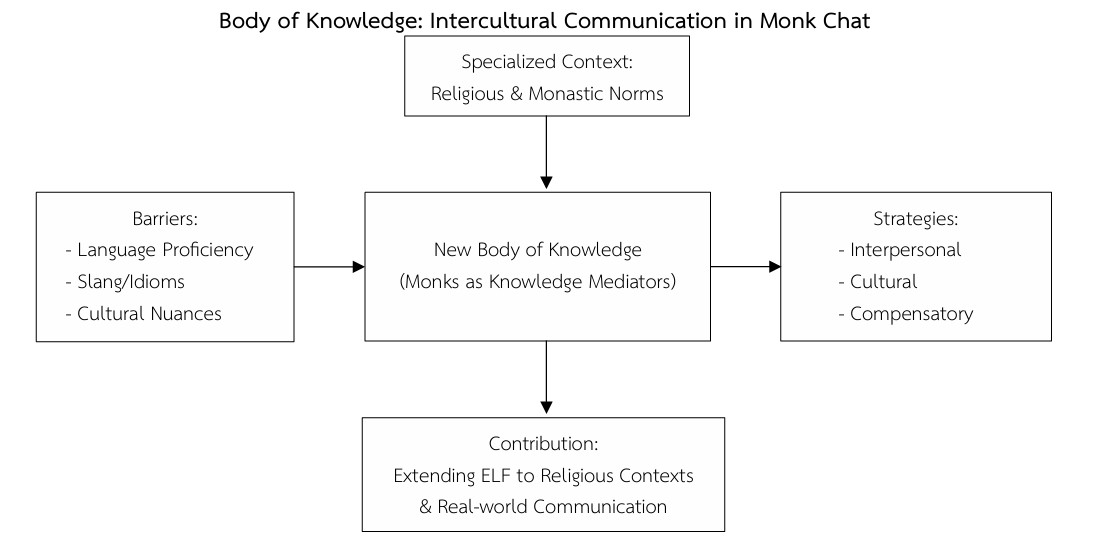
This study investigated (1) English-speaking barriers experienced by Thai Buddhist monks when communicating with foreigners during Monk Chat activities about Buddhism and (2) strategies used to overcome these barriers. Participants were 30 Buddhist monks from Mahachulalongkornrajavidyalaya University (MCU), Chiang Mai Campus, Thailand, purposively selected based on active participation in the Monk Chat Program. Data were collected using two 5-point Likert-scale questionnaires (barriers and strategies) and semi-structured interviews with 10 volunteer monks. A convergent mixed-methods design was employed, integrating descriptive statistics (means, standard deviations, and percentages) with thematic analysis. Results showed that intercultural communication barriers occurred at a moderate level. The most salient barriers were understanding slang/idioms and language proficiency. Monks reported difficulties with fluency, comprehending diverse accents, translating Buddhist terminology, and responding spontaneously. External constraints included limited opportunities for practice and challenges related to foreigners’ speech patterns. Regarding coping strategies, monks reported frequent overall strategy use. Social skills were used most often, particularly active listening and showing cultural respect, followed by personal skills, non-verbal strategies, and verbal strategies such as approximation, paraphrasing, and clarification requests. Peer support and technology use also emerged as supplementary strategies. Overall, the findings indicate that monks manage linguistic limitations through interpersonal sensitivity and strategic resourcefulness in authentic intercultural exchanges.
เอกสารอ้างอิง
Baker, W. (2011). Intercultural awareness: Modelling an understanding of cultures in intercultural communication through English as a lingua franca. Language and intercultural communication, 11(3), 197-214.
Boonmatun, S., & Huttayavilaiphan, R. (2025). Intercultural communication in the temple: Challenges and strategies for Thai monks using English to share Buddhist teachings. World Journal of English Language, 15(5), 141-155.
Braun, V., & Clarke, V. (2006). Using thematic analysis in psychology. Qualitative Research in Psychology, 3(2), 77-101.
Byram, M. (1997). Teaching and assessing intercultural communicative competence. Bristol: Multilingual Matters.
Chand, G. B. (2021). Challenges faced by bachelor level students while speaking English. Indonesian Journal of English Language Teaching and Applied Linguistics, 6(1), 45-60.
Chuanchaisit, S., & Prapphal, K. (2024). A study of English communication strategies of Thai university students. MANUSYA: Journal of Humanities, 12(3), 100-126.
Chuanpongpanich, S. (2021). The challenges of Thailand in promoting the students' English skills to be an effective ASEAN citizen. Santapol College Academic Journal, 7(2), 229-238.
Coskun, A. (2016). Benefits of out-of-class speaking activities for EFL students. Uluslararasi Turkce Edebiyat Kultur Egitim Dergisi, 5(3), 1448-1464.
Creswell, J. W., & Plano Clark, V. L. (2018). Designing and conducting mixed methods research. (3rd ed.). Thousand Oaks, California: SAGE Publications.
Deardorff, D. K. (2006). Identification and assessment of intercultural competence as a student outcome of internationalization. Journal of Studies in International Education, 10(3), 241-266.
EF Education First. (2023). EF English Proficiency Index: Thailand. Retrieved from https://www.ef.com/epi/regions/asia/thailand.
Faerch, C., & Kasper, G. (1983). Strategies in interlanguage communication. Harlow: Longman.
Fetters, M. D., Curry, L. A., & Creswell, J. W. (2013). Achieving integration in mixed methods designs—Principles and practices. Health Services Research, 48(6), 2134-2156.
Kramsch, C. (1993). Context and culture in language teaching. Oxford: Oxford University Press.
Krashen, S. (1982). Principles and practice in second language acquisition. New York: Pergamon Press.
Library of Congress. (2024). Defining globalization. Globalization: A resource guide. Retrieved from https://guides.loc.gov/globalization/definition.
Listyani, L., & Kristie, L. S. (2018). Teachers' strategies to improve students' self-confidence in speaking: A study at two vocational schools in Central Borneo. Register Journal, 11(2), 139-153.
Littlewood, W. (2013). Developing a context-sensitive pedagogy for communication-oriented language teaching. English Teaching, 68(3), 3-25.
Pavenkov, O., & Rubtcova, M. (2021, August 6). Barriers in intercultural communication. Retrieved from https://papers.ssrn.com/sol3/papers.cfm?abstract_id=3983460.
Purba, H. (2021). Intercultural communicative competence in the 21st century: Challenges and opportunities. Journal of English Education and Linguistics Studies, 8(1), 12–30.
Rahayu, N. (2015). An analysis of students' problems in speaking English daily language program at Husnul Khotimah Islamic Boarding School. (Doctoral dissertation, IAIN Syekh Nurjati Cirebon).
Revida, E., Trimurni, F., & Purba, S. (2021). The innovation of tourist villages to enhance tourist visits in Samosir, North Sumatera. Review of International Geographical Education Online, 11(5), 2526-2533.
Schedneck, B. (2021). Religious tourism in northern Thailand: Encounters with Buddhist monks. Seattle: University of Washington Press.
Simmali, J., & Huttayavilaiphan, R. (2025). Intercultural communication barriers and strategies of Thai Buddhist monks with foreigners at an international Buddhist center in Thailand. Journal of Social Science Panyapat, 7(1), 223-240.
Spencer-Oatey, H., & Franklin, P. (2009). Intercultural interaction: A multidisciplinary approach to intercultural communication. London: Palgrave Macmillan.
Srinok, S., Wongsuwan, N., Buppapan, S., Widesbrommakun, P., & Thongdee, V. (2021). Buddhism and Thai educational system: Historical perspectives. Linguistics and Culture Review, 5(4), 1336-1346.
Tahe, A. (2020). The problems of Thai students in mastering English speaking skills in the Islamic University of Lamongan. E-Link Journal, 7(2), 1-16.
Wongkumsai, S. (2023). The importance of English in Thai society and in technology. Northeastern University Academic and Research Journal, 13(2), 232-239.
ดาวน์โหลด
เผยแพร่แล้ว
รูปแบบการอ้างอิง
ฉบับ
ประเภทบทความ
สัญญาอนุญาต
ลิขสิทธิ์ (c) 2026 วารสารสังคมศาสตร์ปัญญาพัฒน์

อนุญาตภายใต้เงื่อนไข Creative Commons Attribution-NonCommercial-NoDerivatives 4.0 International License.


