An Empirical Study on Cross-Cultural Teaching Management in Guangxi Universities Against the Backdrop of China-ASEAN Cooperation
คำสำคัญ:
China-ASEAN Cooperation, Guangxi Universities, Cross-Cultural Teaching Management, Local Context Adaptation; Synergy Mechanismบทคัดย่อ
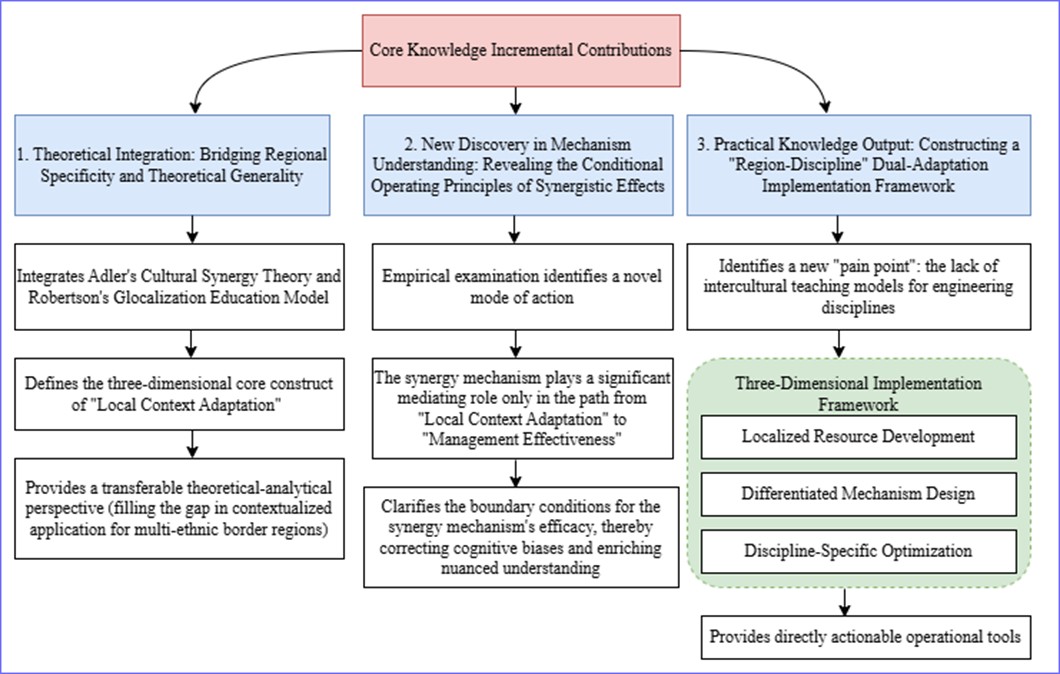
Against the backdrop of deepening China–ASEAN educational cooperation, cross-cultural teaching management has become an important issue in the internationalization of higher education in border regions. Drawing on Cultural Integration and Synergy Theory, this study adopts a mixed-methods approach to explore the key influencing factors and operational mechanisms of cross-cultural teaching management in Guangxi universities. Data were collected from 238 teachers across three types of universities in Guangxi using stratified cluster sampling. The results indicate that the effectiveness of cross-cultural teaching management is influenced by six core dimensions, among which local context adaptation shows the strongest effect. The synergy mechanism plays a significant mediating role between the core variables and management effectiveness, while inclusive leadership positively moderates the relationship between local context adaptation and the synergy mechanism. In addition, significant perceptual differences exist among teacher groups with different backgrounds. Based on these findings, this study proposes optimization strategies such as localized teaching resource development and differentiated teacher training. The study provides empirical evidence for improving cross-cultural teaching management in Guangxi universities and offers insights for the internationalization of higher education in multi-ethnic border regions under the China–ASEAN cooperation framework.
เอกสารอ้างอิง
Adler, N. J. (1991). International dimensions of organizational behavior. (2nd ed.). Boston, Massachusetts: PWS-Kent.
De Hei, M., Tabacaru, C., Sjoer, E., Rippe, R., & Walenkamp, J. (2020). Developing intercultural competence through collaborative learning in international higher education. Journal of studies in international education, 24(2), 190-211.
De Soriano, A. J. Z. G., Montoro, M. A., & Colón, A. M. O. (2024). Digital teaching competence and educational inclusion in higher education. A systematic review. Electronic Journal of e-Learning, 22(1), 31-45.
Deardorff, D. K. (2006). Identification and assessment of intercultural competence as a student outcome of internationalization. Journal of studies in international education, 10(3), 241-266.
Deardorff, D. K. (2011). Assessing intercultural competence. New directions for institutional research, 149, 65.–79.
Deardorff, D. K., & Jones, E. (2022). Intercultural competence as a core focus in international higher education. In D. K. Deardorff, H. de Wit, B. Leask, & F. Charles (Eds.), The handbook of international higher education (pp. 223–241). Oxfordshire: Routledge.
Dooly, M., & Darvin, R. (2022). Intercultural communicative competence in the digital age: Critical digital literacy and inquiry-based pedagogy. Language and Intercultural Communication, 22(3), 354-366.
Goh, M., Akiba, H., Yonezawa, Y., Hirai, T., & Horie, M. (2024). Developing intercultural competence through internationalizing higher education: case studies of three Japanese universities. Journal of Contemporary East Asia Studies, 13(1), 62-90.
Gopal, A. (2011). Internationalization of higher education: Preparing faculty to teach cross-culturally. International Journal of Teaching and Learning in Higher Education, 23(3), 373-381.
Guillén-Yparrea, N., & Ramírez-Montoya, M. S. (2023). Intercultural competencies in higher education: A systematic review from 2016 to 2021. Cogent Education, 10(1), 2167360.
Guo, L., & Laokulrach, M. (2024). The influences of teachers’ intercultural competence on teaching performance and international student engagement: The mediating role of teachers’ transformational leadership. International Journal of Education and Practice, 12(4), 1201-1223.
Gurjar, N., & Bai, H. (2023). Assessing culturally inclusive instructional design in online learning. Educational technology research and development, 71(3), 1253-1274.
Hair, J. F., Hult, G. T. M., Ringle, C. M., & Sarstedt, M. (2017). A primer on partial least squares structural equation modeling (PLS-SEM). (2nd ed.). Thousand Oaks, California: Sage.
Hussain, S., Nshom, E., & Lin, J. (2025). Intercultural communication competence from 2000 to 2024: A systematic review. Review of Communication, 25(4), 229-249.
Ji, Y. (2020). Embedding and facilitating intercultural competence development in internationalization of the curriculum of higher education. Journal of Curriculum and Teaching, 9(3), 13-19.
Johnson, R. B., & Onwuegbuzie, A. J. (2004). Mixed methods research: A research paradigm whose time has come. Educational researcher, 33(7), 14-26.
Kalogerogianni, F. (2025). Teaching in multicultural classrooms through an intercultural perspective on citizenship. Frontiers in Education, 10, 1581833.
Kirkpatrick, D. L. (1959). Techniques for evaluation training programs. Journal of the american society of training directors, 13, 21-26.
Korkmaz, A. V., van Engen, M., Schalk, R., Bauwens, R., & Knappert, L. (2022). INCLEAD: Development of an inclusive leadership measurement tool. Tilburg University Research Portal.
Landis, J. R., & Koch, G. G. (1977). The measurement of observer agreement for categorical data. Biometrics, 33(1), 159–174.
Pinto, S. (2018). Intercultural competence in higher education: Academics’ perspectives. On the Horizon, 26(2), 137–147.
Robertson, R. (1995). Glocalization: Time-space and homogeneity-heterogeneity. In M. Featherstone, S. Lash, & R. Robertson (Eds.), Global modernities (pp. 25–44). Thousand Oaks, California: Sage.
Shore, L. M., Randel, A. E., Chung, B. G., Dean, M. A., Ehrhart, M. G., & Singh, G. (2011). Inclusion and diversity in work groups: A review and model for future research. Journal of Management, 37(4), 1262–1289.
Thompson, S. K. (2012). Sampling. New York: Wiley.
Vertovec, S. (2007). Super-diversity and its implications. Ethnic and Racial Studies, 30(6), 1024–1054.
Zelenková, A., & Hanesová, D. (2019). Intercultural competence of university teachers: A challenge of internationalization. Journal of Language and Cultural Education, 7(1), 1–17.
Zhan, H., Cheng, K. M., Wijaya, L., & Zhang, S. (2024). Investigating the mediating role of self-efficacy between digital leadership capability, intercultural competence, and employability among working undergraduates. Higher Education, Skills and Work-Based Learning, 14(4), 796-820.
ดาวน์โหลด
เผยแพร่แล้ว
รูปแบบการอ้างอิง
ฉบับ
ประเภทบทความ
สัญญาอนุญาต
ลิขสิทธิ์ (c) 2026 วารสารสังคมศาสตร์ปัญญาพัฒน์

อนุญาตภายใต้เงื่อนไข Creative Commons Attribution-NonCommercial-NoDerivatives 4.0 International License.


