The Impact of Multicultural Educational Environments on Students' Foreign Language Communication Competence in Guangxi Private University
คำสำคัญ:
Multicultural Education, Educational Environment, Foreign Language Communication Competence, Guangxi Private Universitiesบทคัดย่อ
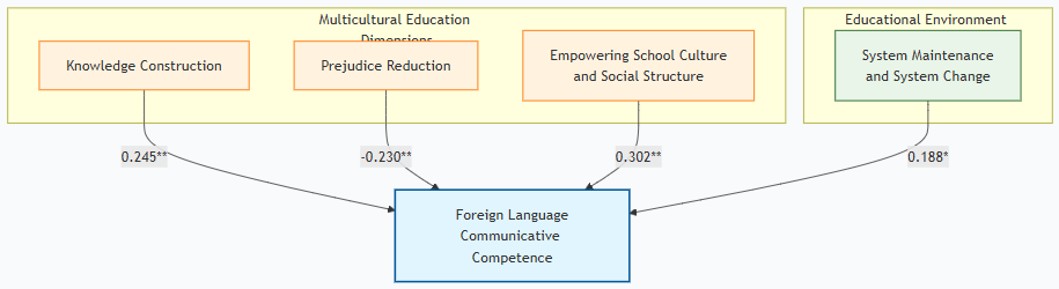
This study focuses on the mechanisms through which multicultural education and the educational environment influence foreign language communication proficiency, with the aim of exploring management strategies to enhance the foreign language communication skills of students majoring in ASEAN languages at private universities in Guangxi. By integrating theories of multicultural education, educational environment, and foreign language communication skills, this study constructs an analytical framework that examines the interactions among these three elements. The study selected third- and fourth-year students majoring in ASEAN languages at four private universities in Guangxi as the research subjects, as this group possesses a certain level of foreign language communication competence and relevant theoretical knowledge. Given the large size of the target population, a multistage sampling method was employed to select the sample, resulting in 266 valid questionnaires. During the data analysis phase, Cronbach’s alpha and confirmatory factor analysis were first used to test the reliability and validity of the questionnaire; subsequently, descriptive statistics were used to present the demographic characteristics of the sample, and correlation analysis was employed to preliminarily explore the relationships among the core variables. Finally, a regression model was constructed with the dimensions of “multicultural education” and “educational environment” as independent variables and “foreign language communication ability” as the dependent variable to precisely assess the specific effects of each dimension. The results indicate that environmental factors at the campus culture level and educational content factors at the knowledge structure level have a significant impact on the improvement of foreign language communication skills. This study not only provides a theoretical analytical framework for future discussions on the factors influencing foreign language communication skills but also offers empirical support for optimizing educational management practices in private universities in Guangxi.
เอกสารอ้างอิง
Banks, J. (1994). An Introduction to Multicultural Education. Boston, MA: Allyn & Bacon.
Banks, J. (2004). Multicultural Education: Historical Development, Dimensions, and Practice. In J. A. Banks, & C. A. M. Banks (Eds.), Handbook of Research on Multicultural Education (pp. 3-29). San Francisco, CA: Jossey-Bass.
Banks, J. (2020). Multicultural Education: Issues and Perspectives. (10th Edition). New Jersey: Wiley.
Cai, Q. (2024). Cultural Landscape, Elites, and Management Forms in Rural Areas of Ethnic Minority Regions in China: A Case Study of Guangxi Province, China. Journal of Landscape Research, 16(6), 76-80.
Canale, M., & Swain, M. (1980). Theoretical Bases of Communicative Approaches to Second Language Teaching and Testing. Applied Linguistics, 1, 1-47.
China Daily. (2024). China-Indonesia cooperation expands job opportunities for Indonesian language graduates. Retrieved from https://govt.chinadaily.com.cn/s/202409/03/WS66d6dbb7498ed2d7b7eb89b1/china-indonesia-cooperation-expands-job-opportunities-for-indonesian-language-graduates.html.
Cochran, W. G. (1977). Sampling techniques. (3rd ed.). New York: John Wiley & Sons.
Fraser, B. J. (1986). Classroom environment. London: Croom Helm.
Haswani, F., Baharuddin, B., & Simbolon, N. (2023). Multicultural education in English language teaching: a study of paradigms, perceptions, and implementation strategies. World Journal of English Language, 13(2), 424-424.
Kline, R. B. (2023). Principles and Practice of Structural Equation Modeling. (Fifth Edition). New York: Guilford Publications.
Krejcie, R. V., & Morgan, D. W. (1970). Determining sample size for research activities. Educational and Psychological Measurement, 30(3), 607–610.
Moos, R. H. (1979). Evaluating educational environments: Procedures, measures, findings and policy implications. San Francisco: Jossey-Bass.
Nunnally, J. C., & Bernstein, I. H. (1994). Psychometric theory. (3rd ed.). New York: McGraw-Hill.
Perez, P. L. (2024). The impact of technology-enhanced language learning on bilingual education. International Journal of Scientific Research and Management, 12(4), 3340-3350.
Soro-Molina, J. E. (2025). Ethnoculture: Educational, Pedagogical, Ethnological and Intercultural Research Perspective. Education Quarterly Reviews, 8(1), 101-116.
ดาวน์โหลด
เผยแพร่แล้ว
รูปแบบการอ้างอิง
ฉบับ
ประเภทบทความ
สัญญาอนุญาต
ลิขสิทธิ์ (c) 2026 วารสารสังคมศาสตร์ปัญญาพัฒน์

อนุญาตภายใต้เงื่อนไข Creative Commons Attribution-NonCommercial-NoDerivatives 4.0 International License.


