ความสัมพันธ์ระหว่างเทคโนโลยีดิจิทัล นวัตกรรมบริการ และการใช้ข้อมูลลูกค้าต่อความสำเร็จของธุรกิจค้าปลีกสมัยใหม่
คำสำคัญ:
ธุรกิจค้าปลีกสมัยใหม่, เทคโนโลยีร้านค้าปลีก, การใช้ข้อมูลลูกค้า, นวัตกรรมบริการร้านค้าปลีกสมัยใหม่, ประสบการณ์ลูกค้าบทคัดย่อ
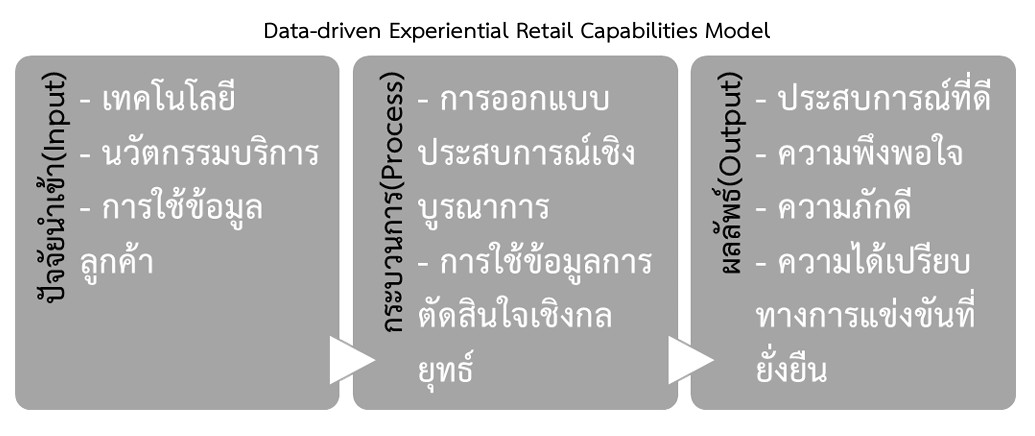
การวิจัยครั้งนี้มีวัตถุประสงค์เพื่อ (1) ศึกษาเทคโนโลยีดิจิทัล และนวัตกรรมบริการร้านค้าปลีกสมัยใหม่ (2) ศึกษาประสบการณ์ ความพึงพอใจ และความภักดีของลูกค้า (3) ศึกษาความสัมพันธ์ระหว่างเทคโนโลยีดิจิทัล นวัตกรรมบริการร้านค้าปลีกสมัยใหม่ และการใช้ข้อมูลลูกค้า ต่อประสบการณ์ ความพึงพอใจ และความภักดีของลูกค้า และ (4) นำเสนอแนวทางการประยุกต์ใช้เทคโนโลยี และนวัตกรรมบริการร้านค้าปลีกสมัยใหม่เพื่อเพิ่มขีดความสามารถในการแข่งขัน การวิจัยนี้เป็นการวิจัยเชิงปริมาณ กลุ่มตัวอย่างคือ ผู้บริโภคที่ใช้บริการธุรกิจค้าปลีกสมัยใหม่ จำนวน 409 คน ซึ่งได้มาจากการสุ่มตัวอย่างแบบบังเอิญ เครื่องมือที่ใช้ในการวิจัยคือแบบสอบถามมาตราส่วนประมาณค่า 5 ระดับ ที่ผ่านการตรวจสอบความตรง และความเชื่อมั่น สถิติที่ใช้ในการวิเคราะห์ข้อมูล ได้แก่ ค่าความถี่ ร้อยละ ค่าเฉลี่ย ส่วนเบี่ยงเบนมาตรฐาน และการวิเคราะห์ความสัมพันธ์ ผลการวิจัยพบว่า (1) เทคโนโลยีดิจิทัล และนวัตกรรมบริการร้านค้าปลีกสมัยใหม่ในภาพรวมอยู่ในระดับมาก โดยเทคโนโลยีดิจิทัลในร้านค้าปลีกมีค่าเฉลี่ยสูงสุด (2) ประสบการณ์ ความพึงพอใจ และความภักดีของลูกค้าอยู่ในระดับมาก โดยประสบการณ์ลูกค้ามีค่าเฉลี่ยสูงสุด (3) เทคโนโลยีดิจิทัล นวัตกรรมบริการร้านค้าปลีกสมัยใหม่ และการใช้ข้อมูลลูกค้า มีความสัมพันธ์เชิงบวกในระดับสูงกับประสบการณ์ ความพึงพอใจ และความภักดีของลูกค้าอย่างมีนัยสำคัญทางสถิติที่ระดับ .01 และ (4) การบูรณาการเทคโนโลยีดิจิทัล และนวัตกรรมบริการร้านค้าปลีกสมัยใหม่ร่วมกับการใช้ข้อมูลลูกค้า สามารถยกระดับประสบการณ์ ความพึงพอใจ และความภักดีของลูกค้า และช่วยเพิ่มขีดความสามารถในการแข่งขันของธุรกิจการค้าปลีกสมัยใหม่ได้อย่างยั่งยืน โดยผู้ประกอบการควรให้ความสำคัญกับการเชื่อมโยงช่องทางออฟไลน์ และออนไลน์ (Omnichannel) และการนำปัญญาประดิษฐ์ (AI) มาวิเคราะห์พฤติกรรมลูกค้าเพื่อการนำเสนอบริการแบบเฉพาะบุคคล อันจะนำไปสู่ความภักดีต่อแบรนด์ในระยะยาว
เอกสารอ้างอิง
พงศ์พิพัฒน์ พงษ์ตน. (2568). ความพึงพอใจ และความภักดีของผู้บริโภคในระบบพาณิชย์อิเล็กทรอนิกส์ไทย. วารสารเกษมบัณฑิต, 26(2), 1–15.
ภิราภรณ์ ก้อนคํา. (2564). นวัตกรรมการบริการที่ส่งผลต่อความสำเร็จของธุรกิจร้านค้าปลีกแบบดั้งเดิม. วารสารศิลปศาสตร์และอุตสาหกรรมบริการ, 4(1), 116–129.
วิจัยกรุงศรี. (2565, 8 กันยายน). แนวโน้มธุรกิจ/อุตสาหกรรมปี 2566-2568: ธุรกิจร้านค้าปลีกสมัยใหม่. สืบค้นจาก https://www.krungsri.com/th/research/industry/industry-outlook/wholesale-retail/modern-trade/io/modern-trade-2022.
สลิลาทิพย์ ทิพยไกรศร. (2564). ความสัมพันธ์เชิงสาเหตุระหว่างการบริหารประสบการณ์ของลูกค้า ความพึงพอใจของลูกค้า ความจงรักภักดี และการบอกต่อ ในธุรกิจค้าปลีกออนไลน์. วารสารวิชาการบริหารธุรกิจ สมาคมสถาบันอุดมศึกษาเอกชนแห่งประเทศไทย, 10(1), 198–213.
Ameen, N., Tarhini, A., Reppel, A., & Anand, A. (2021). Customer experiences in the age of artificial intelligence. Computers in Human Behavior, 114, 106548.
Bartlett, J., Kotrlik, J., & Higgins, C. (2001). Organizational research: Determining appropriate sample size survey research. Information Technology Learning and Performance Journal, 19, 43-51.
Belanche, D., Casaló, L. V., Flavián, C., & Schepers, J. (2020). Service robot implementation: A theoretical framework and research agenda. The Service Industries Journal, 40(3-4), 203–225.
Cronbach, L. J. (1951). Coefficient alpha and the internal structure of tests. Psychometrika, 16(3), 297–334.
Davis, F. D. (1989). Perceived usefulness, perceived ease of use, and user acceptance of information technology. MIS Quarterly, 13(3), 319–340.
Dick, A. S., & Basu, K. (1994). Customer loyalty: Toward an integrated conceptual framework. Journal of the Academy of Marketing Science, 22(2), 99–113.
Grewal, D., Noble, S. M., Roggeveen, A. L., & Nordfalt, J. (2020). The future of in-store technology. Journal of the Academy of Marketing Science, 48(1), 96-113.
Hossain, M., Akter, S., & Yanamandram, V. (2020). Revisiting customer analytics capability for data-driven retailing. Journal of Retailing and Consumer Services, 56, 102187.
Hoyer, W. D., Kroschke, M., Schmitt, B., Kraume, K., & Shankar, V. (2020). Transforming the customer experience through new technologies. Journal of Interactive Marketing, 51, 57–71.
Huang, M.-H., & Rust, R. T. (2018). Artificial intelligence in service. Journal of Service Research, 21(2), 155–172.
Israel, G. D. (1992). Determining Sample Size. Gainesville, FL: Institute of Food and Agricultural Sciences (IFAS), University of Florida.
Kasilingam, D. L. (2020). Understanding the attitude and intention to use smartphone chatbots for shopping. Technology in Society, 62, 101280.
Kotler, P., Kartajaya, H., & Setiawan, I. (2021). Marketing 5.0: Technology for humanity. John Wiley & Sons.
Lemon, K. N., & Verhoef, P. C. (2016). Understanding customer experience throughout the customer journey. Journal of Marketing, 80(6), 69–96.
Likert, R. (1932). A technique for the measurement of attitudes. Archives of Psychology, 140, 1–55.
Lin, R., Chen, R., & Chiu, K. (2010). Customer relationship management and innovation capability: An empirical study. Industrial Management & Data Systems, 110(1), 111–133.
Luo, X., Tong, S., Fang, Z., & Qu, Z. (2019). Frontiers: Machines vs. humans: The impact of AI chatbot disclosure on customer purchases. Marketing Science, 38(6), 937–947.
Oliver, R. L. (1999). Whence consumer loyalty? Journal of Marketing, 63(Special Issue), 33–44.
Pantano, E., & Gandini, A. (2017). Exploring the forms of sociality mediated by innovative technologies in retail settings. Computers in Human Behavior, 77, 367–373.
Pantano, E., Priporas, C. V., Sorace, S., & Iazzolino, G. (2018). Does innovation-orientation lead to retail industry growth? Empirical evidence from patent analysis. Journal of Retailing and Consumer Services, 34, 88-94.
Rese, A., Ganster, L., & Baier, D. (2020). Chatbots in retailers’ customer communication: How to measure their acceptance? Journal of Retailing and Consumer Services, 56, 102176.
Srivastava, M., & Kaul, D. (2016). Social interaction, convenience and customer satisfaction: The mediating role of customer experience. Journal of Retailing and Consumer Services, 30, 102–107.
Teece, D. J., Pisano, G., & Shuen, A. (1997). Dynamic capabilities and strategic management. Strategic management journal, 18(7), 509-533.
Verhoef, P. C., Lemon, K. N., Parasuraman, A., Roggeveen, A., Tsiros, M., & Schlesinger, L. A. (2009). Customer experience creation: Determinants, dynamics and management strategies. Journal of Retailing, 85(1), 31–41.
Wirtz, J., Patterson, P. G., Kunz, W. H., Gruber, T., Lu, V. N., Paluch, S., & Martins, A. (2018). Brave new world: Service robots in the frontline. Journal of Service Management, 29(5), 907–931.
Yamane, T. (1967). Statistics: An introductory analysis. (2nd ed.). New York: Harper and Row.
ดาวน์โหลด
เผยแพร่แล้ว
รูปแบบการอ้างอิง
ฉบับ
ประเภทบทความ
สัญญาอนุญาต
ลิขสิทธิ์ (c) 2026 วารสารสังคมศาสตร์ปัญญาพัฒน์

อนุญาตภายใต้เงื่อนไข Creative Commons Attribution-NonCommercial-NoDerivatives 4.0 International License.


