The Effects of the Jigsaw Method on Vocabulary Learning of English Program Students in a Thai Public School
คำสำคัญ:
Jigsaw Method, Cooperative Learning, Vocabulary Learning, English Program Studentsบทคัดย่อ
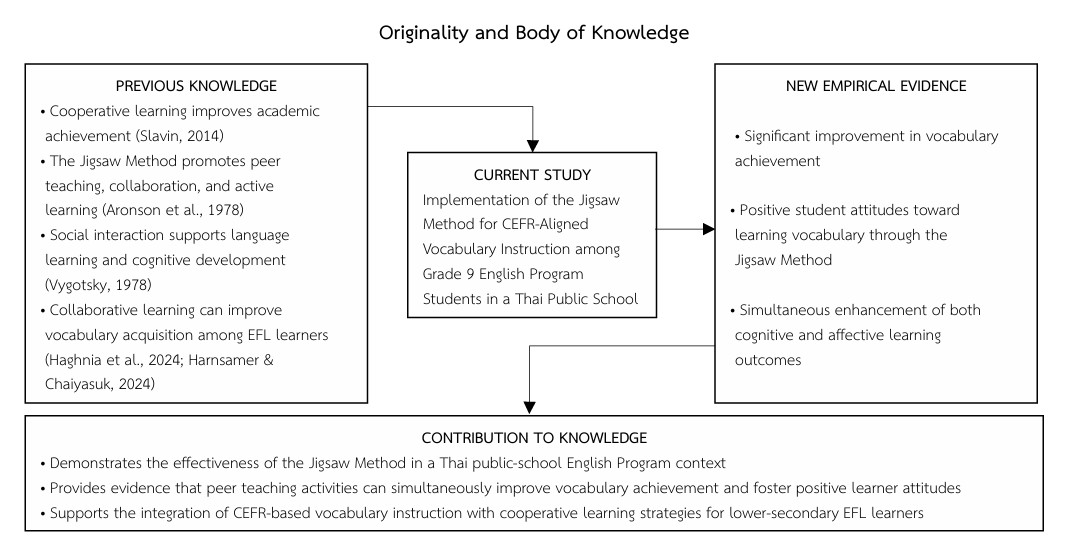
This study aimed to 1) investigate the effects of the Jigsaw method on English vocabulary acquisition among Grade 9 English Program (EP) students in a public school and 2) examine the students' overall attitude in learning through the Jigsaw method. A quasi-experimental one-group pretest–posttest research design was employed. The participants consisted of 30 Grade 9 EP students selected through convenience sampling method. Research instruments included a 30-item vocabulary pretest and posttest aligned with the CEFR B1 level, and a six-item Likert-scale questionnaire designed to measure students’ attitudes toward learning through the Jigsaw method. Quantitative data were analyzed using a dependent samples t-test, while descriptive statistics were used to interpret students’ attitudinal responses. The findings revealed a statistically significant improvement in students’ vocabulary performance following the intervention (t(29) = 16.02, p < .001), with an average score gain of 6.67 points. Furthermore, the results of the attitude questionnaire indicated a high level of positive student perception toward the Jigsaw method, particularly in terms of active participation, collaborative learning, clarity of understanding, and enjoyment of the learning process. The findings indicated that the Jigsaw method is associated with the improved vocabulary scores and positive student attitudes among English Program students in the Thai public school.
เอกสารอ้างอิง
Aronson, E., & Patnoe, S. (2011). The jigsaw classroom: Building cooperation in the classroom. (3rd ed.). London: Pinter & Martin.
Aronson, E., Stephan, C., Sikes, J., Blaney, N., & Snapp, M. (1978). The Jigsaw Classroom. Thousand Oaks: Sage Publication.
Beck, I. L., McKeown, M. G., & Kucan, L. (2013). Bringing words to life: Robust vocabulary instruction (2nd ed.). Guilford Press.
Eskandari, Z., Khatin-Zadeh, O., Farsani, D., & Banaruee, H. (2024). The effect of type of task on EFL learners’ vocabulary learning. Frontiers in Psychology, 15, 1306306.
Gao, Y. L., Wang, F. Y., & Lee, S. Y. (2023). The effects of three different storytelling approaches on the vocabulary acquisition and response patterns of young EFL students. Language Teaching Research, 27(5), 1078-1098.
Gömleksi˙ z, M. N. (2007). Effectiveness of cooperative learning (jigsaw II) method in teaching English as a foreign language to engineering students (Case of Firat University, Turkey). European journal of engineering education, 32(5), 613-625.
Haghnia, M., Karimi, S. N., & Marzban, A. (2024). The Combined Effect of Task Complexity and Task Condition through Collaborative Activities on EFL Learners’ Vocabulary Learning: A Focus on L2 Proficiency. Journal of New Trends in English Language Learning, 3(3). 113-126.
Harnsamer, S. (2024). Effects of collaborative learning on Thai EFL learners’ vocabulary knowledge. (Master of Education, Mahasarakham University)
Johnson, D. W., & Johnson, R. T. (2009). An educational psychology success story: Social interdependence theory and cooperative learning. Educational researcher, 38(5), 365-379.
Khan, K. A., Ali, H., Khattak, S. A., & Khan, S. (2017). Impact of cooperative learning on the achievement of EFL tertiary level learners: A case-study of a mainstream university in a Middle Eastern country. International Journal of English Linguistics, 8(2), 168.
McKeown, M. G. (2019). Effective vocabulary instruction fosters knowing words, using words, and understanding how words work. Language, speech, and hearing services in schools, 50(4), 466-476.
Mengduo, Q., & Xiaoling, J. (2010). Jigsaw Strategy as a Cooperative Learning Technique: Focusing on the Language Learners. Chinese Journal of Applied Linguistics (Foreign Language Teaching & Research Press), 33(4), 113-125.
Ministry of Education. (2008). Basic Education Core Curriculum B.E. 2551 (A.D. 2008). Office of the Basic Education Commission.
Nation, I. S. P. (2020). Learning vocabulary in another language. (2nd ed.). Cambridge: Cambridge University Press.
Schmitt, N. (2010). Researching vocabulary: A vocabulary research manual. Hampshire: Palgrave Macmillan.
Slavin, R. E. (1996). Cooperative learning in middle and secondary schools. The Clearing House, 69(4), 200-204.
Slavin, R. E. (2014). Cooperative learning and academic achievement: Why does groupwork work?. Annals of Psychology, 30(3), 785-791.
Tanapanyaworakul, W. (2021). Improving reading comprehension of EFL students using the jigsaw technique. (Master of Arts, Thammasat University).
Thanyaburi School. (2023). TOEFL Junior English proficiency test report for Grades 7-9 English Program students. Pathum Thani: Thanyaburi School.
Vygotsky, L. S. (1978). Mind in society: The development of higher psychological processes. Cambridge: Harvard University Press.
ดาวน์โหลด
เผยแพร่แล้ว
รูปแบบการอ้างอิง
ฉบับ
ประเภทบทความ
สัญญาอนุญาต
ลิขสิทธิ์ (c) 2026 วารสารสังคมศาสตร์ปัญญาพัฒน์

อนุญาตภายใต้เงื่อนไข Creative Commons Attribution-NonCommercial-NoDerivatives 4.0 International License.


