The Development of English Speaking Skills of Secondary School Students Through Think- Pair-Share Technique
คำสำคัญ:
Think–Pair–Share, English Speaking Skills, Cooperative Learning, Student Perceptions, Lower Secondary School Studentsบทคัดย่อ
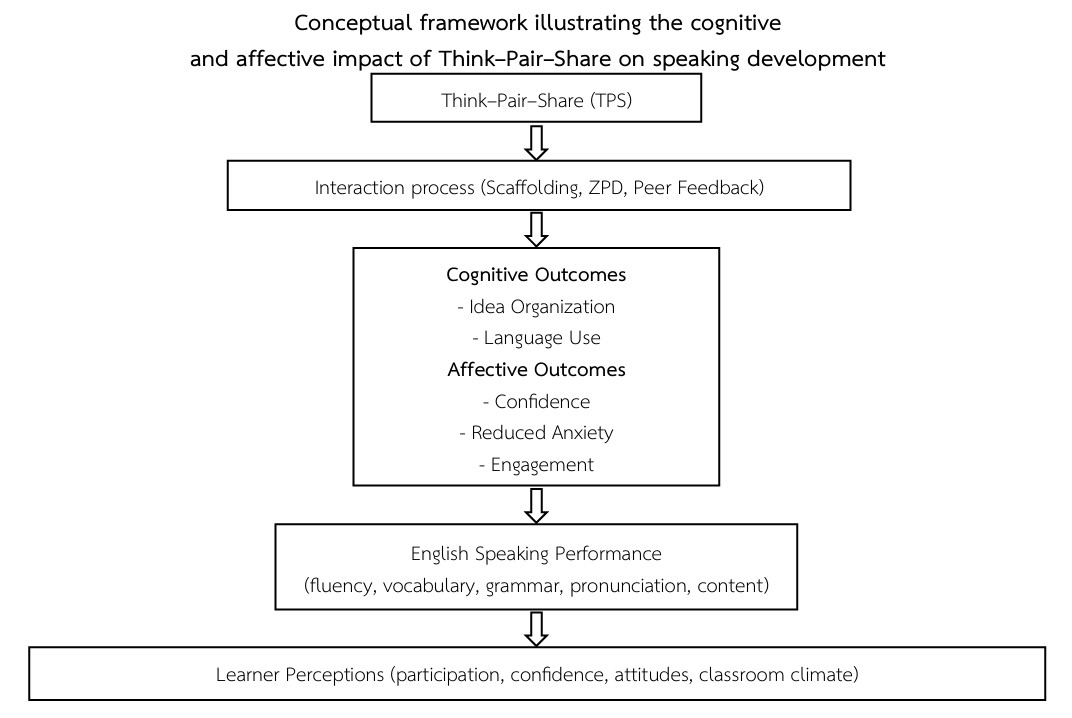
This study aimed to: (1) examine the effectiveness of the Think–Pair–Share (TPS) instructional technique in enhancing English speaking skills and (2) investigate students’ perceptions toward its implementation in the classroom. The participants were 38 lower secondary school students enrolled in an English course. A pre-experimental one-group pretest–posttest design was employed. The research instruments included an English speaking test assessing five components—fluency, vocabulary use, grammatical accuracy, pronunciation, and content relevance—TPS-based lesson plans, and a student perception questionnaire. Quantitative data were analyzed using descriptive statistics (mean and standard deviation) and a paired-samples t-test. The findings revealed that students’ English speaking performance after the TPS intervention was significantly higher than before the intervention (t = 18.92, p < .05). The results also indicated improvement across multiple dimensions of speaking ability, suggesting that the structured stages of TPS supported both linguistic development and communicative performance. In addition, students reported very high levels of positive perceptions toward the TPS technique, particularly in terms of classroom participation, confidence in speaking English, and attitudes toward learning. Overall, the findings suggest that TPS provides learners with structured opportunities for idea organization, peer interaction, and gradual participation, which contribute to a supportive learning environment for speaking practice. The study highlights the effectiveness of TPS as a pedagogical approach for enhancing English speaking skills and fostering positive learner perceptions in the EFL classroom. Pedagogical implications and recommendations for future research are also discussed.
เอกสารอ้างอิง
Brown, H. D. (2001). Teaching by principles: An interactive approach to language pedagogy. Harlow: Longman.
Brown, H. D. (2007). Principles of language learning and teaching. (5th ed.). London: Pearson Education.
Burns, A. (2019). Concepts for teaching speaking in the English language classroom. Cambridge: Cambridge University Press.
Bygate, M. (2018). Learning to speak. Oxford: Oxford University Press.
Campbell, D. T., & Stanley, J. C. (1963). Experimental and quasi-experimental designs for research. Boston, Massachusetts: Houghton Mifflin.
Canale, M., & Swain, M. (1980). Theoretical Bases of Communicative Approaches to Second Language Teaching and Testing. Applied Linguistics, 1, 1-47.
Foley, J. A. (2005). English in Thailand. RELC journal, 36(2), 223-234.
Gillies, R. M. (2016). Cooperative learning: Review of research and practice. Australian Journal of Teacher Education, 41(3), 39-54.
Hymes, D. (1972). On communicative competence. In J. B. Pride & J. Holmes (Eds.), Sociolinguistics (pp. 269–293). London: Penguin.
Johnson, D. W., & Johnson, R. T. (1999). Learning together and alone: Cooperative, competitive, and individualistic learning. (5th ed.). Allyn & Bacon.
Johnson, D. W., & Johnson, R. T. (2020). An Overview of Cooperative Learning. Retrieved from http://www.co-operation.org/what-is-cooperative-learning.
Kagan, S. (1994). Cooperative learning. San Clemente: Kagan Publishing.
Kayi, H. (2006). Teaching speaking: Activities to promote speaking in a second language. The internet TESL journal, 12(11), 1-6.
Khamkhien, A. (2010). Thai learners’ English pronunciation competence: Lesson learned from word stress assignment. Journal of language teaching and research, 1(6), 757-764.
Lantolf, J. P., Thorne, S. L., & Poehner, M. E. (2015). Sociocultural theory and second language development. In B. VanPatten & J. Williams (Eds.), Theories in second language acquisition (2nd ed.) (pp. 207–226). Oxfordshire: Routledge.
Lyman, F. T. (1981). The responsive classroom discussion. In A. S. Anderson (Ed.), Mainstreaming digest (pp. 109–113). Maryland: University of Maryland.
McDonough, J., & McDonough, S. (2014). Research methods for English language teachers. New York: Routledge.
Ministry of Education (Thailand). (2008). The Basic Education Core Curriculum B.E. 2551 (A.D. 2008). Bangkok: Ministry of Education.
Nation, I. S. P., & Newton, J. (2020). Teaching ESL/EFL listening and speaking. (2nd ed.). Oxfordshire: Routledge.
Noom-Ura, S. (2013). English-Teaching Problems in Thailand and Thai Teachers' Professional Development Needs. English Language Teaching, 6(11), 139-147.
Punthumasen, P. (2007). International program for teacher education: An approach to tackling problems of English education in Thailand. In The 11th UNESCO-APEID international conference reinventing higher education: Toward participatory and sustainable development (pp. 1-14). Bangkok: UNESCO.
Richards, J. C. (2017). Teaching English through English: Proficiency, pedagogy and performance. RELC journal, 48(1), 7-30.
Slavin, R. E. (1995). Cooperative learning: Theory, research, and practice. (2nd ed.). Boston, Massachusetts: Allyn & Bacon.
Tatsanajamsuk, P., & Saengboon, S. (2021). The roles of indirect asynchronous electronic feedback and direct corrective feedback in improving students’ L2 writing: A multiple case study of Thai undergraduate students. LEARN Journal: Language Education and Acquisition Research Network, 14(2), 397-426.
Vygotsky, L. S. (1978). Mind in society: The development of higher psychological processes. Cambridge, Massachusetts: Harvard University Press.
Wiriyachitra, A. (2002). English language teaching and learning in Thailand in this decade. Thai TESOL focus, 15(1), 4-9.
Woodrow, L. (2006). Anxiety and speaking English as a second language. RELC journal, 37(3), 308-328.
Zheng, S., & Zhou, X. (2022). Positive influence of cooperative learning and emotion regulation on EFL learners’ foreign language enjoyment. International Journal of Environmental Research and Public Health, 19(19), 12604.
Zwiers, J., & Crawford, M. (2023). Academic conversations: Classroom talk that fosters critical thinking and content understandings. Oxfordshire: Routledge.
ดาวน์โหลด
เผยแพร่แล้ว
รูปแบบการอ้างอิง
ฉบับ
ประเภทบทความ
สัญญาอนุญาต
ลิขสิทธิ์ (c) 2026 วารสารสังคมศาสตร์ปัญญาพัฒน์

อนุญาตภายใต้เงื่อนไข Creative Commons Attribution-NonCommercial-NoDerivatives 4.0 International License.


