The Impact of Organizational Support on University Foreign Language Teachers’ Intercultural Teaching Competency: The Mediating Role of Self-Efficacy
คำสำคัญ:
Organizational Support, Self-Efficacy, ITC, Foreign Language Teachersบทคัดย่อ
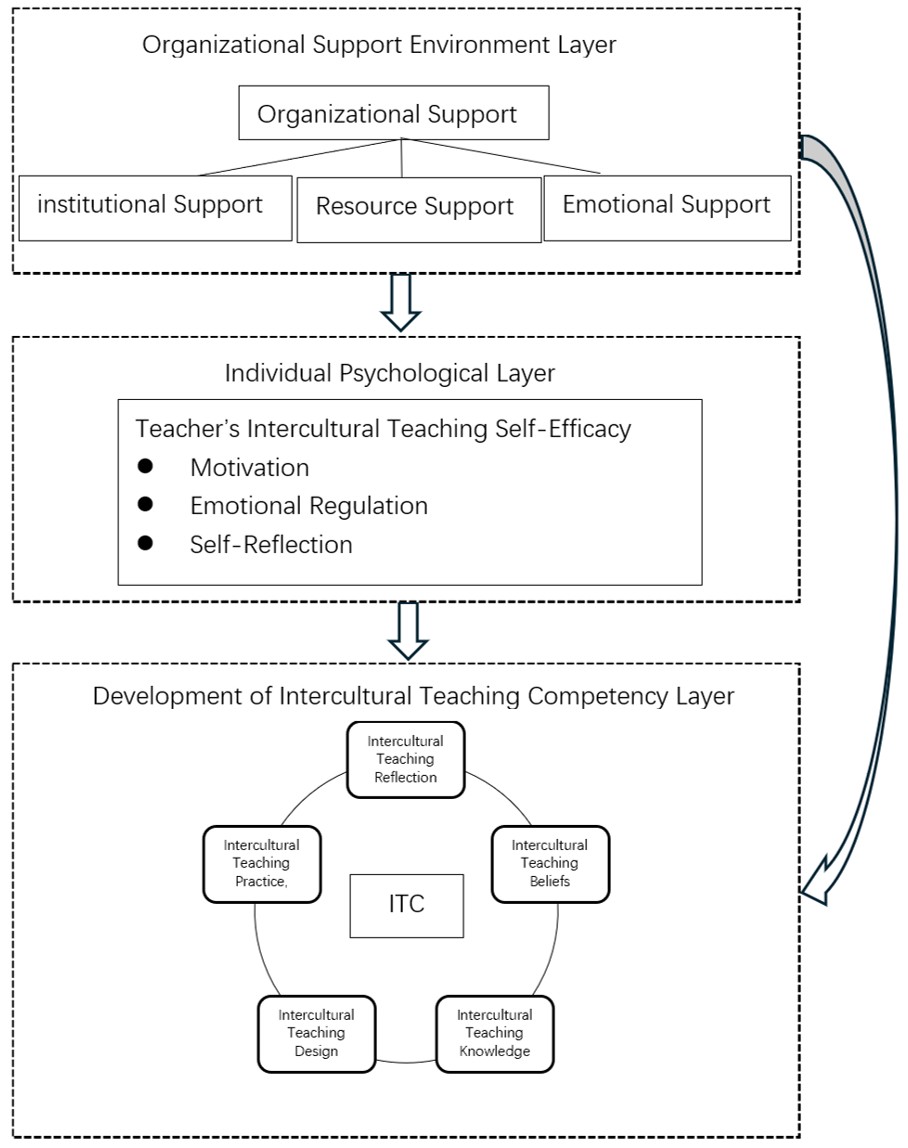
Based on Organizational Support Theory and Social Cognitive Theory, this study aimed to construct a mediating model of organizational support and self-efficacy on intercultural teaching competency (ITC). It explored the mechanism through which organizational support affects foreign language teachers' ITC and examined the mediating role of self-efficacy in this process. The study employed a questionnaire survey method, with 136 foreign language teachers from a private foreign language university in Guangxi as the research subjects, and utilized SmartPLS 4.0 to conduct PLS-SEM structural equation modeling analysis. The results of the study found that: 1) organizational support has a significant positive effect on ITC; 2) organizational support has a significant positive effect on self-efficacy; 3) self-efficacy has a significant positive effect on ITC; and 4) self-efficacy partially mediates the relationship between organizational support and ITC, accounting for 35.5% of the total effect. The findings suggest that strong organizational support not only directly promotes the development of teachers' ITC but also further enhances their teaching competency by boosting their self-efficacy. These findings imply that university administrators should strengthen organizational support (e.g., providing intercultural training resources, establishing collaborative research mechanisms, and improving incentive policies) and enhance teachers' self-efficacy to effectively promote foreign language teachers' intercultural teaching competency.
เอกสารอ้างอิง
Bandura, A. (1997). Self-efficacy: The exercise of control. New York: Freeman.
Bandura, A. (2006). Guide for constructing self-efficacy scales. In F. Pajares & T. Urdan (Eds.), Self-efficacy beliefs of adolescents (pp. 307–337). North Carolina: Information Age Publishing.
Bentler, P. M. (1990). Comparative fit indexes in structural models. Psychological Bulletin, 107(2), 238–246.
Biasutti, M., Concina, E., Frate, S., & Delen, I. (2021). Teacher professional development: Experiences in an international project on intercultural education. Sustainability, 13(8), 4171.
Cha, M. Y., & Carrier, C. (2016). Contingent faculty perceptions of organizational support, workplace attitudes, and teaching evaluations at a public research university. Journal for the Study of Postsecondary and Tertiary Education, 1, 121-151.
Chen, M. (2025). Exploring the influencing effect of tertiary teachers’ perceived organizational support and teacher self-efficacy on their job satisfaction: the mediating role of teacher work engagement. Frontiers in Psychology, 16, 1609824.
Choge, S. (2025). Teachers’ Self-Efficacy and Inclusive Educational Practices in Kenya. KEMI Journal of Educational Leadership and Management, 1(1), 263–278.
Cohen, J. (1988). Statistical power analysis for the behavioral sciences. (2nd ed.). Hillsdale, NJ: Lawrence Erlbaum Associates.
Coşkun, B., Katıtaş, S., & Karadaş, H. (2022). The relationship between faculty members’ organizational support perceptions and personal growth initiative levels, the mediating role of general self-efficacy. International Journal of Modern Education Studies, 6(2), 400-422.
Eisenberger, R., Huntington, R., Hutchison, S., & Sowa, D. (1986). Perceived organizational support. Journal of Applied psychology, 71(3), 500–507.
Eisenberger, R., Rhoades Shanock, L., & Wen, X. (2020). Perceived organizational support: Why caring about employees counts. Annual review of organizational psychology and organizational behavior, 7(1), 101-124.
Hair, J. F., Jr., Hult, G. T. M., Ringle, C. M., Sarstedt, M., Danks, N. P., & Ray, S. (2021). An introduction to structural equation modeling. In Partial least squares structural equation modeling (PLS-SEM) using R: A workbook (pp. 1–29). Cham: Springer International Publishing.
Henseler, J., Hubona, G., & Ray, P. A. (2016). Using PLS path modeling in new technology research: Updated guidelines. Industrial Management & Data Systems, 116(1), 2–20.
Henseler, J., Ringle, C. M., & Sarstedt, M. (2015). A new criterion for assessing discriminant validity in variance-based structural equation modeling. Journal of the academy of marketing science, 43(1), 115-135.
Hu, L., & Hemchua, S. (2025). Understanding the Effect of Professional Learning Community on EFL Teachersâ Intercultural Teaching Competence. Language Related Research, 14(5), 245-283.
Huang, Q., Cheung, A. C., & Xuan, Q. (2023). The impact of study abroad on pre-service and in-service teachers’ intercultural competence: A meta-analysis. Teaching and Teacher Education, 127, 104091.
Jentsch, A., Hoferichter, F., Blömeke, S., König, J., & Kaiser, G. (2023). Investigating teachers' job satisfaction, stress and working environment: The roles of self-efficacy and school leadership. Psychology in the Schools, 60(3), 679–690.
Ji, K. (2015). ELF and its implications for local English teaching: A case study from Guangxi University. The Asian Journal of Applied Linguistics, 2(2), 77-91.
Jiao, C., Qian, J., & Liu, H. (2022). The relationship between preschool inclusive education teachers’ organizational support and work engagement: The mediating role of teacher self-efficacy. Frontiers in Psychology, 13, 900835.
Jöreskog, K. G., & Sörbom, D. (1993). LISREL 8: Structural equation modeling with the SIMPLIS command language. North Carolina: Scientific Software International.
Kang, W. (2026). Heterogeneous Profiles of Korean Teachers’ Multicultural Teaching Efficacy and Implications for Social Sustainability. Sustainability, 18(7), 3559.
Kong, L. N., Liao, H. P., Liu, D. X., & Chen, S. Z. (2023). Relationship of organizational support, psychological capital, and engagement among clinical nursing teachers. Nurse Educator, 48(4), E105-E109.
Li, H., Zhang, Y., & Hu, M. (2021). Multi-regional cooperation: BRI and Guangxi. London: Routledge.
Lu, B., Shao, X., Ge, L., & Wu, J. (2026). Challenges and opportunities in implementing intercultural education in higher education: The perceptions and practice of foreign language teachers in a Chinese university. Language and Intercultural Communication, 26(1), 87-103.
Mäe, K., & Ümarik, M. (2025). Teaching migrant learners: the interplay between school culture and teacher multicultural self-efficacy. Frontiers in Education, 10, 1691247.
Martorana, F., Rania, N., & Lagomarsino, F. (2021). Which intercultural competences for teachers, educators, and social workers? A literature review. International Journal of Intercultural Relations, 85, 92-103.
McMillin, R. (1997). Customer satisfaction and organizational support for service providers. (Doctoral dissertation, University of Florida).
OECD. (2023). Teaching for the Future: Global Engagement, Sustainability and Digital Skills. Retrieved from https://www.oecd.org/en/publications/teaching-for-the-future_d6b3d234-en.html.
Pressley, T., & Ha, C. (2022). Teacher exhaustion during COVID-19: Exploring the role of administrators, self-efficacy, and anxiety. The Teacher Educator, 57(1), 61-78.
Romijn, B. R., Slot, P. L., & Leseman, P. P. (2021). Increasing teachers’ intercultural competences in teacher preparation programs and through professional development: A review. Teaching and teacher education, 98, 103236.
Sancar, R., Atal, D., & Deryakulu, D. (2021). A new framework for teachers’ professional development. Teaching and teacher education, 101, 103305.
Schwarzer, R., & Jerusalem, M. (1995). Generalized self-efficacy scale. In J. Weinman, S. Wright, & M. Johnston (Eds.), Measures in health psychology: A user’s portfolio. Causal and control beliefs (pp. 35–37). Berkshire: NFER-Nelson.
Song, J. H., Chai, D. S., Kim, J., & Bae, S. H. (2018). Job performance in the learning organization: The mediating impacts of self‐efficacy and work engagement. Performance Improvement Quarterly, 30(4), 249-271.
Tualaulelei, E., & Halse, C. (2024). A scoping study of in-service teacher professional development for inter/multicultural education and teaching culturally and linguistically diverse students. Professional development in education, 50(5), 847-861.
Yang, X., & Aumeboonsuke, V. (2024). Influence of Perceived Organizational Support on Innovative Teaching: Insights from University Teachers in Yunnan Province, China. International Journal of Instructional Cases, 8(1), 263-282.
Yaprak, Z., & Ozmen, K. S. (2025). A more critical approach to the intercultural competence: Teacher beliefs, practices, and training. Interchange, 56(2), 159-186.
Zee, M., & Koomen, H. M. (2016). Teacher self-efficacy and its effects on classroom processes, student academic adjustment, and teacher well-being: A synthesis of 40 years of research. Review of Educational research, 86(4), 981-1015.
Zheng, Y., Wang, J., Doll, W., Deng, X., & Williams, M. (2018). The impact of organisational support, technical support, and self-efficacy on faculty perceived benefits of using learning management system. Behaviour & Information Technology, 37(4), 311-319.
Zhu, K., & Yang, R. (2025). Deciphering China’s higher education outreach paradigm in Southeast Asia: can a neo-tributary perspective work?. Higher Education, 89(4), 1041-1060.
ดาวน์โหลด
เผยแพร่แล้ว
รูปแบบการอ้างอิง
ฉบับ
ประเภทบทความ
สัญญาอนุญาต
ลิขสิทธิ์ (c) 2026 วารสารสังคมศาสตร์ปัญญาพัฒน์

อนุญาตภายใต้เงื่อนไข Creative Commons Attribution-NonCommercial-NoDerivatives 4.0 International License.


