Factors Affecting Purchase Intention of Used Car Customers via Facebook in Bangkok
คำสำคัญ:
Perceived Quality, Perceived Price, Perceived Value, Used Car Market, Facebookบทคัดย่อ
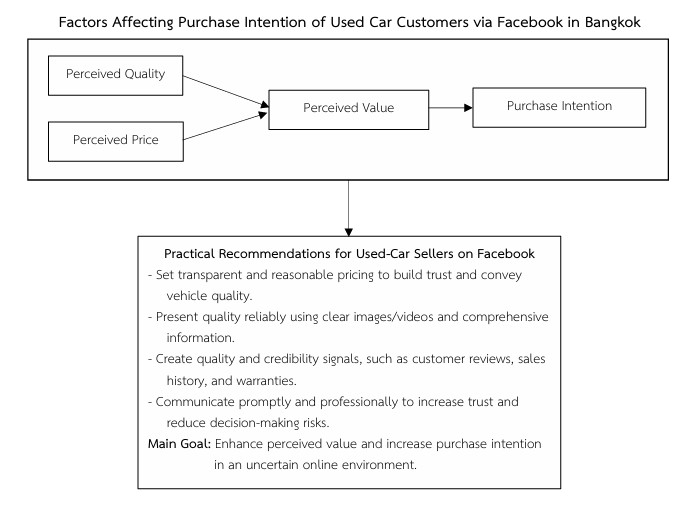
This study investigates the factors influencing Bangkok residents’ intentions to purchase used cars through Facebook, with particular emphasis on the roles of perceived quality, perceived price, and perceived value. Given the uncertainty and information asymmetry commonly associated with used-car purchases, this research examines how these perceptions shape consumer purchase intention in the context of social media marketplaces. Quantitative data were collected from 400 respondents in Bangkok and analyzed using SPSS through multiple regression and correlation analyses. The findings reveal that perceived quality has a strong positive effect on perceived value (β = 0.863, Adjusted R² = 0.744, p < 0.001), while perceived price also significantly influences perceived value (β = 0.809, Adjusted R² = 0.654, p < 0.001). In addition, perceived price positively affects perceived quality (β = 0.667, Adjusted R² = 0.444, p < 0.001). Perceived value was found to be the strongest predictor of purchase intention (β = 0.942, Adjusted R² = 0.887, p < 0.001). Furthermore, mediation analysis based on Baron and Kenny’s (1986) approach confirmed that perceived value partially mediates the relationships between perceived quality and purchase intention, as well as between perceived price and purchase intention. The results suggest that consumers evaluate used cars not only based on price and vehicle condition, but also through trust signals, presentation quality, and overall value perceptions conveyed via Facebook advertising. These findings contribute to a deeper understanding of consumer behavior in online used-car markets and provide practical implications for businesses seeking to enhance customer trust and purchase intention in developing digital economies such as Thailand.
เอกสารอ้างอิง
Akerlof, G. A. (1970). The market for “lemons”: Quality uncertainty and the market mechanism. The Quarterly Journal of Economics, 84(3), 488–500.
Baron, R. M., & Kenny, D. A. (1986). The moderator–mediator variable distinction in social psychological research: Conceptual, strategic, and statistical considerations. Journal of Personality and Social Psychology, 51(6), 1173–1182.
Bei, L. T., & Chiao, Y. C. (2001). An integrated model for the effects of perceived product, perceived service quality, and perceived price fairness on consumer satisfaction and loyalty. Journal of Consumer Satisfaction, Dissatisfaction and Complaining Behavior, 14, 125–140.
Beneke, J., Flynn, R., Greig, T., & Mukaiwa, M. (2013). The influence of perceived product quality, relative price and risk on customer value and willingness to buy: A study of private label merchandise. Journal of Product & Brand Management, 22(3), 218–228.
Bloch, P. H., Sherrell, D. L., & Ridgway, N. M. (1986). Consumer search: An extended framework. Journal of Consumer Research, 13(1), 119–126.
Cronin Jr, J. J., Brady, M. K., & Hult, G. T. M. (2000). Assessing the effects of quality, value, and customer satisfaction on consumer behavioral intentions in service environments. Journal of retailing, 76(2), 193-218.
Dodds, W. B., Monroe, K. B., & Grewal, D. (1991). Effects of price, brand, and store information on buyers’ product evaluations. Journal of marketing research, 28(3), 307-319.
Gefen, D., Karahanna, E., & Straub, D. W. (2003). Trust and tam in online shopping: An integrated model1. MIS quarterly, 27(1), 51-90.
Gogoi, B. (2013). Study of antecedents of purchase intention and its effect on brand loyalty of private label brand of apparel. International Journal of Sales & Marketing Management Research and Development, 3(2), 73-86.
Hajli, N. (2015). Social commerce constructs and consumer's intention to buy. International Journal of Information Management, 35(2), 183-191.
Joshi, A., Kale, S., Chandel, S., & Pal, D. K. (2015). Likert scale: Explored and explained. British journal of applied science & technology, 7(4), 396-403.
Keller, K. L. (2008). Strategic brand management: Building, measuring, and managing brand equity. (3rd ed.). New Delhi: Pearson Prentice Hall.
Kotler, P., & Armstrong, G. (2010). Principles of marketing. (13th ed.). Englewood Cliffs: Pearson Education.
Likert, R. (1932). A technique for the measurement of attitudes. Archives of Psychology, 140, 1–55.
Nunnally, J. C., & Bernstein, I. H. (1994). Psychometric theory. (3rd ed.). New York: McGraw-Hill.
Pavlou, P. A. (2003). Consumer acceptance of electronic commerce: Integrating trust and risk with the technology acceptance model. International journal of electronic commerce, 7(3), 101-134.
Petrick, J. F. (2004). The roles of quality, value, and satisfaction in predicting cruise passengers’ behavioral intentions. Journal of travel research, 42(4), 397-407.
Putsom, W., Suwannarat, P., & Songsrirote, N. (2019). The effect of entrepreneurial leadership, value creation and automotive parts manufacturing businesses performance in Thailand. Human Resource and Organization Development Journal, 11(2), 1-33.
Rao, A. R., & Monroe, K. B. (1989). The effect of price, brand name, and store name on buyers’ perceptions of product quality: An integrative review. Journal of marketing Research, 26(3), 351-357.
Rovinelli, R.J. and Hambleton, R.K. (1977). On the Use of Content Specialists in the Assessment of Criterion-Referenced Test Item Validity. Tijdschrift Voor Onderwijs Research, 2, 49-60.
Suwannarat, P. (2023). The moderating role of trust in influencing the effectiveness of export incentives of exporters in the ASEAN. Journal of Asia Business Studies, 17(2), 279-307.
Suwannarat, P., Untachai, S., Piewdang, S., Rattanapun, S., Waisarayutt, C., & Wiwatpiyawong, R. (2025). A Comparative Study of the Impact of Service Climate on Employee Commitment in the Greater Mekong Subregion. International Journal of Asian Business and Information Management, 16(1), 1-20.
Sweeney, J. C., & Soutar, G. N. (2001). Consumer perceived value: The development of a multiple item scale. Journal of retailing, 77(2), 203-220.
Zeithaml, V. A. (1988). Consumer perceptions of price, quality, and value: a means-end model and synthesis of evidence. Journal of marketing, 52(3), 2-22.
ดาวน์โหลด
เผยแพร่แล้ว
รูปแบบการอ้างอิง
ฉบับ
ประเภทบทความ
สัญญาอนุญาต
ลิขสิทธิ์ (c) 2026 วารสารสังคมศาสตร์ปัญญาพัฒน์

อนุญาตภายใต้เงื่อนไข Creative Commons Attribution-NonCommercial-NoDerivatives 4.0 International License.


