Exploring Brand Equity’s Influence on Repurchase Intention between Local and Global Cosmetic Brands: The Case of PROYA and L’Oréal Paris in China
คำสำคัญ:
Brand Equity, Repurchase Intention, Local and Global Brands, Consumer Behavior, Cosmetics Industryบทคัดย่อ
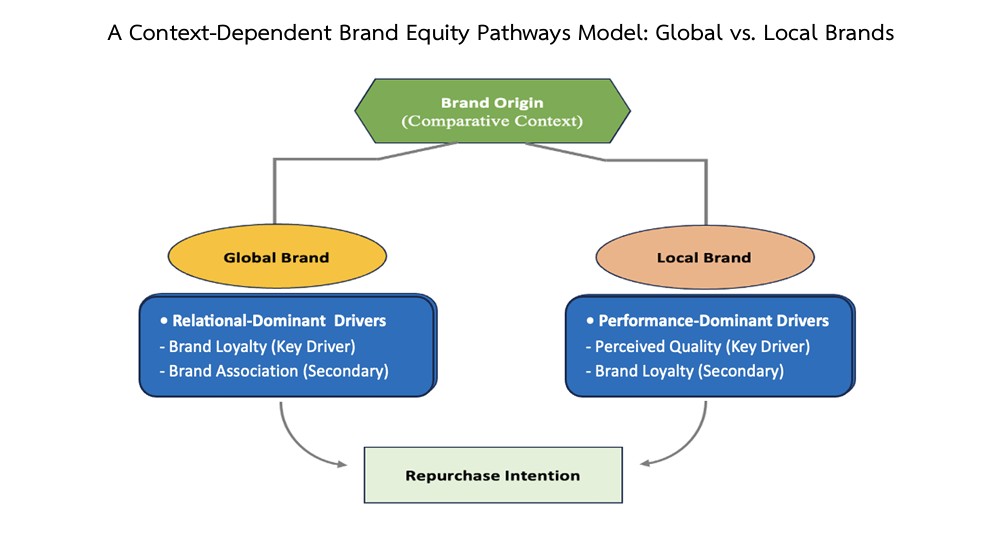
This article aims to examine the impact of four fundamental dimensions of brand equity—brand awareness, brand association, perceived quality, and brand loyalty—on repurchase intention. It also seeks to investigate the differences in these impacts between local and global cosmetic brands. Finally, it aims to identify the most influential brand equity dimension for each brand. Data were collected using an online survey of 390 Chinese consumers aged 18 to 59, representing Generations X, Y, and Z, all of whom had prior purchasing experience with both brands. A purposive sampling method was employed to ensure the relevance of the sample. SPSS was used to analyze the data, including reliability testing, correlation, and regression to test the relationships between variables. The findings show that brand loyalty is the strongest predictor of repurchase intention for L’Oréal Paris, highlighting the role of consumer attachment. Perceived quality is the primary driver of repurchase intention for PROYA, reflecting the importance of product performance. Additionally, the relative importance of brand equity dimensions, as conceptualized by Aaker (1991), differs between the global brand L’Oréal Paris and the local brand PROYA.
เอกสารอ้างอิง
Aaker, D. A. (1991). Managing brand equity: Capitalizing on the value of a brand name. New York: The Free Press.
Arai, A., Ko, Y. J., & Ross, S. (2014). Branding athletes: Exploration and conceptualization of athlete brand image. Sport management review, 17(2), 97-106.
Bauer, H. H., Stokburger-Sauer, N. E., & Exler, S. (2008). Brand image and fan loyalty in professional team sport: A refined model and empirical assessment. Journal of sport Management, 22(2), 205-226.
Bujang, M. A., Sa’at, N., & Bakar, T. M. I. T. A. (2017). Determination of minimum sample size requirement for multiple linear regression and analysis of covariance based on experimental and non-experimental studies. Epidemiology, biostatistics, and public health, 14(3), e12117.
Chaileedo. (2021). L’Oréal Paris: How a foreign brand can become top in China. Retrieved from https://chaileedo.com/loreal-paris-how-a-foreign-brand-can-become-top-in-china/.
Chaudhuri, A., & Holbrook, M. B. (2001). The chain of effects from brand trust and brand affect to brand performance: the role of brand loyalty. Journal of marketing, 65(2), 81-93.
China Briefing. (2024). China’s cosmetics and personal care market: Key trends and business outlook. Retrieved from https://www.china-briefing.com/news/chinas-cosmetics-and-personal-care-market-key-trends-and-business-outlook/.
China Daily. (2024). Clarins bullish about China market. Retrieved from https://www.chinadaily.com.cn/a/202409/12/WS66e2559aa3103711928a798c.html.
Chinapp. (2026). Top 10 makeup and beauty brands. Retrieved from https://www.chinapp.com/paihang/meirong
Chinomona, R., & Maziriri, E. T. (2017). The influence of brand awareness, brand association and product quality on brand loyalty and repurchase intention: a case of male consumers for cosmetic brands in South Africa. Journal of Business and Retail Management Research, 12(1), 143–154.
Cochran, W. G. (1977). Sampling techniques. (3rd ed.). New York: John Wiley & Sons.
Dwivedi, A. (2015). A higher-order model of consumer brand engagement and its impact on loyalty intentions. Journal of Retailing and Consumer Services, 24, 100-109.
Ebrahim, R., Ghoneim, A., Irani, Z., & Fan, Y. (2016). A brand preference and repurchase intention model: the role of consumer experience. Journal of Marketing management, 32(13-14), 1230-1259.
Faircloth, J. B., Capella, L. M., & Alford, B. L. (2001). The effect of brand attitude and brand image on brand equity. Journal of marketing theory and practice, 9(3), 61-75.
Gallart-Camahort, V., Fiol, L. C., & García, J. S. (2023). Influence of the internet on retailer’s perceived quality in the generation of retailer’s brand equity. Vision: The Journal of Business Perspective, 27(1), 33-47.
Grewal, R., Cote, J. A., & Baumgartner, H. (2004). Multicollinearity and measurement error in structural equation models: Implications for theory testing. Marketing science, 23(4), 519-529.
Hair, J. F., Babin, B. J., Anderson, R. E., & Black, W. C. (2019). Multivariate Data Analysis. (8th ed.). Boston, Massachusetts: Cengage Learning.
He, J., & Wang, C. L. (2015). Cultural identity and consumer ethnocentrism impacts on preference and purchase of domestic versus import brands: An empirical study in China. Journal of Business Research, 68(6), 1225-1233.
Hellier, P. K., Geursen, G. M., Carr, R. A., & Rickard, J. A. (2003). Customer repurchase intention: A general structural equation model. European journal of marketing, 37(11-12), 1762-1800.
Hollebeek, L. D. (2011). Demystifying customer brand engagement: Exploring the loyalty nexus. Journal of Marketing Management, 27(7–8), 785–807.
Hsu, C. L., Liu, C. C., & Lee, Y. D. (2012). Effect of commitment and trust towards micro-blogs on consumer behavioral intention: A relationship marketing perspective. International Journal of Electronic Commerce Studies, 3(1), 1–20.
Huang, R., & Sarigöllü, E. (2012). How brand awareness relates to market outcome, brand equity, and the marketing mix. Journal of Business Research, 65(1), 92-99.
Jiemian. (2024). The top ten beauty brands in China are undergoing a major transformation. Retrieved from https://www.jiemian.com/article/12739906.html.
Kapferer, J. N. (2008). The new strategic brand management: Creating and sustaining brand equity long term. (4th ed.). London: Kogan Page.
Keller, K. L. (1993). Conceptualizing, measuring, and managing customer-based brand equity. Journal of Marketing, 57(1), 1–22.
Kim, T., & Lee, H. Y. (2011). External validity of market segmentation methods: A study of buyers of prestige cosmetic brands. European Journal of Marketing, 45(1/2), 153–169.
Likert, R. (1932). A technique for the measurement of attitudes. Archives of Psychology, 22(140), 1-55
Lim, J. (2025). L'Oreal Leads at CN¥ 5.34B While Mid-Tier Brands Surge +7.5% in China. Retrieved from https://moojing-global.com/news-research/loreal-leads-china-cosmetics-as-mid-tier-brands-surge.
Mason, C. H., & Perreault, W. D. (1991). Collinearity, Power, and Interpretation of Multiple Regression Analysis. Journal of Marketing Research, 28(3), 268-280.
Netemeyer, R. G., Krishnan, B., Pullig, C., Wang, G. P., Yagci, M., Dean, D., Ricks, J., & Wirth, F. (2004). Developing and validating measures of facets of customer-based brand equity. Journal of Business Research, 57(2), 209–224.
Nunnally, J. C. (1978). Psychometric theory. (2nd ed.). New York: McGraw-Hill.
O’Brien, R. M. (2007). A caution regarding rules of thumb for variance inflation factors. Quality & Quantity, 41(5), 673–690.
Oliver, R. L. (1999). Whence consumer loyalty?. Journal of Marketing, 63(4), 33–44.
Percy, L., & Rossiter, J. R. (1992). A model of brand awareness and brand attitude advertising strategies. Psychology & Marketing, 9(4), 263–274.
Proya Cosmetics Co., Ltd. (2024). Annual report 2024. Retrieved from https://www.proya-group.com/local_upload/20250428/1916677464588423168.pdf.
Tabachnick, B. G., & Fidell, L. S. (2013). Using Multivariate Statistics. (6th ed.). Boston, MA: Pearson.
The Paper. (2024). Top 10 Domestic Beauty Brands Revealed: In the Era of Billions, Who is Leading the Change?. Retrieved from https://www.thepaper.cn/newsDetail_forward_30773247.
Tong, X., & Hawley, J. M. (2009). Measuring customer-based brand equity: Empirical evidence from the sportswear market in China. Journal of Product & Brand Management, 18(4), 262–271.
Vo Minh, S., Huong, N. G., & Ha, G. D. N. (2022). The role of social brand engagement on brand equity and purchase intention for fashion brands. Cogent Business & Management, 9(1), 2143308.
Yoo, B., & Donthu, N. (2001). Developing and validating a multidimensional consumer-based brand equity scale. Journal of Business Research, 52(1), 1–14.
Yoo, B., Donthu, N., & Lee, S. (2000). An examination of selected marketing mix elements and brand equity. Journal of the Academy of Marketing Science, 28(2), 195–211.
Zeithaml, V. A. (1988). Consumer perceptions of price, quality, and value: A means–end model and synthesis of evidence. Journal of Marketing, 52(3), 2–22.
ดาวน์โหลด
เผยแพร่แล้ว
รูปแบบการอ้างอิง
ฉบับ
ประเภทบทความ
สัญญาอนุญาต
ลิขสิทธิ์ (c) 2026 วารสารสังคมศาสตร์ปัญญาพัฒน์

อนุญาตภายใต้เงื่อนไข Creative Commons Attribution-NonCommercial-NoDerivatives 4.0 International License.


