Current and Desired Conditions, Priority Needs, and Guidelines for Educational Administration amid Global Geopolitical Change in Education Hub Schools under the Secondary Educational Service Area Office Bangkok 1
คำสำคัญ:
Educational Administration, Global Geopolitical Change, Education Hub Schoolsบทคัดย่อ
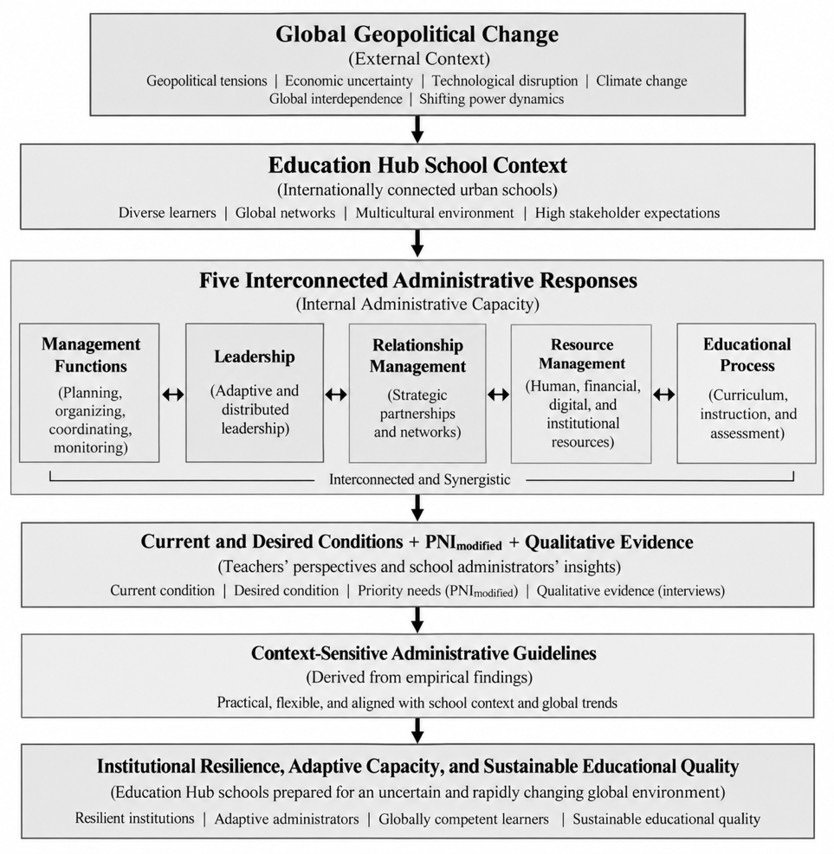
This research aimed to 1) examine the current and desired conditions of school administrators’ ability to cope effectively with educational administration amid global geopolitical change in Education Hub schools under the Secondary Educational Service Area Office Bangkok 1; 2) identify the priority needs of such ability; and 3) propose guidelines for educational administration in response to global geopolitical change. An explanatory mixed-methods design was employed, integrating quantitative and qualitative findings at the interpretation stage. The quantitative sample comprised 216 teachers from three Education Hub schools, selected through stratified random sampling with proportional allocation. Data were collected using a dual-response questionnaire and analyzed using frequency, percentage, mean, standard deviation, mean difference, and the Modified Priority Needs Index (PNImodified). The qualitative component involved three school administrators as key informants, with semi-structured interview data thematically analyzed to explain quantitative findings and develop practical, context-sensitive guidelines. The findings showed that the overall current and desired conditions were at high levels (M = 3.908, S.D. = 0.806; M = 4.312, S.D. = 0.760, respectively), with an overall PNImodified of 0.104. The Educational Process dimension had the highest current and desired conditions (M = 3.930, S.D. = 0.790; M = 4.331, S.D. = 0.744, respectively), while Management Functions had the highest priority need (PNImodified = 0.109). The qualitative findings confirmed the quantitative results, indicating that geopolitical changes pressured school policy and learner competencies. Schools responded through planning, curriculum adjustment, technology, partnerships, resource mobilization, and authentic assessment, but these practices were not yet fully institutionalized. Integrating the findings led to five interconnected guidelines: institutionalizing geopolitical environmental scanning and contingency planning; strengthening transformational and distributed leadership; formalizing and diversifying strategic partnerships through MOUs; investing in digital infrastructure and personnel development as strategic priorities; and continuously aligning curriculum, instruction, and assessment with globally relevant competencies.
เอกสารอ้างอิง
Bass, B. M., & Avolio, B. J. (Eds.). (1994). Improving organizational effectiveness through transformational leadership. Thousand Oaks, CA: SAGE Publications.
Cascio, J. (2020). Facing the age of chaos. Retrieved from https://medium.com/@cascio/facing-the-age-of-chaos-b00687b1f51d.
Cochran, W. G. (1977). Sampling techniques. (3rd ed.). New York: John Wiley & Sons.
Creswell, J. W., & Creswell, J. D. (2018). Research design: Qualitative, quantitative, and mixed methods approaches. (5th ed.). Los Angeles: SAGE Publications.
Creswell, J. W., & Poth, C. N. (2018). Qualitative inquiry and research design: Choosing among five approaches. (4th ed.). Thousand Oaks: SAGE Publications.
Cronbach, L. J. (1951). Coefficient alpha and the internal structure of tests. Psychometrika, 16, 297–334.
Dodds, K. (2019). Geopolitics: A very short introduction. (3rd ed.). Oxford: Oxford University Press.
Fayol, H. (1917). Administration industrielle et générale: prévoyance, organisation, commandement, coordination, contrôle. Malakoff: Dunod.
Flint, C. (2021). Introduction to geopolitics. (4th ed.). London: Routledge.
Flint, C., & Taylor, P. J. (2025). Political geography: World-economy, nation-state, and locality. (8th ed.). London: Routledge.
Janlasee, P., Nuntee, S., & Prommuangkun, S. (2024). The Scenarios of Educational Administration of Secondary Schools in Thailand during the Next Decade (AD 2022-2031). International Education Studies, 17(1), 77-84.
Katz, D., & Kahn, R. L. (1978). The social psychology of organizations. (2nd ed.). New York: Wiley.
Krejcie, R. V., & Morgan, D. W. (1970). Determining sample size for research activities. Educational and Psychological Measurement, 30(3), 607–610.
Likert, R. (1932). A technique for the measurement of attitudes. Archives of Psychology, 22, 1–55.
Marginson, S. (2025). Globalisation and the geopolitics of higher education (Working Paper No. 120). Retrieved from https://researchcghe.org/wp-content/uploads/2025/04/WP_120-1.pdf.
McDiarmid, G. W., & Zhao, Y. (2022). Learning for uncertainty: Teaching students how to thrive in a rapidly evolving world. Abingdon, Oxfordshire: Routledge.
McGregor, D. (1960). The human side of enterprise. New York: McGraw-Hill.
Mearsheimer, J. J. (2019). Bound to fail: The rise and fall of the liberal international order. International security, 43(4), 7-50.
OECD. (2020). Back to the future of education: Four OECD scenarios for schooling. Paris: OECD Publishing.
OECD. (2021). Education policy outlook 2021: Shaping responsive and resilient education in a changing world. Paris: OECD Publishing.
OECD. (2023). OECD skills outlook 2023: Skills for a resilient green and digital transition. Paris: OECD Publishing.
Rodpipat, J. (2024). Confirmatory Factor Analysis of Creative Leadership in Climate Change Management: A Case Study of the Department of Climate Change and Environment. (Master of Science, Chulalongkorn University).
Silalaiy, K. (2023). School Management Guidelines in New Normal: School Management Guidelines in New Normal. Ratanabuth Journal, 5(1), 58–74.
Tuathail, G. (1997). Critical geopolitics: The politics of writing global space. London: Routledge.
Tuathail, G. (2010). New directions in critical geopolitics: An introduction. GeoJournal, 75, 315–325.
Tyler, R.W. (1949). Basic Principles of Curriculum and Instruction. Chicago: University of Chicago Press.
UNESCO. (2021). Reimagining our futures together: A new social contract for education. Paris: UNESCO.
UNESCO. (2023). Global education monitoring report 2023: Technology in education: A tool on whose terms?. Paris: UNESCO.
Wongthongdee, S., Petcharaks, N., Kumsuprom, S., Navanuch, P., Tantrajin, P., Jaisue, N., Dejthongjun Limpananarkthong, S., Soponpatima, T., Limlerjalearnvanit, N., & Limsiri, P. (2024). Competencies for Future Executives and the Powerful Assessment Methods. The Journal of Prapokklao Hospital Clinical Medical Education Center, 41(1), 106-114.
Wongwanich, S. (2015). Needs assessment research. (3rd ed.). Bangkok: Chulalongkorn University Press.
Zhou, J., & Zhang, H. (2025). Transforming education in the AI era: a technology–organization–environment framework inquiry into public discourse. Applied Sciences, 15(7), 3886.
ดาวน์โหลด
เผยแพร่แล้ว
รูปแบบการอ้างอิง
ฉบับ
ประเภทบทความ
สัญญาอนุญาต
ลิขสิทธิ์ (c) 2026 วารสารสังคมศาสตร์ปัญญาพัฒน์

อนุญาตภายใต้เงื่อนไข Creative Commons Attribution-NonCommercial-NoDerivatives 4.0 International License.


