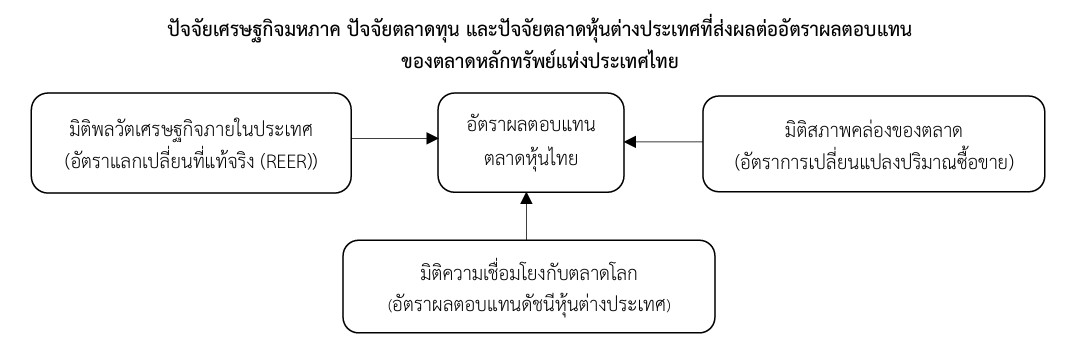
ปัจจัยเศรษฐกิจมหภาค ปัจจัยตลาดทุน และปัจจัยตลาดหุ้นต่างประเทศที่ส่งผลต่ออัตราผลตอบแทนของตลาดหลักทรัพย์แห่งประเทศไทย
คำสำคัญ:
อัตราผลตอบแทนตลาดหุ้น, ปัจจัยเศรษฐกิจมหภาค, วิกฤตเศรษฐกิจบทคัดย่อ
บทความวิจัยนี้มีวัตถุประสงค์เพื่อศึกษาความสัมพันธ์ระหว่างอัตราผลตอบแทนตลาดหุ้นไทยกับปัจจัยเศรษฐกิจมหภาคภายในประเทศ ปัจจัยด้านตลาดทุน และอัตราผลตอบแทนตลาดหุ้นต่างประเทศ รวมทั้งบทบาทของเหตุการณ์วิกฤตเศรษฐกิจ การวิจัยครั้งนี้เป็นการวิจัยเชิงปริมาณ (Quantitative Research) โดยใช้ข้อมูลอนุกรมเวลารายไตรมาสตั้งแต่ปี พ.ศ. 2548 ถึง พ.ศ. 2567 รวมทั้งสิ้น 80 ไตรมาส ในส่วนของสถิติที่ใช้ในการวิเคราะห์ข้อมูล ได้แก่ สถิติเชิงพรรณนา การทดสอบความนิ่งของข้อมูล (ADF และ KPSS Test) การตรวจสอบปัญหาทางเศรษฐมิติ อาทิ ปัญหาสหสัมพันธ์เชิงพหุ Autocorrelation และ Heteroskedasticity ตลอดจนการประมาณค่าแบบจำลองด้วยวิธีสมการถดถอยพหุคูณ (Ordinary Least Squares: OLS) ผลการศึกษาพบว่า ปัจจัยที่มีความสัมพันธ์เชิงบวกกับอัตราผลตอบแทนตลาดหลักทรัพย์แห่งประเทศไทยอย่างมีนัยสำคัญทางสถิติในแบบจำลองหลัก ได้แก่ อัตราเงินเฟ้อปัจจุบัน อัตราแลกเปลี่ยนที่แท้จริงถ่วงน้ำหนักการค้า การเปลี่ยนแปลงของปริมาณการซื้อขายหลักทรัพย์ และอัตราผลตอบแทนดัชนี S&P500 ขณะที่อัตราผลตอบแทนดัชนี MSCI Emerging Markets CSI300 และ TOPIX มีความสัมพันธ์เชิงบวกอย่างมีนัยสำคัญในแบบจำลองทางเลือก ในทางกลับกัน ปัจจัยที่ไม่ปรากฏความสัมพันธ์อย่างมีนัยสำคัญทางสถิติกับอัตราผลตอบแทนตลาดหลักทรัพย์ฯ ในแบบจำลองหลัก ได้แก่ อัตราการเปลี่ยนแปลงปริมาณเงิน การเปลี่ยนแปลงของอัตราดอกเบี้ยซื้อคืนพันธบัตรระยะ 1 วันซึ่งใช้เป็นตัวแทนของอัตราดอกเบี้ยนโยบาย และอัตราการเปลี่ยนแปลงของหนี้สาธารณะ ส่วนอัตราการเปลี่ยนแปลงของการลงทุนโดยตรงจากต่างประเทศสุทธิไหลเข้า ซึ่งไม่ได้รวมอยู่ในแบบจำลองหลัก ไม่มีนัยสำคัญทางสถิติในแบบจำลองทางเลือกที่มีตัวแปรดังกล่าว ขณะที่ตัวแปรวิกฤตเศรษฐกิจ แม้จะไม่มีนัยสำคัญในแบบจำลองหลัก แต่ในหลายแบบจำลองทางเลือกแสดงให้เห็นถึงผลกระทบในทิศทางเชิงลบ ซึ่งสะท้อนว่าวิกฤตเศรษฐกิจส่งผลกระทบอย่างรุนแรงต่อความเชื่อมั่นของนักลงทุนและกดดันให้ผลตอบแทนในตลาดทุนปรับตัวลดลง ดังนั้น ผู้กำหนดนโยบายควรยกระดับการเปิดเผยข้อมูลที่โปร่งใสและสื่อสารทิศทางเศรษฐกิจอย่างชัดเจนเพื่อรักษาความเชื่อมั่นของนักลงทุน นอกจากนี้ ผู้ลงทุนควรติดตามทิศทางของตลาดหุ้นต่างประเทศและสภาพคล่องของตลาดประกอบการบริหารความเสี่ยงของพอร์ตการลงทุน
เอกสารอ้างอิง
ณิฐชมนต์ฐิติ ภัทร์เลิศเดช. (2559). ผลกระทบของปัจจัยเศรษฐกิจมหภาคต่ออัตราผลตอบแทนของการจัดพอร์ตการลงทุน. (วิทยาศาสตรมหาบัณฑิต, มหาวิทยาลัยกรุงเทพ).
ตลาดหลักทรัพย์แห่งประเทศไทย. (2568). ข้อมูลสถิติตลาดหลักทรัพย์แห่งประเทศไทย. สืบค้นจาก https://www.set.or.th/th/market/statistics/market-statistics/main.
ธนวรรธน์ ตรีระสหกุลย์ และ สุเมธ ธุวดาราตระกูล. (2561). ปัจจัยทางเศรษฐกิจที่ส่งผลกระทบต่อดัชนีตลาดหลักทรัพย์แห่งประเทศไทย. วารสารบริหารธุรกิจศรีนครินทรวิโรฒ, 9(2), 12-29.
ธนาคารแห่งประเทศไทย. (2568). ฐานข้อมูลสถิติธนาคารแห่งประเทศไทย. สืบค้นจาก https://www.bot.or.th/th/statistics.html.
หลักทรัพย์บัวหลวง. (2568). เจาะกลยุทธ์ลงทุนหุ้นนอกพร้อม Top-Pick DR. สืบค้นจาก https://www.bualuang.co.th/article/drseminarbyset.
Ashraf, B. N. (2020). Stock markets’ reaction to COVID-19: Cases or fatalities?. Research in international business and finance, 54, 101249.
Baker, S. R., Bloom, N., Davis, S. J., Kost, K., Sammon, M., & Viratyosin, T. (2020). The unprecedented stock market reaction to COVID-19. The review of asset pricing studies, 10(4), 742-758.
Beirne, J., Caporale, G. M., Schulze-Ghattas, M., & Spagnolo, N. (2010). Global and regional spillovers in emerging stock markets: A multivariate GARCH-in-mean analysis. Emerging Markets Review, 11(3), 250–260.
Bhuiyan, E. M., & Chowdhury, M. (2020). Macroeconomic variables and stock market indices: Asymmetric dynamics in the US and Canada. The Quarterly Review of Economics and Finance, 77, 62–74.
Bloomberg L.P. (2025). MSCI Emerging Markets Index (MXEF Index): Quarterly closing values, 2005-2024 [Data set]. Retrieved from https://www.msci.com/documents/10199/c0db0a48-01f2-4ba9-ad01-226fd5678111.
CEIC Data. (2025). CEIC global database: Thailand. Retrieved from https://www.ceicdata.com
Celebi, K., & Hönig, M. (2019). The impact of macroeconomic factors on the German stock market: Evidence for the crisis, pre- and post-crisis periods. International Journal of Financial Studies, 7(2), 18.
Chancharoenchai, K., Dibooglu, S., & Mathur, I. (2005). Stock returns and the macroeconomic environment prior to the Asian crisis in selected Southeast Asian countries. Emerging Markets Finance and Trade, 41(4), 38–56.
Chen, N. F., Roll, R., & Ross, S. A. (1986). Economic forces and the stock market. The Journal of Business, 59(3), 383-403.
Chiah, M., & Zhong, A. (2020). Trading from home: The impact of COVID-19 on trading volume around the world. Finance Research Letters, 37, 101784.
Fama, E. F. (1970). Efficient capital markets: A review of theory and empirical work. The journal of Finance, 25(2), 383-417.
Fama, E. F. (1981). Stock returns, real activity, inflation, and money. The American economic review, 71(4), 545-565.
Forson, J. A., & Janrattanagul, J. (2014). Selected macroeconomic variables and stock market movements: Empirical evidence from Thailand. Contemporary Economics, 8(2), 154-174.
Friedman, M. (1956). The quantity theory of money: A restatement. In M. Friedman (Ed.), Studies in the quantity theory of money (pp. 3–21). Chicago: University of Chicago Press.
Ghulam, S., Mubashar, A., Bashir, M., & Hussain, S. (2025). Foreign Direct Investment and Stock Market Development: Evidence from Asia. Journal of Social Sciences Review, 5(1), 1-10.
Gujarati, D. N., & Porter, D. C. (2009). Basic econometrics. (5th ed.). New York: McGraw-Hill/Irwin.
Humpe, A., McMillan, D. G., & Schöttl, A. (2025). Macroeconomic determinants of the stock market: A comparative study of Anglosphere and BRICS. Finance Research Letters, 75, 106869.
Investing.com. (2025). TOPIX historical data [Data set]. Retrieved from https://www.investing.com/indices/topix-historical-data.
iYom BIZ + INSPIRATION. (2566). สรุปวิกฤตในตลาดหุ้นในไทยช่วง 30 ปีที่ผ่านมา (พ.ศ. 2535–2566). สืบค้นจาก https://iyom-bizinspiration.com/การลงทุน/all-crisis-in-thailand-stocks-market-30-years-ago/.
Karpoff, J. M. (1987). The relation between price changes and trading volume: A survey. Journal of Financial and Quantitative Analysis, 22(1), 109–126.
Kwon, C. S., & Shin, T. S. (1999). Cointegration and causality between macroeconomic variables and stock market returns. Global Finance Journal, 10(1), 71-81.
Maysami, R. C., & Koh, T. S. (2000). A vector error correction model of the Singapore stock market. International Review of Economics & Finance, 9(1), 79-96.
Mukherjee, T. K., & Naka, A. (1995). Dynamic relations between macroeconomic variables and the Japanese stock market: An application of a vector error correction model. The Journal of Financial Research, 18(2), 223–237.
Persons, W. M. (1911). Fisher's “The Purchasing Power of Money” [The Purchasing Power of Money, Irving Fisher]. Publications of the American Statistical Association, 12(96), 818-829.
Ross, S. A. (1976). The arbitrage theory of capital asset pricing. Journal of Economic Theory, 13(3), 341-360.
Siang, C. C., & Rayappan, P. (2023). A study on the effect of macroeconomic factors on stock market performance in Malaysia. In E3S Web of Conferences (Vol. 389, p. 09037). Les Ulis: EDP Sciences.
Tangjitprom, N. (2011). Macroeconomic factors of emerging stock market: the evidence from Thailand. International Journal of Financial Research, 3(2), 105-114.
Topcu, M., & Gulal, O. S. (2020). The impact of COVID-19 on emerging stock markets. Finance Research Letters, 36, 101691.
Wisniewski, T. P., & Jackson, P. M. (2021). Government debt expansion and stock returns. International Journal of Finance & Economics, 26(4), 5017-5030.
Wongbangpo, P., & Sharma, S. C. (2002). Stock market and macroeconomic fundamental dynamic interactions: ASEAN-5 countries. Journal of asian Economics, 13(1), 27-51.
World Bank. (2024). GDP growth (annual %) - Thailand. Retrieved from https://data.worldbank.org/indicator/NY.GDP.MKTP.KD.ZG?locations=TH.
Zhang, D., Hu, M., & Ji, Q. (2020). Financial markets under the global pandemic of COVID-19. Finance Research Letters, 36, 101528.
ดาวน์โหลด
เผยแพร่แล้ว
รูปแบบการอ้างอิง
ฉบับ
ประเภทบทความ
สัญญาอนุญาต
ลิขสิทธิ์ (c) 2026 วารสารสังคมศาสตร์ปัญญาพัฒน์

อนุญาตภายใต้เงื่อนไข Creative Commons Attribution-NonCommercial-NoDerivatives 4.0 International License.


