Educational Psychology in Islamic Preaching
Keywords:
Educational Psychology, Islamic Preaching, UnityAbstract
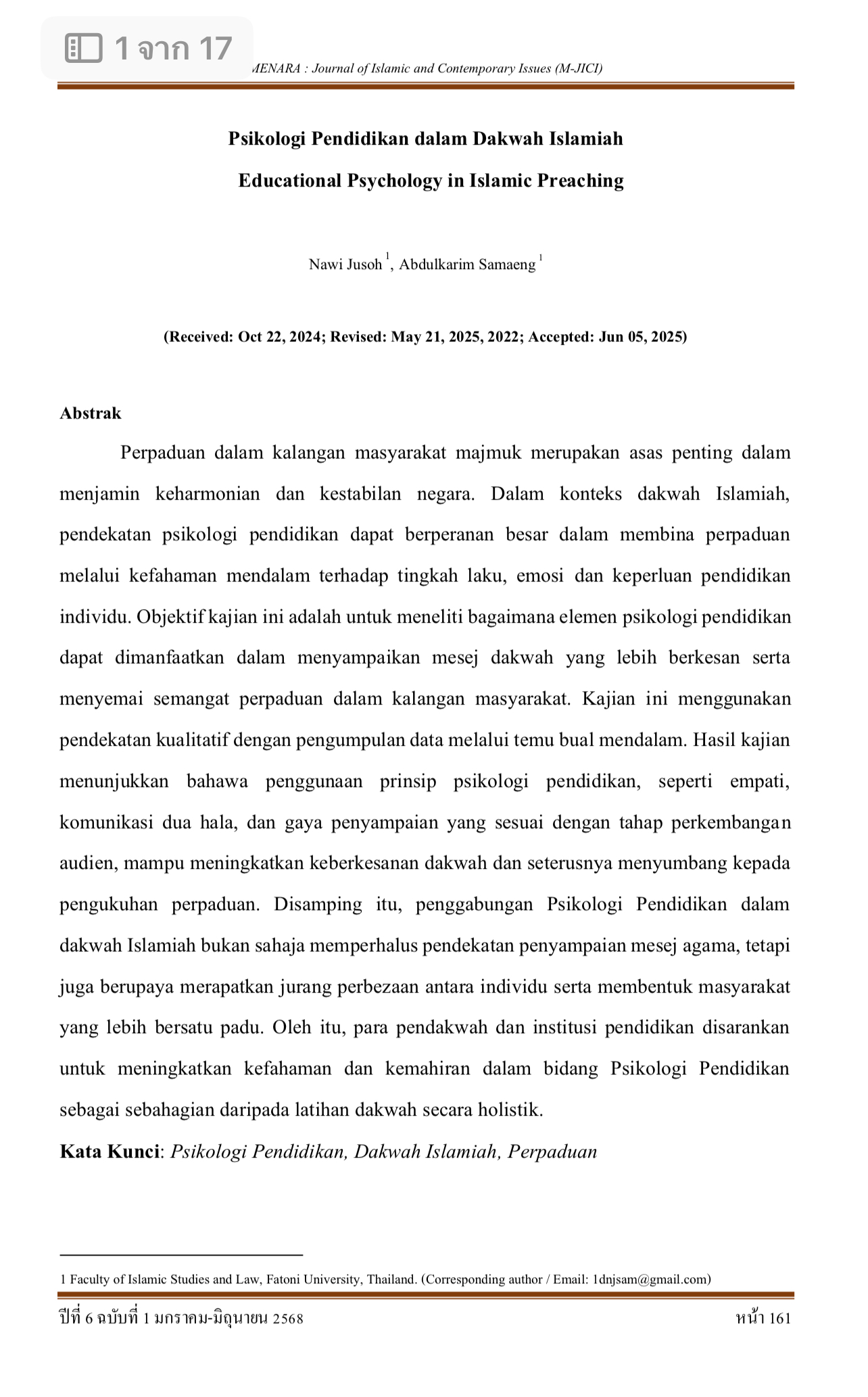
Unity within a pluralistic society is a fundamental pillar in ensuring national harmony and stability. In the context of Islamic preaching, the approach of educational psychology plays a significant role in fostering unity through a deep understanding of individual behavior, emotions, and educational needs. The objective of this study is to examine how elements of educational psychology can be utilized to deliver more effective preaching messages and instill a spirit of unity within society. This study adopts a qualitative approach, with data collected through in-depth interviews. The findings reveal that the application of Educational Psychology principles such as empathy, two-way communication, and delivery styles suited to the developmental level of the audience can enhance the effectiveness of preaching and subsequently contribute to the strengthening of unity. Moreover, the integration of educational psychology into Islamic preaching not only refines the method of religious message delivery but also helps bridge differences between individuals and foster a more cohesive society. Therefore, it is recommended that preachers and educational institutions improve their understanding and skills in educational psychology as part of a holistic preaching training program.
References
al-Ghazali. (2005). Ihya’ Ulum al-Din. Damsyik: Dar al-Fikr.
Braun, V. & Clarke, V. (2006). Using thematic analysis in psychology. Qualitative Research in Psychology, 3(2), 77–101.
Goleman, D. (1995). Emotional Intelligence. Los Angelis: Bantam Books.
Khoo, G. C. (2002). Reclaiming Adat: Contemporary Malaysian Film and Literature. Malaysia: UBC Press.
Maslow, A. H. (1943). A Theory of Human Motivation. Psychological Review, 50(4), 370–396.
Rukun Negara Malaysia. (1970). Jabatan Perdana Menteri Malaysia. Selangor: Printer Interpirce.
Ryan, R. M., & Deci, E. L. (2000). Intrinsic and Extrinsic Motivations: Classic Definitions and New Directions. Contemporary Educational Psychology, 25(1), 54–67.
Santrock, J. W. (2011). Educational Psychology (5th ed.). United States: McGraw-Hill Education.
Shamsul Amri Baharuddin. (2006). Unity in Diversity: Ethnic Relations in Malaysia. Selangor: Universiti Kebangsaan Malaysia Press.
Slavin, R. E. (2018). Educational Psychology: Theory and Practice. BTS Norway: Pearson Education.
Zakaria Stapa (2003). Psikologi Dakwah. Bangi: Penerbit UKM.
Downloads
Published
How to Cite
Issue
Section
License
Copyright (c) 2025 MENARA : Journal of Islamic and Contemporary Issues

This work is licensed under a Creative Commons Attribution-NonCommercial-NoDerivatives 4.0 International License.


