The Results of Learning Management on al-Hadith Subject Entitled Morals and Ethics by Using Electronic Book for Intermediate Islamic Studies Stage Students, Year 2
Keywords:
Morals and Ethics, Electronic Book, Learning Management, Al-HadithAbstract
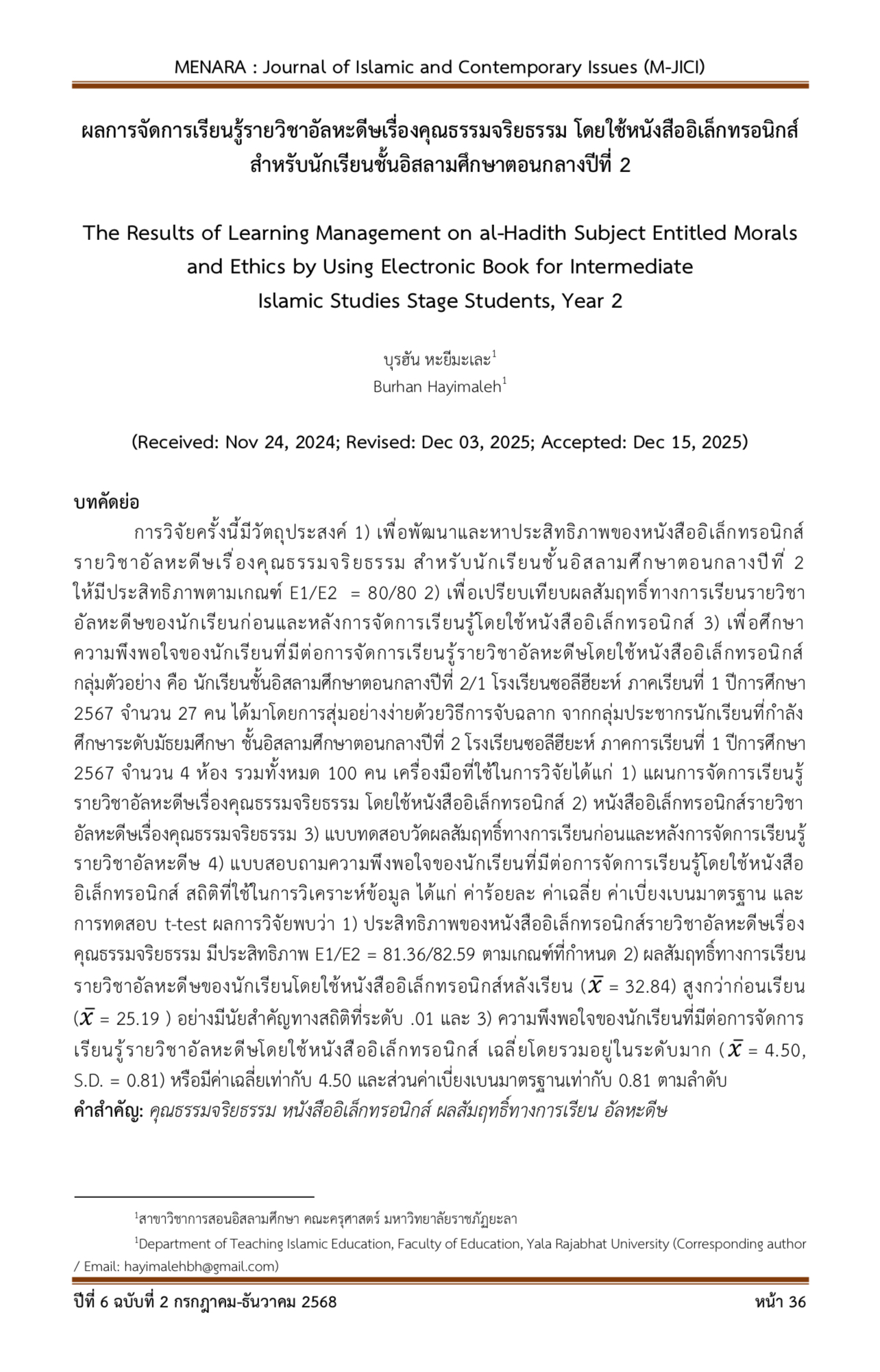
The objectives of this research were 1) to develop and find the effectiveness of an electronic book on the al-Hadith subject entitled morals and ethics for intermediate Islamic studies stage students, year 2 according to standard criteria E1/E2 = 80/80, 2) to compare the learning achievement of students in al-Hadith subject before and after learning using an electronic book, and 3) to assess the students’ satisfaction towards learning management on al-Hadith subject using an electronic book. The target group was 27 intermediate Islamic Studies Year 2 students at Salihiyah School who studied in the first semester of the 2024 academic year. They were obtained through simple random sampling using the draw lots method from the population of intermediate Islamic Studies Year 2 students at Salihiyah School in the first semester of the 2024 academic year. The instruments were used: 1) learning management plans on the al-Hadith subject entitled morals and ethics, 2) an electronic book on the al-Hadith subject, 3) pre-test and post-test learning achievement in the al-Hadith subject, and 4) a questionnaire on students’ satisfaction towards learning management using an electronic book. The data was analyzed using mean, percentage, standard deviation, and t-test. The results showed that: 1) The effectiveness of an electronic book on the al-Hadith subject entitled morals and ethics for intermediate Islamic Studies stage students, year 2, reached the required standard with E1/E2 = 81.36/82.59, which was higher than the set criteria. 2) The comparison of the student’s learning achievement on the al-Hadith subject using an electronic book after learning was higher than before learning at the statistically significant level of .01, and 3) The students’ satisfaction towards learning management on the al-Hadith subject by using an electronic book was high with an overall average score of (𝑥̅= 4.50, S.D. = 0.81) or with a mean of 4.50 and a standard deviation of 0.81, respectively
References
เอกสารอ้างอิงฉบับภาษาไทย
กระทรวงศึกษาธิการ. (2555). หลักสูตรอิสลามศึกษา พ.ศ. 2546 (ฉบับปรับปรุง 2555). กระทรวงศึกษาธิการ.
จินตวีร์ คล้ายสังข์. (2555). Desktop Publishing สู่ E-Book เพื่อส่งเสริมการใฝ่รู้ของผู้เรียนยุคดิจิทัล. วีพริ้นท์.
ทักษพร แจ่มศรี. ทัศนกร สมใจหวัง. (2564). การพัฒนาผลสัมฤทธิ์ทางการเรียนภาษาไทยเรื่องชนิดของคำตามรูปแบบการ
สอนแบบสร้างองค์ความรู้ร่วมกับบทเรียนอิเล็กทรอนิกส์ (E-Book) สำหรับนักเรียนชั้นประถมศึกษาปีที่ 6. วารสารวิชาการและวิจัยสังคมศาสตร์, 16(2), 103-116.
ทัศนกร สมใจหวัง. (2559). การพัฒนาหนังสืออิเล็กทรอนิกส์บนแท็บเล็ต เรื่อง ความรู้สู่อาเซียน กลุ่มสาระการเรียนรู้สังคมศึกษา ศาสนาและวัฒนธรรม สำหรับนักเรียนชั้นประถมศึกษาปีที่ 2. วารสารมหาวิทยาลัยศิลปากร, 9(3), 177-190.
ธนภรณ์ นนตะแสน. (2560). การพัฒนาชุดกิจกรรมการเรียนรู้แบบร่วมมือร่วมกับการใช้หนังสืออิเล็กทรอนิกส์ เรื่อง เทคโนโลยีสารสนเทศ ชั้นมัธยมศึกษาปีที่ 1. วารสารวิชาการหลักสูตรและการสอน มหาวิทยาลัยราชภัฏสกลนคร, 9(24), 125-134.
ภัทราพร เตชวาณิชย์. (2562). ผลการใช้วิธีการทางประวัติศาสตร์ร่วมกับหนังสืออิเล็กทรอนิกส์ เรื่อง รัฐโบราณ ในดินแดนไทย เพื่อเสริมสร้างความคิดเชิงมโนทัศน์ทางประวัติศาสตร์ของนักเรียนชั้นมัธยมศึกษาปีที่ 4. วารสารมหาวิทยาลัยศิลปากร, 12(4), 673-685.
ไพฑูรย์ ศรีฟ้า. (2552). E-Book หนังสือพูดได้. พิมพ์ครั้งที่ 2. ฐานบุ๊คส์.
ลิลดา เกตุเอม. (2555). การพัฒนาหนังสืออิเล็กทรอนิกส์วิชาภาษาอังกฤษ เรื่อง Food and Drink ของนักเรียนชั้นประถมศึกษาปีที่ 6 ศูนย์การเรียนรู้เครือข่ายโรงเรียนขนาดเล็ก โรงเรียนวัดนาขวาง อำเภอเมือง จังหวัดสมุทรสาคร. วารสารวิชาการ Veridian E-Journal: กลุ่มมนุษยศาสตร์และสังคมศาสตร์, 6(2), 287-295.
อาดีละห์ ลือแบบราเห็ง. (2564). การพัฒนาผลสัมฤทธิ์รายวิชาอัตตารีค เรื่อง อูลุลอัซมียฺ โดยใช้หนังสืออิเล็กทรอนิกส์ (E-Book) สำหรับนักเรียนชั้นประถมศึกษาปีที่ 5. มนารอ: วารสารประเด็นอิสลามร่วมสมัย, 2(1), 41-54.
อาหมัด มูดอ. (2558). การพัฒนาความรู้ความเข้าใจด้านจริยธรรมสาระอัลหะดีษ โดยใช้หนังสือนิทานสำหรับนักเรียนชั้นอิสลามศึกษาตอนต้นปีที่ 4. มนารอ: วารสารประเด็นอิสลามร่วมสมัย, 3(1), 29-40.
อิบรอฮีม ณรงค์รักษาเขต. (2552). ประวัติการศึกษาอิสลาม. หาดใหญ่กราฟฟิก.
ฮาสะนะ เสนสะนา. (2566). ผลการใช้หนังสืออิเล็กทรอนิกส์ (E-Book) เพื่อพัฒนาผลสัมฤทธิ์ทางการเรียนรายวิชาประวัติศาสตร์สำหรับนักเรียนชั้นอิสลามศึกษาตอนปลายปีที่ 1. มนารอ: วารสารประเด็นอิสลามร่วมสมัย, 4(2), 37-50.
เอกสารอ้างอิงฉบับภาษาต่างประเทศ
Barker, P. (1996). Psychotherapeutic metaphors: A guide to theory and practice. Routledge
Bruner, J. S. (1966). Toward a theory of instruction. Harvard University Press.
Gardner, H. (1983). Frames of mind: The theory of multiple intelligences. UK: Basic Books.
Mayer, R. E. (2005). The Cambridge handbook of multimedia learning. Cambridge University Press.
Sharples, M. (2013). Mobile learning: Research, practice and challenges. International Journal of Mobile and Blended Learning, 5(1), 4–18.
Vygotsky, L. S. (1978). Mind in society: The development of higher psychological processes. Harvard University Press.
Downloads
Published
How to Cite
Issue
Section
License
Copyright (c) 2025 MENARA : Journal of Islamic and Contemporary Issues

This work is licensed under a Creative Commons Attribution-NonCommercial-NoDerivatives 4.0 International License.


