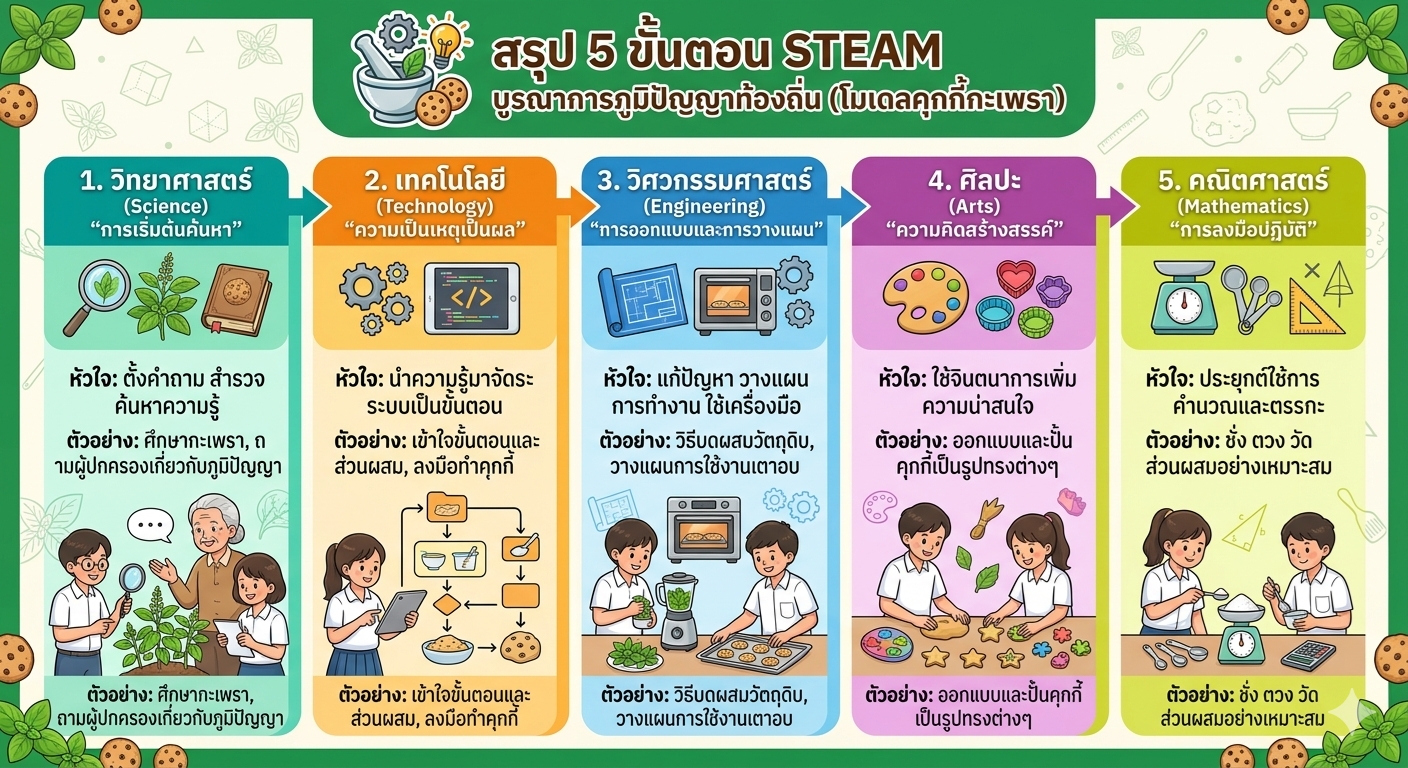
The Development of Thai Language Learning Activities Based on the STEAM Approach through Holy Basil Cookies Integrated with Local Wisdom toward Reading Comprehension Achievement of Grade 4 Students
Article Sidebar
Main Article Content
Abstract
The purposes of this research were: 1) to study the effectiveness of a Thai language learning management plan based on the STEM approach on the topic “Holy Basil Cookies” integrated with local wisdom toward the reading comprehension achievement of Grade 4 students, targeting an efficiency criterion of 70/70 ; 2) to compare the Thai reading comprehension achievement of Grade 4 students before and after learning using the Thai language learning management plan based on the STEM approach on the topic “Holy Basil Cookies” integrated with local wisdom; and 3) to study the satisfaction of Grade 4 students toward the Thai language learning activities based on the STEM approach on the topic “Holy Basil Cookies” integrated with local wisdom. This research employed a mixed-methods design. The population consisted of 23 Grade 4 students at Huai Phlu School, Kaeng Sopha Sub-district, Wang Thong District, Phitsanulok Province, in the academic year 2024, selected through purposive sampling. The research instruments included: 1) a learning management plan, 2) pre- and post-learning achievement tests, and 3) a satisfaction questionnaire. Data were analyzed using mean, percentage, standard deviation (S.D.), and t-test.
The result revealed the following:
1. The effectiveness of the Thai language learning management plan based on the STEM approach on the topic “Holy Basil Cookies” integrated with local wisdom toward the reading comprehension achievement of Grade 4 students was 72.70/84.13.
2. The Thai reading comprehension achievement of Grade 4 students after learning with the plan was significantly higher than before learning at the .05 level.
3. The students’ satisfaction toward the Thai language learning activities based on the STEM approach on the topic “Holy Basil Cookies” integrated with local wisdom was at the highest level.
Article Details

This work is licensed under a Creative Commons Attribution-NonCommercial-NoDerivatives 4.0 International License.
เพื่อให้เป็นไปตามกฎหมายลิขสิทธิ์ ผู้นิพนธ์ทุกท่านต้องลงลายมือชื่อในแบบฟอร์มใบมอบลิขสิทธิ์บทความ ให้แก่วารสารฯ พร้อมกับบทความต้นฉบับที่ได้แก้ไขครั้งสุดท้าย นอกจากนี้ ผู้นิพนธ์ทุกท่านต้องยืนยันว่าบทความ ต้นฉบับที่ส่งมาตีพิมพ์นั้น ได้ส่งมาตีพิมพ์เฉพาะในวารสาร วิชาการธรรม ทรรศน์ เพียงแห่งเดียวเท่านั้น หากมีการใช้ ภาพหรือตารางของผู้นิพนธ์อื่นที่ปรากฏในสิ่งตีพิมพ์อื่นมาแล้ว ผู้นิพนธ์ต้องขออนุญาตเจ้าของลิขสิทธิ์ก่อน พร้อมทั้ง แสดงหนังสือที่ได้รับการยินยอมต่อบรรณาธิการ ก่อนที่บทความจะได้รับการตีพิมพ์References
จุไรรัตน์ ลักษณะศิริ และบาหยัน อิ่มสำราญ. (2547). การใช้ภาษาไทย. กรุงเทพฯ: พี.เพรส
ดารุณี เพ็งน้อย และนิวัฒน์ บุญสม. (2564). การพัฒนาความสามารถในการแก้ปัญหาอย่างสร้างสรรค์และการสร้างผลงานทางวิทยาศาสตร์ ของนักเรียนชั้นประถมศึกษาปีที่ 5 ด้วยการจัดกิจกรรมการเรียนรู้ตามแนวคิด STEAM Education. วารสารศิลปากรศึกษาศาสตร์วิจัย, 13(1), 238-257.
บันลือ พฤกษะวัน. (2562). แนวพัฒนาการอ่านเร็ว คิดเป็น. กรุงเทพฯ: จุฬาลงกรณ์มหาวิทยาลัย.
พัฒนา พรหมณี, ยุพิน พิทยาวัฒนชัย และจีระศักดิ์ ทัพผา. (2563). แนวคิดเกี่ยวกับความพึงพอใจและการสร้างแบบสอบถามความพึงพอใจในงาน. วารสารสังคมศาสตร์และมนุษยศาสตร์ สถาบันอุดมศึกษาเอกชนแห่งประเทศไทย, 26(1), 59-66. https://so06.tci-thaijo.org/index.php/apheit-ss/article/view/241557
พิมพ์ใจ แสงสอน. (2565). การพัฒนาชุดกิจกรรมการเรียนรู้วิทยาศาสตร์ตามแนวคิดสะตีมศึกษา (STEAM Education) ร่วมกับการเรียนรู้แบบร่วมมือเพื่อส่งเสริมความสามารถในการแก้ปัญหา ทักษะการทำงานเป็นทีม และผลสัมฤทธิ์ทางการเรียน สำหรับนักเรียนชั้นประถมศึกษาปีที่ 5. เข้าถึงได้จาก https://www.kroobannok.com/createpdf_abstract.php?b_id=188960
ภิญโญ วงษ์ทอง. (2562). ผลของการจัดกิจกรรมการเรียนรู้บูรณาการ STEAM Education ที่มีต่อผลสัมฤทธิ์ทางการเรียนวิทยาศาสตร์ทักษะการคิดอย่างมีวิจารณญาณ และความพึงพอใจของนักเรียนชั้นประถมศึกษาปีที่ 4. วารสารหน่วยวิจัยวิทยาศาสตร์ เทคโนโลยี และสิ่งแวดล้อมเพื่อการเรียนรู้, 10(1), 94-112.
ภูธเนศ ม่วงราม และแววดาว ดาทอง. (2566). ผลสัมฤทธิ์ทางการเรียน จิตวิทยาศาสตร์ และความพึงพอใจต่อการจัดการเรียนรู้ ตามรูปแบบสะตีมศึกษา (STEAM EDUCATION) เรื่อง อาหารและสารอาหารของนักเรียนชั้นประถมศึกษาปีที่ 6 โรงเรียนโคกหินตั้งศึกษาศิลป์. วารสารศึกษาศาสตร์ มหาวิทยาลัยบูรพา, 34(1), 19-31.
ศูนย์สะเต็มศึกษาแห่งชาติ. (2557). แนวทางการจัดการเรียนรู้สะเต็มศึกษา. กรุงเทพฯ: สกสค.
สถาบันทดสอบทางการศึกษาแห่งชาติ (องค์การมหาชน). (2566). รายงานผลการทดสอบทางการศึกษาระดับชาติขั้นพื้นฐาน (O-NET). เข้าถึงได้จาก https://www.niets.or.th
สำนักงานเลขาธิการสภาการศึกษา. (2564). แนวทางการพัฒนาทักษะการอ่านของผู้เรียนไทยในศตวรรษที่ 21. เข้าถึงได้จาก https://www.onec.go.th
สำนักงานเลขาธิการสภาการศึกษา. (2565). การส่งเสริมการเรียนรู้จากภูมิปัญญาท้องถิ่นเพื่อการพัฒนาที่ยั่งยืน. เข้าถึงได้จาก https://www.onec.go.th
อัครวินท์ คําตัน และทรงภพ ขุนมธุรส. (2567). การพัฒนาชุดกิจกรรมการเรียนรู้ภาษาไทยตามแนวคิดสตีมศึกษา (STEAM Education) เพื่อส่งเสริมความสามารถด้านการเขียนเรื่องตามจินตนาการของนักเรียนชั้นประถมศึกษาปีที่ 5. วารสารมณีเชษฐาราม วัดจอมมณี, 7(2), 249-265.
เอื้อมพร โชคสุชาติ. (2565). การพัฒนาทักษะการอ่านจับใจความภาษาไทย. กรุงเทพฯ: มหาวิทยาลัยราชภัฏบ้านสมเด็จเจ้าพระยา.
OECD. (2023). PISA 2022 results (Volume I): The state of learning and equity in education. Paris: OECD Publishing.
Perignat, E., & Katz-Buonincontro, J. (2019). STEAM in practice and research: An integrative literature review. Thinking Skills and Creativity, 31, 31-43. https://doi.org/10.1016/j.tsc.2018.10.002
Quigley, C., & Herro, D. (2022). The role of STEAM in developing 21st-century skills. Journal of STEM Education Research, 5(1), 1-15. https://doi.org/10.1007/s41979-021-00065-1
UNESCO. (2021). Education for sustainable development: A roadmap. Paris: UNESCO Publishing.
