The Application of Buddhist Printciples to Reduce the Problems of Violence from Media Influence for The Peaceful Coexistence of Modern Teenagersts
Article Sidebar
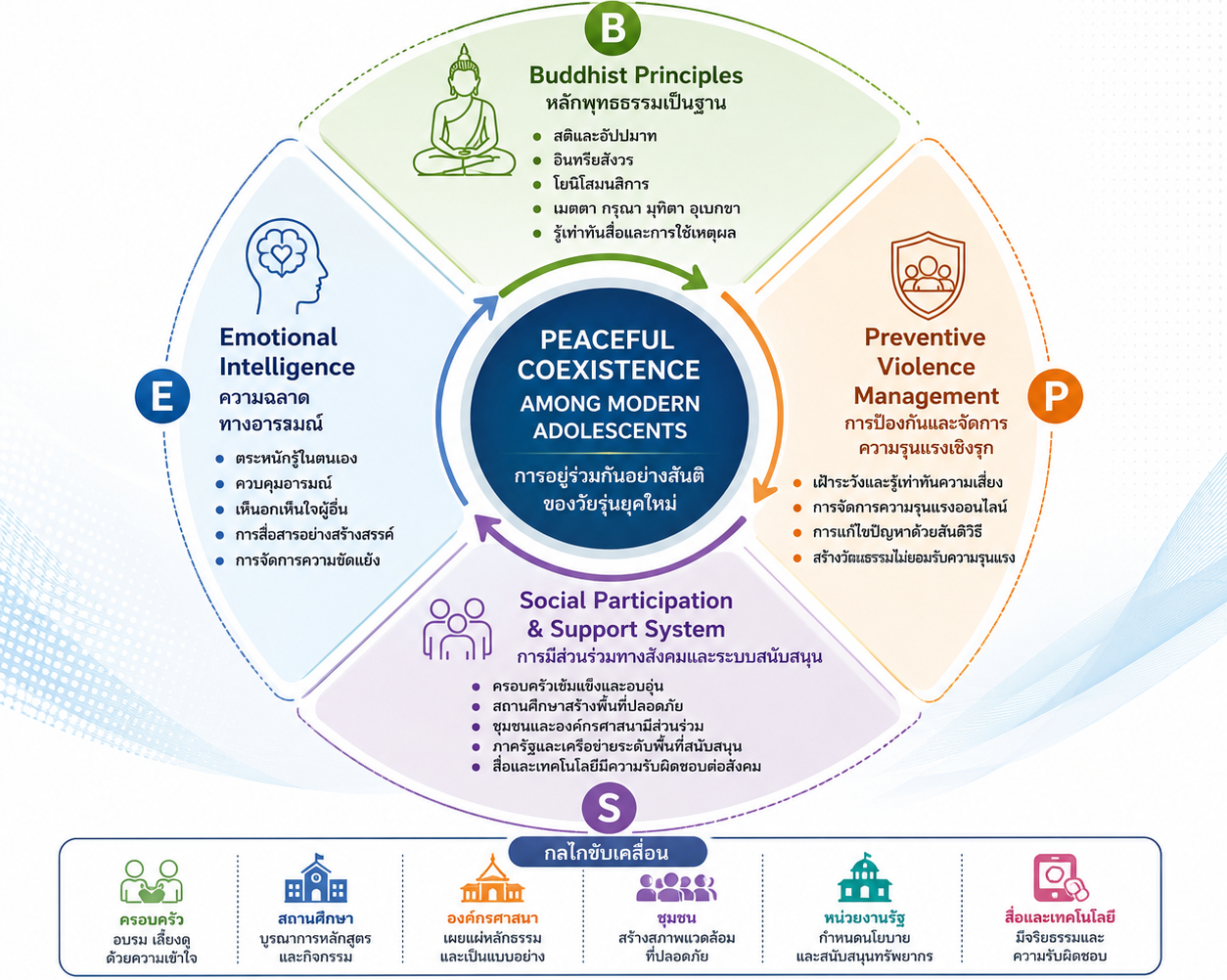
Main Article Content
Abstract
This research aimed to: (1) examine the current situation and needs for addressing violence influenced by media exposure in order to promote peaceful coexistence among modern adolescents; (2) develop strategies for fostering peaceful coexistence based on Buddhist principles; (3) propose a model for applying Buddhist principles to reduce media-influenced violence; and (4) disseminate the proposed model to organizations and communities in the central northeastern region of Thailand. This study employed a research and development (R&D) approach using a mixed-methods design. The population consisted of 521,427 adolescents aged 18–25 years residing in Roi Et, Khon Kaen, Maha Sarakham, and Kalasin provinces. The quantitative sample comprised 400 participants, while 40 key informants were selected for the qualitative study. Research instruments included a questionnaire, an in-depth interview form, and a model evaluation form. Quantitative data were analyzed using descriptive statistics, correlation analysis, and multiple regression analysis, whereas qualitative data were analyzed through content analysis.
The findings revealed that:
1. The need for addressing media-influenced violence was at a high level (x̄ = 4.50).
2. The strategy for promoting peaceful coexistence consisted of strengthening Buddhist principles, enhancing emotional intelligence, and implementing preventive violence management. Buddhist principles (r = .712), emotional intelligence (r = .683), and violence management (r = .721) were positively and significantly correlated with the reduction of media-influenced violence.
3. The developed model comprised the integration of Buddhist principles, emotional intelligence development, violence management, and collaboration among families, educational institutions, and communities. Buddhist principles (β = .281), emotional intelligence (β = .254), and violence management (β = .261) significantly predicted the reduction of violent behavior influenced by media exposure.
4. A portable handbook on the application of Buddhist principles was developed and disseminated to relevant organizations and communities for practical implementation.
Article Details

This work is licensed under a Creative Commons Attribution-NonCommercial-NoDerivatives 4.0 International License.
เพื่อให้เป็นไปตามกฎหมายลิขสิทธิ์ ผู้นิพนธ์ทุกท่านต้องลงลายมือชื่อในแบบฟอร์มใบมอบลิขสิทธิ์บทความ ให้แก่วารสารฯ พร้อมกับบทความต้นฉบับที่ได้แก้ไขครั้งสุดท้าย นอกจากนี้ ผู้นิพนธ์ทุกท่านต้องยืนยันว่าบทความ ต้นฉบับที่ส่งมาตีพิมพ์นั้น ได้ส่งมาตีพิมพ์เฉพาะในวารสาร วิชาการธรรม ทรรศน์ เพียงแห่งเดียวเท่านั้น หากมีการใช้ ภาพหรือตารางของผู้นิพนธ์อื่นที่ปรากฏในสิ่งตีพิมพ์อื่นมาแล้ว ผู้นิพนธ์ต้องขออนุญาตเจ้าของลิขสิทธิ์ก่อน พร้อมทั้ง แสดงหนังสือที่ได้รับการยินยอมต่อบรรณาธิการ ก่อนที่บทความจะได้รับการตีพิมพ์References
ตฤณห์ โพธิ์รักษา. (2565). อิทธิพลของสื่อที่มีผลตอพฤติกรรมความรุนแรงของเด็กและเยาวชน. วารสารรัฐศาสตร์รอบรู้และสหวิทยาการ, 5(2), 97-116. https://so01.tci-thaijo.org/index.php/WPSMS/article/view/253283
นววิช นวชีวินมัย และสกล วรเจริญศรี. (2567). การวิเคราะห์ปัจจัยเชิงสาเหตุของการเผชิญกับการข่มเหงรังแกของวัยรุ่นตอนต้น. Journal of Roi Kaensarn Academi, 9(11), 754-771.
พรเทพ เจริญกิจ. (2566). บทบาทตัวละครในละครโทรทัศน์ที่มีอิทธิพลต่อพฤติกรรมการเลียนแบบของนักศึกษามหาวิทยาลัยราชภัฏธนบุรี สมุทรปราการ. วารสารศิลปะและวัฒนธรรมลุ่มแม่น้ำมูล, 12(12), 39-52. https://so07.tci-thaijo.org/index.php/acj/article/view/1855
พระมหาจิรวัฒน์ (อิทฺธิญาโณ เพชรศรี), พระศรีสุทธิพงศ์ และศิริโรจน์ นามเสนา. (2567). ศึกษาวิเคราะห์การพัฒนาเยาวชนของกรมพินิจตามหลักพุทธธรรม. Journal of Interdisciplinary Buddhism, 2(4), 1-12. https://so09.tci-thaijo.org/index.php/rabij/article/view/3132
พระอธิการสุพรรณ วิสุทฺโธ (รอบไธสง), พระมหาสุพร รกฺขิตธมฺโม และเบญจมาศ สุวรรณวงศ์. (2567). ศึกษาวิเคราะห์หลักพุทธธรรมเพื่อเสริมสร้างการรู้เท่าทันสื่อสังคมปัจจุบันของวัยรุ่นไทย. Academic MCU Buriram Journal, 9(2), 92-103. https://so06.tci-thaijo.org/index.php/ambj/article/view/273270
พิศุทธิภา เมธีกุล. (2567). การศึกษาแนวทางจัดกิจกรรมเพื่อส่งเสริมการรู้เท่าทันดิจิทัลและสุขภาวะทางจิตสำหรับวัยรุ่นตอนต้น. Thai Journal of Clinical Psychology, 55(3), 17-30. https://so03.tci-thaijo.org/index.php/tci-thaijclinicpsy/article/view/279309
ศิริอัญภัค ศิรินนท์วัชรกุล. (2567). หลักพุทธธรรมเพื่อส่งเสริม 13 นโยบายกระทรวงสาธารณสุขเป้าหมาย 100 วัน. Academic Graduate Journal, 2(4), 110-118. https://so18.tci-thaijo.org/index.php/A_GJ/article/view/338
Aaker, D. A. (2014). Cultivation theory and media influence on audience perceptions. New York: Free Press.
Klapper, J. T. (1960). The effects of mass communication. New York: Free Press.
Peaceful Societies. (2022). Witnessing violence among high school students in Thailand. Retrieved from https://www.peacefulsocieties.org
