Development of a Bohmian Dialogue Community Model for Thai Educational Contexts
Article Sidebar
Main Article Content
Abstract
This action research study aimed to develop guidelines, pilot implementation, and present a model for establishing Educational Bohm's Dialogue Communities through PAOR. The three-phase design encompassed: (1) Planning : literature review on Dialogue and Contemplative Education, interviews with four experts, development and expert validation of guidelines and operational manual; (2) Implementation & Observation : six-month field trial with 30–35 voluntary participants, six monthly dialogue circles, data collection via observation forms and After-Action Review; (3) Reflection : peer-learning workshop extracting lessons through inductive content analysis.
Results found that :
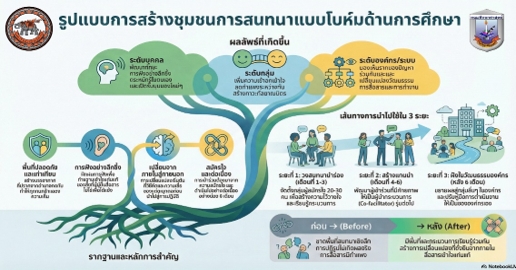
First, the guidelines comprise four essential components: egalitarian safe space, facilitator preparation, continuous activity sequencing (Check-in → Deep Listening → Dialogue → Check-out), and Soft Metrics evaluation. The eight-module manual received high validity ratings. Second, participants demonstrated changes across three dimensions: individual (listening awareness), relational (kalayanamitra), and systemic (organizational culture awareness). Third, the proposed model—four dimensions across three implementation phases—functions as an open system adaptable to diverse educational contexts.
Article Details

This work is licensed under a Creative Commons Attribution-NonCommercial-NoDerivatives 4.0 International License.
เพื่อให้เป็นไปตามกฎหมายลิขสิทธิ์ ผู้นิพนธ์ทุกท่านต้องลงลายมือชื่อในแบบฟอร์มใบมอบลิขสิทธิ์บทความ ให้แก่วารสารฯ พร้อมกับบทความต้นฉบับที่ได้แก้ไขครั้งสุดท้าย นอกจากนี้ ผู้นิพนธ์ทุกท่านต้องยืนยันว่าบทความ ต้นฉบับที่ส่งมาตีพิมพ์นั้น ได้ส่งมาตีพิมพ์เฉพาะในวารสาร วิชาการธรรม ทรรศน์ เพียงแห่งเดียวเท่านั้น หากมีการใช้ ภาพหรือตารางของผู้นิพนธ์อื่นที่ปรากฏในสิ่งตีพิมพ์อื่นมาแล้ว ผู้นิพนธ์ต้องขออนุญาตเจ้าของลิขสิทธิ์ก่อน พร้อมทั้ง แสดงหนังสือที่ได้รับการยินยอมต่อบรรณาธิการ ก่อนที่บทความจะได้รับการตีพิมพ์