การพัฒนารูปแบบการสร้างชุมชนการสนทนาแบบโบห์มในบริบทการศึกษาไทย
Article Sidebar
Main Article Content
บทคัดย่อ
ผลการวิจัยพบว่า
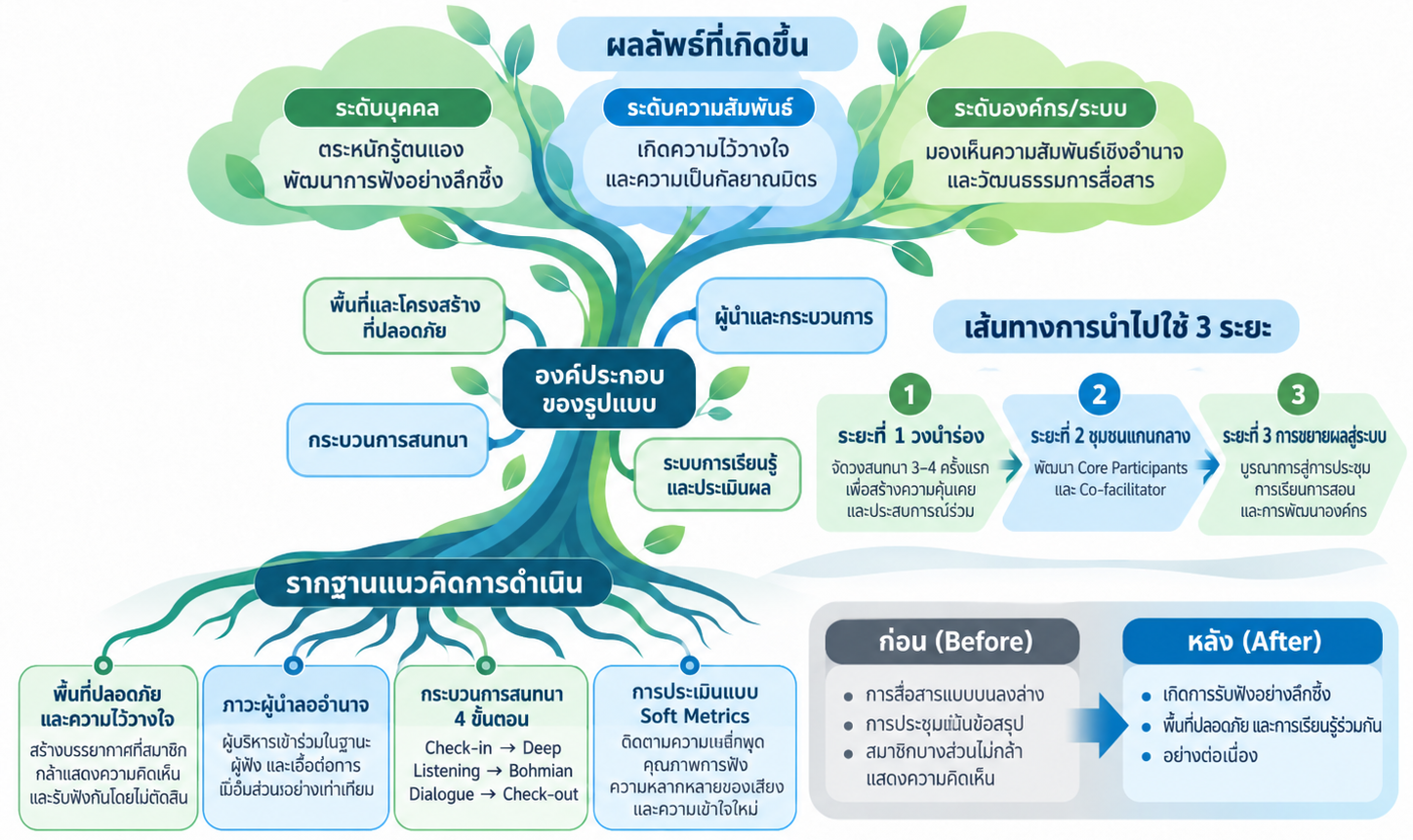
1. แนวทางและคู่มือที่พัฒนาขึ้นครอบคลุมการเตรียมพื้นที่ การเตรียมกระบวนกร กระบวนการสนทนา 4 ขั้นตอน ได้แก่ การเปิดวงสนทนา การฟังอย่างลึกซึ้ง การสนทนาแบบโบห์ม และการปิดวงสนทนา ตลอดจนการประเมินผลและการขยายผล โดยผู้ทรงคุณวุฒิประเมินความเหมาะสมของแนวทางและคู่มืออยู่ในระดับมากที่สุด มีค่าเฉลี่ย 4.60 และ 4.55 ตามลำดับ
2. ผลการทดลองใช้สะท้อนการเรียนรู้ 3 ระดับ ได้แก่ ระดับบุคคลด้านการตระหนักรู้ตนเองและการฟัง ระดับความสัมพันธ์ด้านความไว้วางใจและความเป็นกัลยาณมิตร และระดับการรับรู้เชิงระบบด้านความสัมพันธ์เชิงอำนาจและวัฒนธรรมความเกรงใจ
3. รูปแบบที่สังเคราะห์ขึ้นประกอบด้วย 4 มิติ ได้แก่ พื้นที่และโครงสร้างที่ปลอดภัย ผู้นำและกระบวนกร กระบวนการสนทนา และระบบการเรียนรู้และประเมินผล โดยดำเนินการผ่าน 3 ระยะ ได้แก่ การทดลองนำร่อง การสร้างชุมชนแกนกลาง และการขยายผลสู่ระบบองค์กร ทั้งนี้ ภาวะผู้นำที่ลดอำนาจตามตำแหน่งเป็นเงื่อนไขเอื้อสำคัญที่ปรากฏจากข้อมูลการวิจัยทั้งสองวงรอบ
Article Details

อนุญาตภายใต้เงื่อนไข Creative Commons Attribution-NonCommercial-NoDerivatives 4.0 International License.
เพื่อให้เป็นไปตามกฎหมายลิขสิทธิ์ ผู้นิพนธ์ทุกท่านต้องลงลายมือชื่อในแบบฟอร์มใบมอบลิขสิทธิ์บทความ ให้แก่วารสารฯ พร้อมกับบทความต้นฉบับที่ได้แก้ไขครั้งสุดท้าย นอกจากนี้ ผู้นิพนธ์ทุกท่านต้องยืนยันว่าบทความ ต้นฉบับที่ส่งมาตีพิมพ์นั้น ได้ส่งมาตีพิมพ์เฉพาะในวารสาร วิชาการธรรม ทรรศน์ เพียงแห่งเดียวเท่านั้น หากมีการใช้ ภาพหรือตารางของผู้นิพนธ์อื่นที่ปรากฏในสิ่งตีพิมพ์อื่นมาแล้ว ผู้นิพนธ์ต้องขออนุญาตเจ้าของลิขสิทธิ์ก่อน พร้อมทั้ง แสดงหนังสือที่ได้รับการยินยอมต่อบรรณาธิการ ก่อนที่บทความจะได้รับการตีพิมพ์เอกสารอ้างอิง
Antinluoma, M., Ilomäki, L., & Toom, A. (2021). Practices of professional learning communities. Frontiers in Education, 6, 617613. https://doi.org/10.3389/feduc.2021.617613
Bohm, D. (1996). On dialogue (L. Nichol, Ed.). London: Routledge.
Clark, A. M., Zhan, M., Dellinger, J. T., & Semingson, P. L. (2023). Innovating teaching practice through professional learning communities: Determining knowledge sharing and program value. SAGE Open, 13(4), 1-11. https://doi.org/10.1177/21582440231200983
Edmondson, A. C. (1999). Psychological safety and learning behavior in work teams. Administrative Science Quarterly, 44(2), 350-383. https://doi.org/10.2307/2666999
Edmondson, A. C., & Bransby, D. P. (2023). Psychological safety comes of age: Observed themes in an established literature. Annual Review of Organizational Psychology and Organizational Behavior, 10, 55-78. https://doi.org/10.1146/annurev-orgpsych-120920-055217
Frazier, M. L., Fainshmidt, S., Klinger, R. L., Pezeshkan, A., & Vracheva, V. (2017). Psychological safety: A meta-analytic review and extension. Personnel Psychology, 70(1), 113-165. https://doi.org/10.1111/peps.12183
Gunnlaugson, O., Cueto de Souza, R., Zhao, S., Yee, A., Scott, C., & Bai, H. (2023). Revisiting the nature of transformative learning experiences in contemplative higher education. Journal of Transformative Education, 21(1), 84-101. https://doi.org/10.1177/15413446211067285
Hofstede, G., Hofstede, G. J., & Minkov, M. (2010). Cultures and organizations: Software of the mind. (3rd ed.). New York: McGraw-Hill.
Hord, S. M. (1997). Professional learning communities: Communities of continuous inquiry and improvement. Austin, TX: Southwest Educational Development Laboratory.
Isaacs, W. (1999). Dialogue and the art of thinking together: A pioneering approach to communicating in business and in life. New York: Currency/Doubleday.
Mezirow, J. (1991). Transformative dimensions of adult learning. San Francisco, CA: Jossey-Bass.
Newman, A., Donohue, R., & Eva, N. (2017). Psychological safety: A systematic review of the literature. Human Resource Management Review, 27(3), 521-535. https://doi.org/10.1016/j.hrmr.2017.01.001
Prabjandee, D. (2019). Unwelcome truths of the professional learning community policy in Thailand: Teacher's sensemaking. Issues in Educational Research, 29(1), 223-242.
Senge, P. M. (1990). The fifth discipline: The art and practice of the learning organization. New York: Doubleday.
Spillane, J. P. (2006). Distributed leadership. San Francisco, CA: Jossey-Bass.
Ukosakul, M. (2005). The significance of 'face' and politeness in social interaction as revealed through Thai 'face' idioms. In R. T. Lakoff & S. Ide (Eds.), Broadening the horizon of linguistic politeness (pp. 117-125). Amsterdam: John Benjamins.