The Development of an Instructional Model of English for Communication Based on Blended Learning and English for Specific Purposes for Students at Thailand National Sports University
Article Sidebar
Main Article Content
Abstract
This research aimed to: This research aimed to: (1) develop an English communication instructional model based on blended learning and English for Specific Purposes (ESP) for students at Thailand National Sports University; (2) compare students’ learning achievement before and after the implementation of the model and examine their development in English communication skills; and (3) investigate students’ satisfaction with the model. This study employed a Research and Development (R&D) approach consisting of two phases: model development and evaluation of the model’s implementation. The population consisted of 180 first-year students at Thailand National Sports University, Bangkok Campus, who were enrolled in the English for Communication course in the second semester of the 2024 academic year. The sample comprised 38 students selected through cluster sampling, including 23 students from the Physical Education program and 15 students from the Sports Science and Exercise program. The research instruments included lesson plans, parallel-form pre-test and post-test achievement tests, an assessment of four English communication skills, and a student satisfaction questionnaire. The lesson plans were evaluated by nine experts, with a mean score of 4.89 and a standard deviation of 0.25, while the data collection instruments had an Index of Item-Objective Congruence (IOC) value of 1.00. Data were analyzed using percentage, mean, standard deviation, a paired-samples t-test, and relative gain scores.
The findings revealed that:
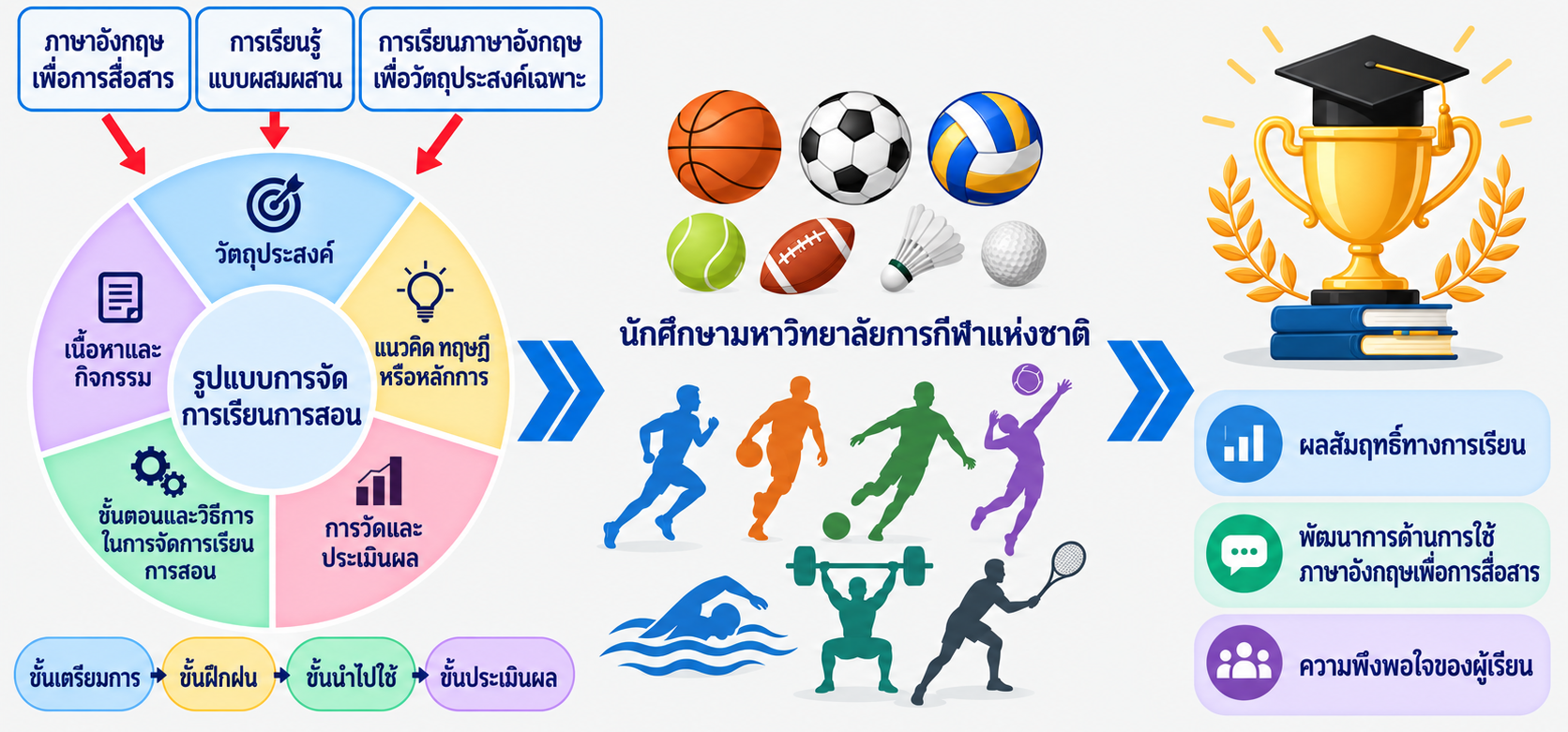
1. The developed instructional model consisted of six principles and four instructional stages: Preparation, Practice, Application, and Assessment.
2. The mean post-test achievement scores of students in both programs were significantly higher than their mean pre-test scores at the .05 level, and their average relative gain scores were at a high level.
3. Students’ satisfaction with the instructional model was at the highest level, particularly regarding the teacher’s role, activity worksheets, assessment tests, learning materials, and instructional procedures.
Article Details

This work is licensed under a Creative Commons Attribution-NonCommercial-NoDerivatives 4.0 International License.
เพื่อให้เป็นไปตามกฎหมายลิขสิทธิ์ ผู้นิพนธ์ทุกท่านต้องลงลายมือชื่อในแบบฟอร์มใบมอบลิขสิทธิ์บทความ ให้แก่วารสารฯ พร้อมกับบทความต้นฉบับที่ได้แก้ไขครั้งสุดท้าย นอกจากนี้ ผู้นิพนธ์ทุกท่านต้องยืนยันว่าบทความ ต้นฉบับที่ส่งมาตีพิมพ์นั้น ได้ส่งมาตีพิมพ์เฉพาะในวารสาร วิชาการธรรม ทรรศน์ เพียงแห่งเดียวเท่านั้น หากมีการใช้ ภาพหรือตารางของผู้นิพนธ์อื่นที่ปรากฏในสิ่งตีพิมพ์อื่นมาแล้ว ผู้นิพนธ์ต้องขออนุญาตเจ้าของลิขสิทธิ์ก่อน พร้อมทั้ง แสดงหนังสือที่ได้รับการยินยอมต่อบรรณาธิการ ก่อนที่บทความจะได้รับการตีพิมพ์References
นิศราภรณ์ ชาติโสม, ทัศนี วรรณทอง และพลธาวิน วัชรทรธำรงค์. (2566). การพัฒนาทักษะการฟังและพูดภาษาอังกฤษของนักเรียนชั้นประถมศึกษาปีที่ 3 โดยใช้กิจกรรมการเรียนรู้เชิงรุกแบบผสมผสาน. ครุศาสตร์สาร, 17(2), 117-129.
ประกาศคณะกรรมการมาตรฐานการอุดมศึกษา. (2567). ประกาศคณะกรรมการการอุดมศึกษา เรื่อง แนวทางนโยบายการยกระดับมาตรฐานภาษาอังกฤษในสถาบันอุดมศึกษา พ.ศ. 2567. เข้าถึงได้จาก https://www.ops.go.th/en/ches-downloads/edustandard/item/9625-2567
มยุรี สวัสดิ์เมือง, ขวัญฤทัย บุญยะเสนา, สุจิรา ไชยกุสินธุ์, สุวีณา รุ่งโรจน์รัตนากร, Peter Ajonghakoh Foabeh และสุนทรา เฟื่องฟุ้ง. (2567). การเรียนการสอนภาษาอังกฤษแบบบูรณาการด้วยเทคโนโลยีดิจิทัลและการฝึกปฏิบัติจริง สำหรับนักศึกษาสายวิทยาศาสตร์. วารสารวิทยาศาสตร์และเทคโนโลยี มทร.สุวรรณภูมิ, 8(3), 16-31.
ศิรินยา พิพัฒน์ศรีสวัสดิ์. (2567). การพัฒนารูปแบบวิทยาการจัดการเรียนรู้แบบผสมผสานตามทฤษฎีความรู้ในเนื้อหา ผนวกวิธีสอนและเทคโนโลยีเพื่อพัฒนาความสามารถทางการสื่อสารภาษาอังกฤษของนักศึกษาระดับปริญญาตรีในสถาบันการศึกษาเอกชน. วารสารปัญญาภิวัฒน์, 16(1), 276-291.
สมบัติ คชสิทธิ์, จันทนี อินทรสูต, และธนกร สุวรรณพฤฒิ. (2560). การจัดการเรียนรู้ภาษาอังกฤษให้กับผู้เรียนยุค Thailand 4.0. วารสารวไลยอลงกรณ์ปริทัศน์
(มนุษยศาสตร์และสังคมศาสตร์), 7(2), 175-186.
สำนักงานเลขาธิการสภาการศึกษา กระทรวงศึกษาธิการ. (2560). แผนการศึกษาแห่งชาติ พ.ศ. 2560-2579. กรุงเทพฯ: พริกหวานกราฟฟิค.
Basturkmen, H. (2020). Developing courses in English for specific purposes. Basingstoke: Palgrave Macmillan.
Cruz Bernal, D. A. (2023). Analyzing ads under CALLA in an EFL classroom: A case study with middle school students in Colombia. Enletawa Journal, 16(1), 1-32.
Đorić, V. (2020). The model of English language learning of the sport students. TIMS Acta, 14, 103-108.
Hyland, K. (2022). English for Specific Purposes: What is it and where is it taking us? ESP Today, 10(2), 202-220.
I-Hsin, K. (2012). The effect of ESP materials on college athlete students’ English learning motivation. Hwa Kang English Journal, 18(1), 117-146.
Joyce, B., & Weil, M. (2000). Models of teaching. (6th ed.). Upper Saddle River, NJ: Prentice Hall.
Kashef, S. H., Khorasani, R., & Zahabi, A. (2014). Investigating the effect of a learning-centered instruction on non-English major students’ attitudes toward English course. Procedia - Social and Behavioral Sciences, 98, 859-863. https://doi.org/10.1016/j.sbspro.2014.03.492
Lui, Z. & Li, C. (2024). An Integrating of Blended Learning Based on Superstar in Table Tennis General Course for Sports Majors. International Journal of Sociologies and Anthropologies Science Reviews, 4(4), 351-366.
Panadero, E., & Järvelä, S. (2021). The effects of self-regulated learning on academic achievement: A meta-analysis. Educational Psychology Review, 33(4), 1639-1662.
Shih, R. (2017). The effect of English for specific purposes (ESP) learning–language lab versus mobile-assisted learning. International Journal of Distance Education Technologies, 15(3), 15-30.
