
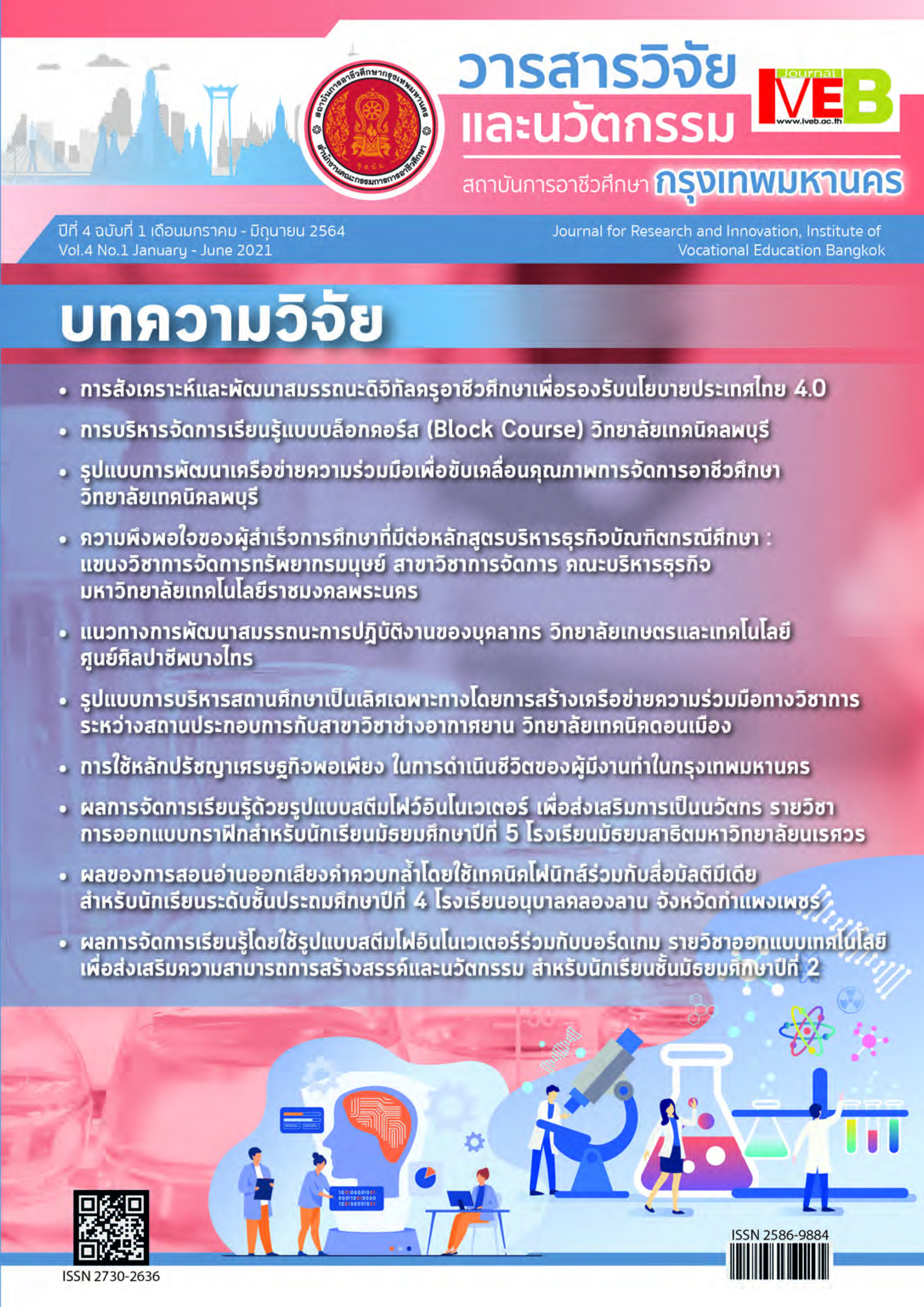
The Collaborative Network Development Model to Drive the Quality Vocational Education Management, Lopburi Technical College.
Article Sidebar
Main Article Content
Abstract
The purposes of this research were: 1) study the condition and guidelines for the development of collaborative network to drive quality of vocational education management at Lopburi Technical College, 2) to build collaborative network development model to drive quality of vocational education management at Lopburi Technical College, 3) to make an experiment on the collaborative network development model to drive quality of vocational education management at Lopburi Technical College; and, 4) to evaluate the use of the collaborative network development model to drive quality of vocational education management at Lopburi Technical College. The research was conducted in 4 parts. The samples consisted of a total of 248 educational institution administrators, teachers, and personnel from collaborative network who were selected by simple random sampling and 20 experts who were obtained by purposive sampling. The findings were as followed:
- Regarding the condition and guidelines for the development of collaborative networks to drive quality of vocational education management at Lopburi Technical College Overall, it was found that in overall it was at the moderate level, and about the guidelines, it showed that the college should work together with the collaborative networks to formulate strategies for developing vocational education collaborative networks, quality-driven mechanism, driving quality through collaborative networks, and, evaluation of the collaborative network development to drive quality of vocational education management.
- Concerning the model, it was found that the model was created with 4 components: 1) strategies to develop a network of vocational education collaboration 2) quality-driven mechanism by the vocational education management cooperation network 3) quality-driven operation through a cooperation network; and; 4) supervision, monitoring, evaluation of the development of collaborative networks to drive quality of vocational education management.
- Regarding the experiment with participants in 7 projects, it was found that in overall they were satisfied at the highest level. Concerning their achievement, it showed that the participants’ knowledge and understanding towards the projects increased from the medium level to the most level.
- Regarding the evaluation of the model, the findings were as follows: 1) about the learning achievement of the learners from the use of the model, the average score after using the model was higher than before using the model; 2) in overall the model development success was at the highest level; 3) about the opinion towards the format in terms of suitability, possibility, and benefits, it was at the highest level; 4) there was an increase of 30 collaborative networks from organizations and workplaces; and; 5) from the implementation of the model. It showed that there were 28 items of awards for college administrators and students
Article Details
References
สำนักงานคณะกรรมการพัฒนาระบบราชการ. (2553). แผนยุทธ์ศาสตร์การพัฒนาระบบราชการไทย ปี 2553-2561. กรุงเทพมหานคร : วี.ที.ซี คอมมินิเคชั่น.
สำนักงานคณะกรรมการพัฒนาเศรษฐกิจและสังคมแห่งชาติ. (2558). การจัดทำแผนพัฒนา เศรษฐกิจและสังคมแห่งชาติ ฉบับที่ 12 (พ.ศ. 2560-2564). สำนักงานคณะกรรมการพัฒนาเศรษฐกิจและสังคมแห่งชาติ.
สำนักงานคณะกรรมการการอาชีวศึกษา. (2560). แผนพัฒนาการอาชีวศึกษา พ.ศ. 2560 – 2579. กรุงเทพ. สำนักงานคณะกรรมการการอาชีวศึกษา.
ไสว อุทุม ประเสริฐ ภู่เงิน และปรานีพัน จารุวัฒนพันธ์. (2557). การดำเนินงานเครือข่ายความร่วมมือทางวิชาการในโรงเรียนมัธยมศึกษา สังกัดสำนักงานเขตพื้นที่การศึกษามัธยมศึกษา เขต 32. วารสารบัณฑิตศึกษา มหาวิทยาลัยราชภัฏวไลยอลงกรณ์ ในพระบรมราชูปถัมภ์, ปีที่ 8 ฉบับที่ 2. 235-246.
สรัญญา จุฑานิล. (2556). การบริหารเครือข่ายของสถาบันพัฒนาองค์กรชุมชน สำนักงานปฏิบัติการภาคตะวันออกเฉียงเหนือ. วิทยานิพนธ์มหาบัณฑิต คณะรัฐประศาสนศาสตร์ สถาบันบัณฑิต พัฒนบริหารศาสตร์.
ชูทรัพย์ ภาวงศ์. (2551). การมีส่วนร่วมในการดำเนินงานในชุมชน. สกลนคร: โรงเรียนบ้านบ่อแก.
พิสิฐ เทพไกรวัล. (2554). การพัฒนารูปแบบเครือข่ายความร่วมมือเพื่อคุณภาพการจัดการศึกษา ในโรงเรียนประถมศึกษาขนาดเล็ก. วิทยานิพนธ์ปริญญาปรัชญาดุษฎีบัณฑิต. สาขาวิชาการบริหารการศึกษา. บัณฑิตวิทยาลัย มหาวิทยาลัยขอนแก่น.
สำนักงานส่งเสริมการศึกษานอกระบบและการศึกษาตามอัธยาศัย. (2549). แผนยุทธศาสตร์ปฏิรูปการศึกษานอกระบบ และการศึกษาตามอัธยาศัยเพื่อการเรียนรู้ตลอดชีวิต. กรุงเทพฯ : รังสีการพิมพ์.
ชาญทนงค์ บุญรักษา. (2556). การพัฒนารูปแบบการบริหารการใช้ทรัพยากรร่วมกันเพื่อการจัดการศึกษาระดับปริญญาตรีในสถาบันการอาชีวศึกษา. วิทยานิพนธ์การศึกษาดุษฎีบัณฑิต. สาขาวิชาบริหารการศึกษา มหาวิทยาลัยนเรศวร.
The World Bank. (2018). Systems Approach for Better Education Results. Washington DC: USA.
สันติ บุญภิรมย์. (2552). การบริหารงานวิชาการ. กรุงเทพฯ: บุ๊คพอยท์.
Shaeffer, S. (Ed). (1994). Partnerships and Participation in Basic Education: A Series of Training Modules and Case Study Abstracts for Educational Planners and Mangers. Paris: UNESCO, International Institute for Educational Planning.
นิรุตต์ บุตรแสนลี. (2561). การพัฒนารูปแบบการจัดการอาชีวศึกษาระบบทวิภาคีที่มุ่งเน้นประสิทธิผลของสถานศึกษา สังกัดสำนักงานคณะกรรมการการอาชีวศึกษา ด้วยกระบวนการวิจัยเชิงปฏิบัติการแบบมีส่วนร่วม. วิทยานิพนธ์ศึกษาศาสตร์ดุษฎีบัณฑิต. สาขาวิชาวิจัยวัดผลและสถิติการศึกษา คณะศึกษาศาสตร์ มหาวิทยาลัยบูรพา.
สถาพร โพธิ์หวี. (2560). รูปแบบการพัฒนาเครือข่ายความร่วมมือเพื่อการขับเคลื่อนคุณภาพการจัดการศึกษาวิชาชีพระยะสั้นของวิทยาลัยสารพัดช่างเพชรบูรณ์. เพชรบูรณ์ : วิทยาลัยสารพัดช่างเพชรบูรณ์ สำนักงานคณะกรรมการการอาชีวศึกษา.
Robbins H., & Finley, M. (1998). Why Team Don’t Work. 2nd ed. London: Orient Business.
Norwich and Evans. (2017). Cluster: Inter-school collaboration in meeting special educational Needs in ordinary schools. Retrieved January 11, 2018, from http://www.ebscohot.com
Ribchester, & William J. Edwards. (2007). Co-operation in the countryside: Small primary School Clusters. Retrieved January 15, 2018, from http://www.ebscohot.com.
