
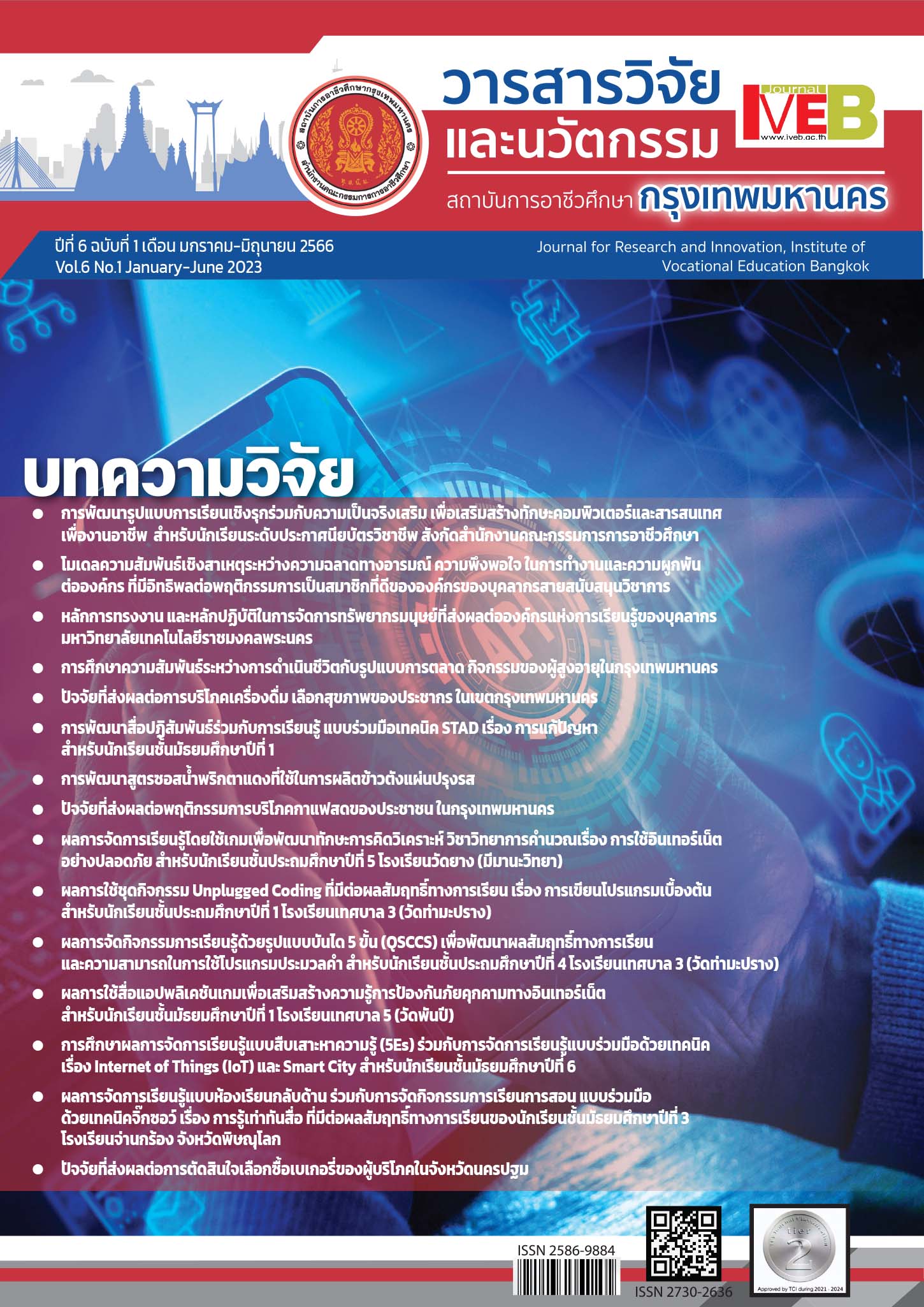
์Mr. The Royal King’s Working Principle, Human Resource Management Pratice Affecting Learning Organization of Personnel in Rajamangala University of Technology Phra Nakhon
Article Sidebar
Main Article Content
Abstract
The objectives of this research were 1) to study the Royal King’s working principle, the principles of human resource management practice and learning organizations of personnel of Rajamangala University of Technology Phra Nakhon; 2) to investigate the relationship between working principles and learning organization of personnel of Rajamangala University of Technology Phra Nakhon; and; 3) to study the relationship between human resource management practices and learning organizations of personnel of Rajamangala University of Technology Phra Nakhon. The sample group used in the study was 360 personnel of Rajamangala University of Technology Phra Nakhon. The tools used to collect data were questionnaires. The statistics used in the data analysis were percentage, mean, standard deviation. and Pearson's correlation coefficient.
The results of the study were as the followings.
Most of the respondents were female, and single with the age 36 – 45, single status, as well as having master’s degree and work experience between 11 - 20 years. Most of them were academic personnel. Regarding the working principle, it showed that most personnel had a high level of overall opinion ( = 3.88). Concerning the principles of human resource management, it revealed that most of the personnel overally had opinions at a high level (
= 3.80). Concerning learning organization, it showed that major personnel had a high level of overall opinion (
= 3.86). From the correlation analysis, it was found that the working principle had a positive relationship with the learning organization overally at the high level (r=0.698) and Human resource management practices had a positive relationship with learning organizations in overall at the high level(r=0.639), and, the principles of human resource management and learning organizations are related in all aspects.
Article Details

This work is licensed under a Creative Commons Attribution-NonCommercial-NoDerivatives 4.0 International License.
References
Marquardt, M. J. (1999). Action learning in action: Transforming pro blems and peoplefor world-class organizational learning. Palo Alto, Calif: Davies-Black.
Alvin Toffler. 1991. Powershift: Knowledge, Wealth, and Violence at the Edge of the 21st Century. New York: Bantam Books.
สำนักงานคณะกรรมการพิเศษเพื่อประสานงานโครงการอันเนื่องมาจากพระราชดำริ (สำนักงาน กปร.). 2551. [ออนไลน์]. กษัตริย์นักพัฒนา. [สืบค้นเมื่อวันที่ 13 ตุลาคม 2564] จาก http://www.rdpb.go.th/th/King/หลักการทรงงาน-c24
มหาวิทยาลัยเทคโนโลยีราชมงคลพระนคร. ม.ป.ป. [ออนไลน์]. ประวัติ โครงสร้าง มหาวิทยาลัยเทคโนโลยีราชมงคลพระนคร. [สืบค้นเมื่อวันที่ 13 ตุลาคม 2564]. จาก https://www.rmutp.ac.th/ประวัติ-โครงสร้าง
Krejcie, R. V. and Morgan, D. W. (1970). Determining Sample Size for Research Activiles, Educational and Psychological Measurement. 30 (3) : 607 - 610.
ลลิต ถนอมสิงห์. (2557). หลักการทรงงานและองค์กรแห่งการเรียนรู้นำไปสู่องค์กรแห่งควายั่งยืน. วารสารวิชาการ คณะบริหารธุรกิจ, 9(1), 1-21
สุธินี ฤกษ์ขำ. (2557). การพัฒนาทรัพยากรมนุษย์: หลักการและการประยุกต์. กรุงเทพฯ: โรงพิมพ์แห่งจุฬาลงกรณ์มหาวิทยาลัย.
กฤษดา ชาญรบ. (2556). ความเป็นองค์กรแห่งการเรียนรู้ของสถานศึกษา สังกัดสำนักงานเขตพื้นที่การศึกษาประถมศึกษานครศรีธรรมราช เขต 1. ปริญญานิพนธ์ ครุศาสตรมหาบัณฑิต สาขาวิชาการบริหารการศึกษา มหาวิทยาลัยราชภัฏนครศรีธรรมราช.
พงศกร ศรีรงค์ทอง. (2561). การพัฒนาทรัพยากรมนุษย์ องค์การแห่งการเรียนรู้ และการจัดการความรู้ การ
บูรณาการแนวคิดเพื่อนำไปสู่ความสำเร็จขององค์การ. วารสารจันทรเกษมสาร, 24(47), 1–16.
