
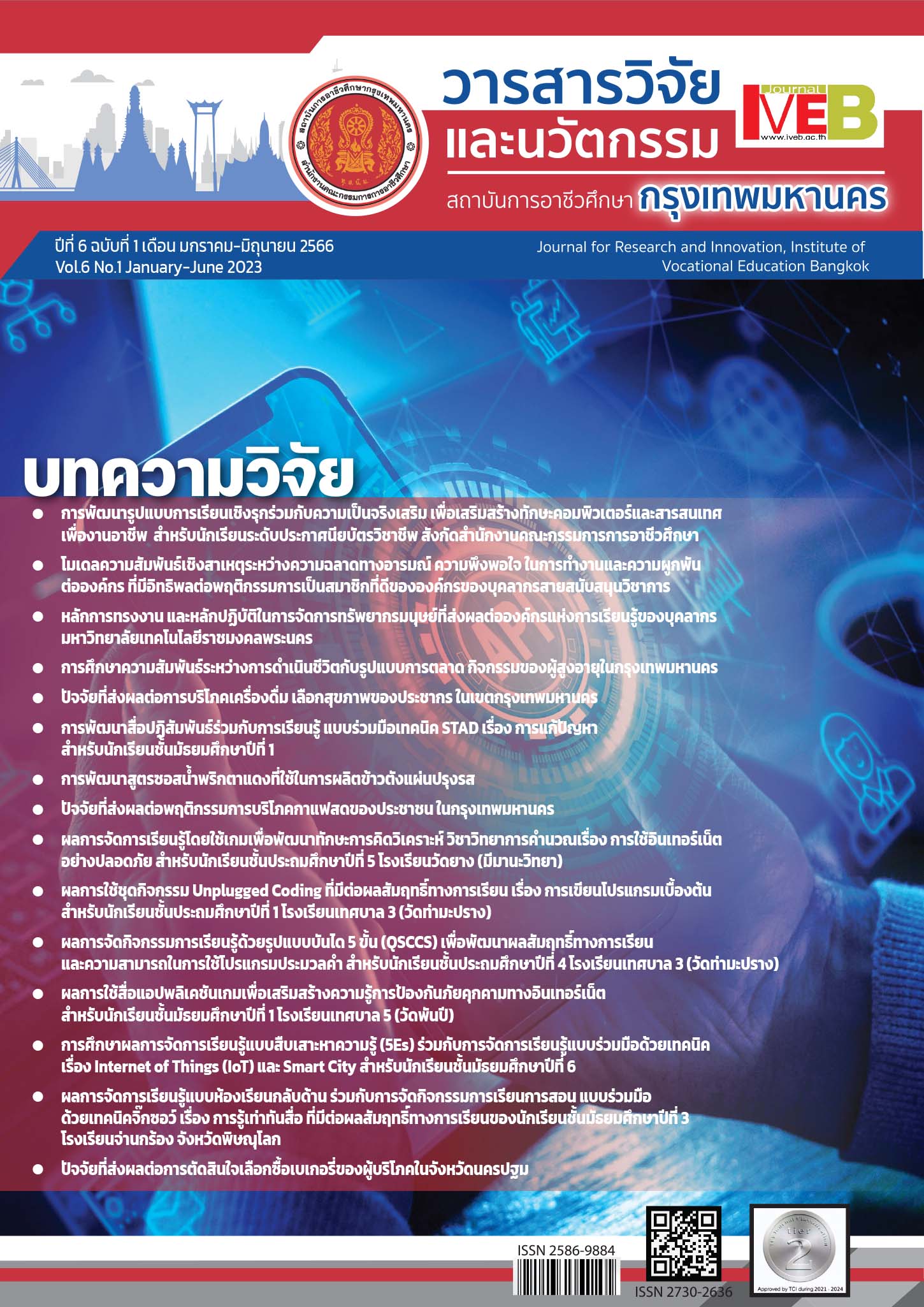
The Effects of Lesson Planning Using Learning Activities with QSCCS in Developing Achievement and Competency on Word Processing Program of the 4th Grade Students at Tessaban 3 School (Wat Tha Maprang)
Article Sidebar
Main Article Content
Abstract
This research aimed to 1) study the effectiveness of the five-step learning management plans for the Science learning area on computing science with its topic “data presentation with software”, 2) compare the achievement during and after learning by using the five-step learning management, and, 3) study the students’ satisfaction towards learning activities using the five-step learning management. The research targets were the 33 students in grade 4 at Tessaban 3 School (Wat Tha Maprang). The instruments of the study consisted of 1) learning management plans, 2) the achievement test, and, 3) the satisfaction survey. The statistics used included mean, standard deviation, and t-test.
The results showed that
1) The efficiency of the five-step learning management plans for the Science learning area on computing science with its title “data presentation with software” was at 85.58/73.33, which was higher than the determined criteria.
2) The average achievement scores after learning were higher than during learning at a statistically significant level of 0.5.
3) The entire satisfaction of students towards the five-step learning activities to develop achievement and ability to use a word processing program was at the highest level (= 4.54, S.D. = 0.33).
Article Details

This work is licensed under a Creative Commons Attribution-NonCommercial-NoDerivatives 4.0 International License.
References
สถาบันส่งเสริมการสอนวิทยาศาสตร์และเทคโนโลยี (สสวท.), กระทรวงศึกษาธิการ. (2561). [ออนไลน์]. คู่มือการใช้หลักสูตรสาระเทคโนโลยี (วิทยการคำนวณ) กลุ่มสาระวิทยาศาสตร์. [สืบค้นเมื่อวันที่ 15 พฤศจิกายน 2565] จาก http://oho.ipst.ac.th/cs-curriculum-teacher-guide/
วัชรพัฒน์ ศรีคำเวียง. (2561). [ออนไลน์]. วิทยาการคำนวณ (Computing Science). [สืบค้นเมื่อวันที่ 10 พฤศจิกายน2565]. จาก https://www.scimath.org/lesson-technology/item/8808-computing-science
กระทรวงศึกษาธิการ. (2560). ตัวชี้วัดและสารการเรียนรู้แกนกลาง กลุ่มสาระแกนกลางเรียนรู้วิทยาศาสตร์ (ฉบับปรับปรุง พ.ศ.2560) ตามหลักสูตรแกนกลางการศึกษาขั้นพื้นฐาน พุทธศักราช 2551. กรุงเทพฯ: กระทรวงศึกษาธิการ.
อรวรรณ พิลา. (2564). การศึกษาผลการพัฒนากิจกรรมการเรียนรู้ด้วยกระบวนการ QSCCS โดยใช้สื่อสังคมออนไลน์ เพื่อพัฒนาทักษะการแก้ปัญหาของนักเรียนระดับชั้นมัธยมศึกษาปีที่ 5. วารสารการวิจัยการศึกษาขั้นพื้นฐาน, 1(1) 149-167.
บุญชม ศรีสะอาด. (2545). การวิจัยเบื้องต้น (พิมพ์ครั้งที่ 7). กรุงเทพฯ : สุวีริยาสาส์น
พุฒิญารัศมิ์ วรรณสุข. (2562). การพัฒนาชุดการเรียนรู้แบบบันได 5 ขั้น (QSCCS) ที่ส่งเสริมความสามารถด้านภาษา
ชั้นประถมศึกษาปีที่ 3 โรงเรียนวัดบ้านทุ่งสว่าง สำนักงานเขตพื้นที่การศึกษานครราชสีมาเขต 7. กรุงเทพฯ: สำนักงานคณะกรรมการการศึกษาขั้นพื้นฐานกระทรวงศึกษาธิการ.
ทิพรัตน์ สิทธิวงศ์ และทะเนศ วงศ์นาม. (2559). การศึกษาผลการใช้กิจกรรมการเรียนการสอนด้วยบันได 5 ขั้น (QSCSS) สำหรับนิสิตปริญญาโทสาขาเทคโนโลยีและสื่อสารการศึกษา คณะศึกษาศาสตร์ มหาวิทยาลัยนเรศวร. วารสารศึกษาศาสตร์มหาวิทยาลัยนเรศวร, 18 (4), 86-98.
ชฎาพร มีเอนก, พัชรินทร์ รั้งท้วม และสุภาณี เส็งศรี. (2565). [ออนไลน์]. การจัดการเรียนรู้แบบสืบเสาะหาความรู้ 5 ขั้น ร่วมกับการใช้ผังมโนทัศน์ เพื่อพัฒนาผลสัมฤทธิ์ทางการเรียน เรื่อง โครโมโซมและสารพันธุกรรม นักเรียนชั้นมัธยมศึกษาปีที่ 4. วารสารวิจัยและนวัตกรรม สถาบันการอาชีวศึกษากรุงเทพมหานคร, 2565 (2), 219-233.
